Closed Pipe Frequency Calculator
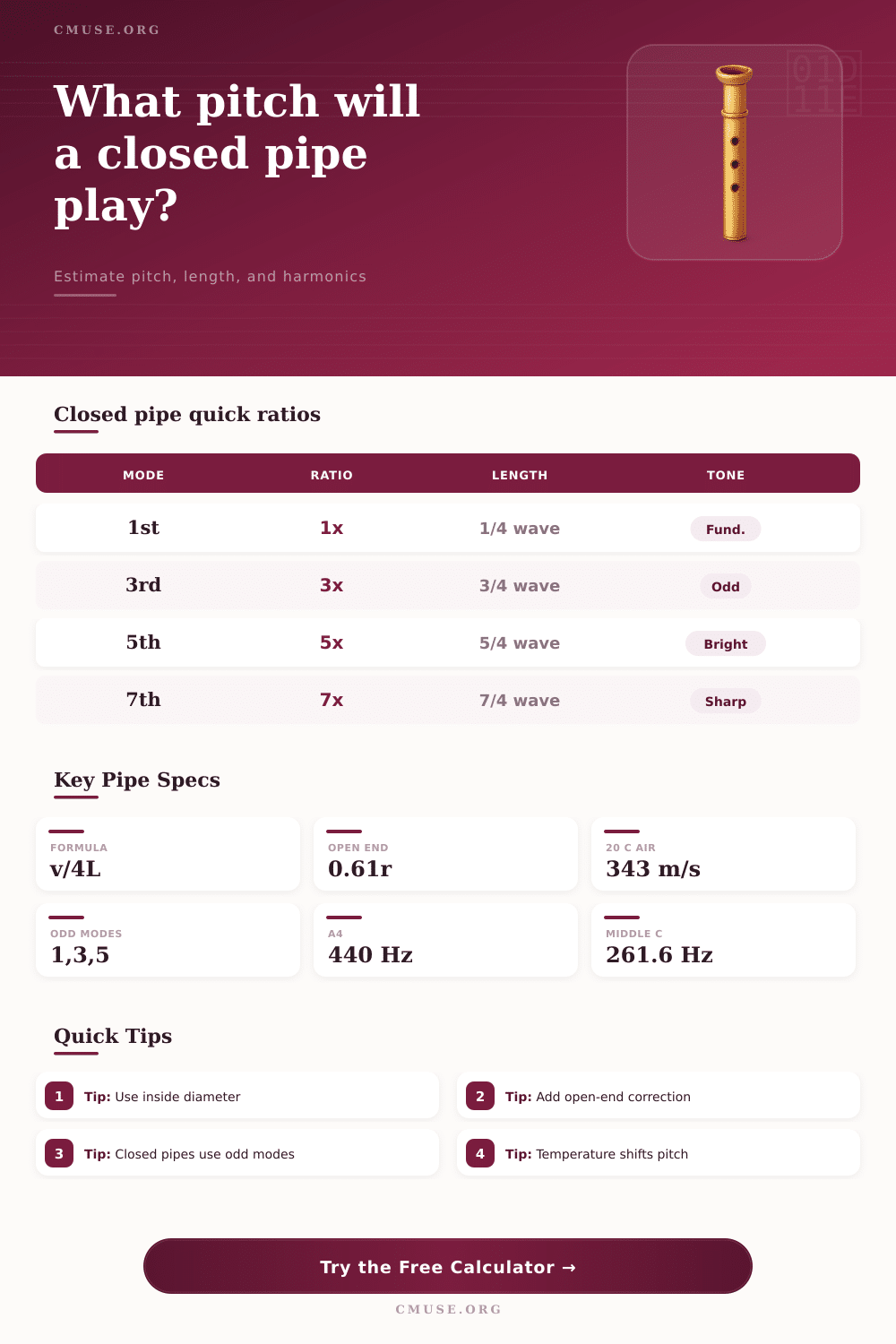
Estimate the pitch of a pipe closed at one end, including temperature-adjusted speed of sound, open-end correction, odd harmonics, and target length for a chosen note or frequency.
Preset use: Load a recorder, organ pipe, bottle neck, tube, or demonstration pipe, then adjust length, bore, temperature, harmonic number, and end correction.
Calculation Breakdown
| Quantity | Formula | Closed-Pipe Meaning | Use In Calculator |
|---|---|---|---|
| Fundamental frequency | f1 = v / 4Le | Quarter-wave resonance of a pipe closed at one end | Main pitch for harmonic 1 |
| Odd harmonic frequency | fn = n x v / 4Le | n is 1, 3, 5, 7, 9, or 11 | Selected harmonic output |
| Effective length | Le = L + e | Physical length plus open-end correction | Prevents pitch from calculating too sharp |
| Unflanged open end | e = 0.61r | Approximate free open rim correction | Default correction mode |
| Air speed estimate | v = 331.3 + 0.606T | T is air temperature in Celsius | Adjusts pitch for warm or cool rooms |
| Harmonic | Frequency Ratio | Wavelength Fit | Musical Color |
|---|---|---|---|
| 1st | 1 x f1 | One quarter-wave fits the effective pipe length | Fundamental closed-pipe tone |
| 3rd | 3 x f1 | Three quarter-waves fit the effective length | Octave plus fifth above the fundamental |
| 5th | 5 x f1 | Five quarter-waves fit the effective length | Two octaves plus major third, slightly just |
| 7th | 7 x f1 | Seven quarter-waves fit the effective length | Strong color, flatter than equal-tempered minor seventh |
| 9th | 9 x f1 | Nine quarter-waves fit the effective length | Higher octave color of the third harmonic |
| Air Temperature | Speed Of Sound | Pitch Effect Vs 20°C | Practical Meaning |
|---|---|---|---|
| 0°C / 32°F | 331.3 m/s | About -61 cents | Cold air makes the same pipe noticeably flatter |
| 10°C / 50°F | 337.4 m/s | About -31 cents | Cool rooms can pull tuning down |
| 20°C / 68°F | 343.4 m/s | Reference point | Common room-temperature estimate |
| 30°C / 86°F | 349.5 m/s | About +31 cents | Warm air raises the pipe pitch |
| 40°C / 104°F | 355.5 m/s | About +61 cents | Hot outdoor conditions can shift nearly a semitone |
| Pipe Or Instrument Context | Approx Fundamental | Typical Bore | Calculation Note |
|---|---|---|---|
| Stopped organ pipe C4 | 261.6 Hz | 18 to 28 mm | Physical pipe is near one quarter wavelength after correction |
| Clarinet-like cylindrical tube | Register dependent | 14 to 16 mm | Behaves approximately as a closed pipe at low modes |
| Closed panpipe C5 | 523.3 Hz | 8 to 15 mm | Short sealed tube, sensitive to end correction |
| Physics resonance tube | 100 to 1000 Hz | 20 to 50 mm | Use movable water or plunger length as the closed end |
| Bass stopped pipe C2 | 65.4 Hz | 60 mm or larger | Long tube; temperature and exact mouth shape matter |
| Target Note | Frequency | Effective Quarter-Wave Length | Use Case |
|---|---|---|---|
| C3 | 130.81 Hz | 65.63 cm | Small stopped organ or large classroom tube |
| A3 | 220.00 Hz | 39.02 cm | Reference pitch tube below middle C |
| C4 | 261.63 Hz | 32.82 cm | Middle C closed-pipe demonstration |
| A4 | 440.00 Hz | 19.51 cm | Tuning fork pitch pipe design |
| C5 | 523.25 Hz | 16.40 cm | Short panpipe or compact closed tube |
An open-end correction must be calculated for any individual that is calculating the pitch of a closed pipe. When a person blow across the end of a pipe, the air column dont stop moving at the physical end of the pipe. Because the air column continues beyond the physical end of the pipe, the length of the pipe can be considered more longer than the physical length of the pipe.
This added length is referred to as an open-end correction for that pipe. As a result of this open-end correction, the calculated frequency of that pipe will be incorrect if the open-end correction is not include in that calculation. The calculator include several different inputs that will determine the result of the calculator.
How Open-End Correction Changes the Pitch of a Pipe
These different inputs include the length of the pipe, the bore diameter of the pipe, the temperature of the air within the pipe, and the specific harmonic that the user must calculate. Each of these variable is important to the calculation. The length of the pipe is one of the most important variables in the calculation of the pitch of the pipe, but the length that should of been used is the effective length of the pipe, which includes the open-end correction.
The bore diameter of the pipe is another important variable because the open-end correction increase with the increase in the radius of the pipe. The temperature of the air in the pipe is another important variable because the speed of sound within the air change with the change in the temperature of the air. Finally, the specific harmonic that the user must calculate is important because the pipe can have a fundamental tone and odd overtone that the pipe produced.
A person must account for the fact that the temperature of the air will change the speed of sound within the pipe. As a result, the pitch of the pipe will change with the change in the temperature of the air. At cold temperature, the speed of sound decrease within the air, which will reduce the pitch of the pipe.
At warm temperatures, however, the speed of sound within the air will increase, which will increase the pitch of the pipe. Thus, a pipe that may be designed to produce a specific pitch at a temperature of 20 °C may produce a pitch that is higher than that which is calculated if that pipe is used in an area that is warmer than 20 °C.
A person must also understand the difference between pipe that are open at both ends and those that are open at one end and closed at the other. Pipes that are open at both ends can produce both even and odd harmonic.
Pipes that are open at one end and closed at the other end only produce odd harmonics. Thus, if a pipe that was presumed to be a closed pipe began to produce even harmonics, it is possible that the pipe has changed in some way. Finally, it is possible for various factor to change the effective length of the pipe.
Factors like the shape of the mouth, the thickness of the walls of the pipe, and the way in which the person covers the pipe may all change the effective length of the pipe. Each of these factor will have a small effect upon the length of the pipe, each of which will result in some change in the pitch of the pipe. Thus, although the pipe may have a calculated pitch with the calculator, small adjustment to the length of the pipe may be required to accurately tune that pipe to the calculated pitch.
In order to utilize the calculator correctly, a person must measure the inside diameter of the pipe. Furthermore, that person must also select the apropriate open-end correction for the pipe, and they must enter the temperature at which the pipe will be used. These three measurements will result in a calculated frequency that is very close to the pitch of the pipe.
If any of these three variable are ignored, however, the calculated frequency wont match the pitch of that pipe.