Inharmonicity Calculator
Estimate stiff-string inharmonicity coefficient B, partial sharpening, octave stretch, and tuning offsets from speaking length, diameter, tension, and material stiffness.
Preset use: Load a common piano, guitar, bass, violin, cello, harp, or dulcimer string, then adjust length, gauge, tension, material, fundamental, and target partial.
Calculation Breakdown
| Partial | Ideal Harmonic | Stiff String Frequency | Sharpness |
|---|---|---|---|
| 2 | 880 Hz | 880.2 Hz | 0.4 cents |
| Instrument Or String Area | Typical B Range | Audible Result | Useful Reading |
|---|---|---|---|
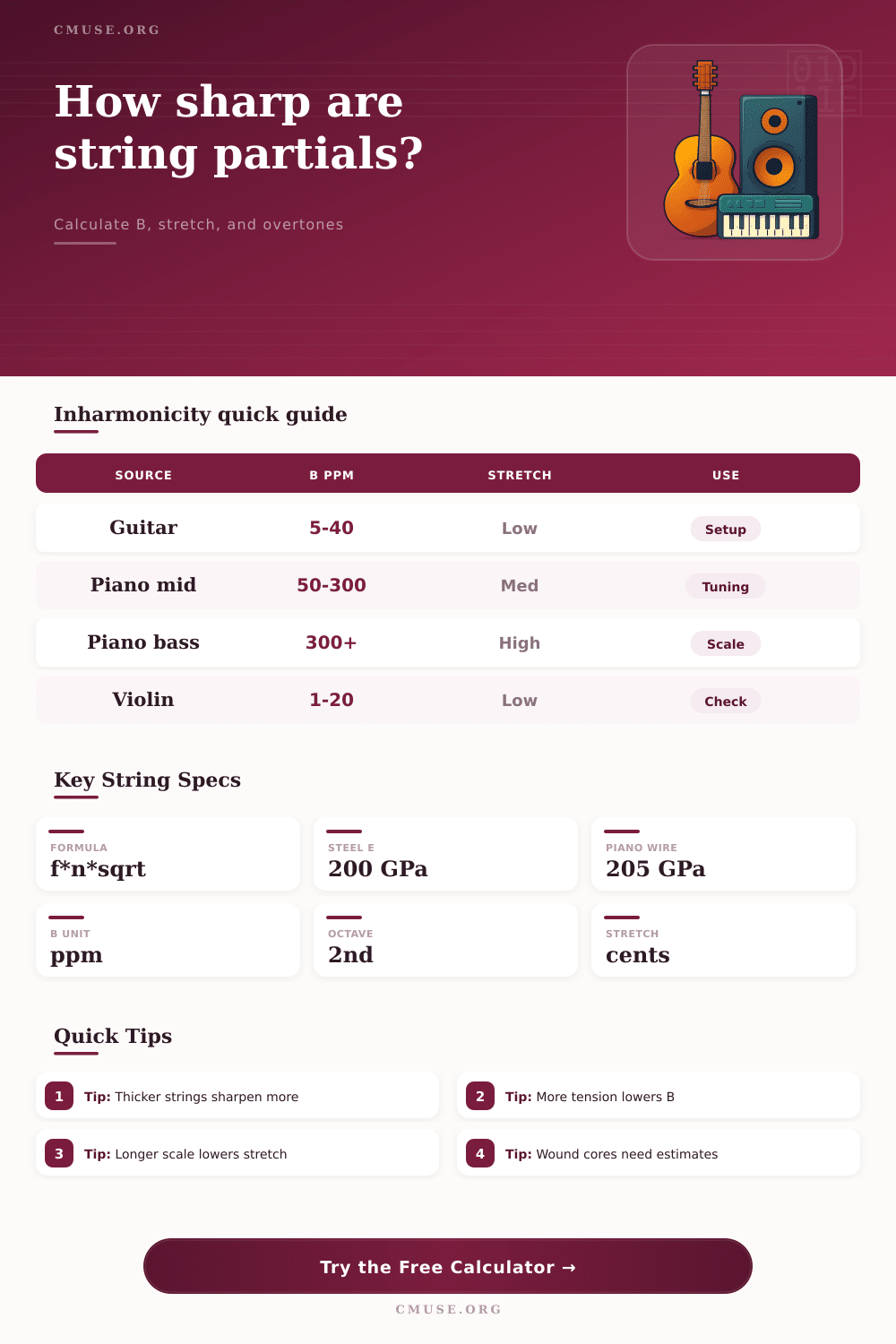
| Violin, viola, and light bowed strings | 1 to 20 ppm | Partials stay close to harmonic | Usually low stretch unless the string is very short or stiff |
| Classical and electric guitar plain strings | 5 to 40 ppm | Upper partials sharpen slightly | Setup changes in scale, tension, and gauge are easy to compare |
| Piano midrange plain wire | 50 to 300 ppm | Octaves need visible stretch | The tuning curve follows partial matching, not pure octaves |
| Piano tenor and bass wound strings | 100 to 800+ ppm | Upper partials can sit very sharp | Effective core stiffness matters more than outer winding diameter |
| Short scale experimental strings | 300 to 2000+ ppm | Strong bell-like inharmonicity | Raise length or tension, or lower stiffness, to reduce stretch |
| Material Model | Young's Modulus Used | Core Factor | Best Use |
|---|---|---|---|
| Piano music wire | 205 GPa | 1.00 | Plain piano strings and high-tension music wire |
| Plain steel | 200 GPa | 1.00 | Guitar plain strings, violin E, steel test strings |
| Wound steel core estimate | 205 GPa | 0.32 | Piano bass, cello, and bass strings when only outer gauge is known |
| Bronze wound core estimate | 110 GPa | 0.30 | Acoustic guitar wound strings and bronze-wound courses |
| Nickel wound core estimate | 200 GPa | 0.34 | Electric guitar and electric bass wound strings |
| Gut, nylon, fluorocarbon | 3 to 5 GPa | 1.00 | Flexible harp, classical guitar, and historical strings |
| Preset Scenario | Length | Tension | Expected Behavior |
|---|---|---|---|
| Piano A4 plain wire | 0.39 m | 690 N | Moderate B; octave stretch is part of normal piano tuning |
| Piano A0 bass string | 1.90 m | 800 N | Wound core model; upper partials can drive bass stretch decisions |
| Guitar high E plain steel | 0.648 m | 73 N | Low but measurable upper-partial sharpening |
| Bass guitar G wound string | 0.864 m | 190 N | Outer winding adds mass, but core stiffness controls much of B |
| Violin E plain steel | 0.328 m | 75 N | Short length raises B, but thin gauge keeps it controlled |
| Harp gut middle string | 0.720 m | 180 N | Flexible material produces small inharmonicity for its diameter |
| Quantity | Formula Used | Meaning | How To Read It |
|---|---|---|---|
| B coefficient | B = pi^3 x E x d^4 / (64 x T x L^2) | Dimensionless stiffness term for a round string estimate | More B means more partial sharpening |
| Partial frequency | fn = n x f1 x sqrt(1 + B x n^2) | Frequency of the nth stiff-string partial | Compare against n x f1 for cents offset |
| Sharpness cents | 1200 x log2(fn / (n x f1)) | How far the partial sits above a harmonic multiple | Positive values indicate stretched upper partials |
| Stretch checkpoint | Same cents formula at 2nd, 4th, 8th, or 16th partial | Octave-stack reference for tuning comparisons | Useful when matching upper partials across notes |
String inharmonicity are the phenomenon that causes strings that are tuned to a specific frequency to sound slightly out of tune. String inharmonicity is the result of the stiffness of the string. As the string is bent, the string create resistance against the bending of that string.
This resistance causes the overtones (partials) of that string to be higher than they would of be if the string were an ideal string. The higher the partials of the string are tuned, the more noticeable the issue become, particalurly in the higher octaves of the instruments strings. There are four specific factor that contribute to the amount of sharpening (increasing frequency) of the partials caused by string inharmonicity.
Why Strings Can Sound Out of Tune
These four factors are the length of the vibrating string, the diameter of the string core, the tension of the string, and the resistance of the string material to bending. Shorter lengths of vibrating strings, cores with a thicker diameter, and strings composed of metals with high resistance to bending will increase the amount of sharpening. Higher tension applied to the string and longer lengths of speaking string will reduce the effect of string inharmonicity.
The calculator can calculate each of these four variable. String inharmonicity is noticeable when musicians attempt to tune octaves of a stringed instrument. On a piano, technicians do not tune the octaves to pure tones since the overtones of the upper octave string do not align to the overtones of the lower octave string.
Instead, the technician will tune the upper overtones of the lower string to the lower overtones of the string of the higher octave. The calculator will demonstrate to the technician how far the overtones have moved. This will allow the technician to begin tuning the piano strings by ear.
String inharmonicity also occur on a guitar, however, it is generaly much milder. Octaves of high E strings will generaly not require compensation on a guitar with a long scale-length. However, on short scale parlor guitars with heavy gauge strings, compensation for the inharmonicity of the string may be required at the eighth or tenth partial of the high E strings.
This will affect how the guitar sounds at the twelfth fret. Wound strings presents a specific situation in calculating string inharmonicity. Wound strings have a core string and an outer winding.
The outer winding adds to the mass of the string, but adds very little resistance to the bending of the string. Therefore, the diameter and material of the core string become the most important variables in the calculation of the inharmonicity of wound strings. Using the outer diameter of the wound string as the diameter of the wound string will create an overestimation of the inharmonicity of that string.
Therefore, presets for bass strings, electric bass strings, and bronze wound strings are provided that allow for calculation of the inharmonicity of wound strings. The material of the string is a very important factor in string inharmonicity. For instance, music wire have a resistance to bending of 205 GPa while nylon has a resistance of only roughly 3 GPa.
Each of the different string materials can be selected in the calculator. By changing the material of the string, the calculator can demonstrate the effect that different materials will have on the resistance to bending of that string. A gut-strung harp will have a thicker string than a harp with steel strings of the same length because gut has a lower resistance to bending than steel.
This affects the clarity of the higher overtones of the instruments. There are also some real-world conditions that will affect string inharmonicity. For instance, changes in the temperature will change the tension of the string.
Changes in the humidity will change the thickness of the strings of gut or nylon materials. Finally, the bridge and nut may change the length of the vibrating string by a few millimeter. The calculator will provide an estimation of the inharmonicity of the string.
However, you should make adjustments with your ear and a spectrum analyzer to the string vibrations. Run the number through the calculator to determine any variables, but then verify with your instrument. Through the calculator, it is possible to see the effect that changing only one of the variables will have on the inharmonicity of the string.
For instance, if the vibrating length of the string is lengthened by 10%, the coefficient of string inharmonicity will decrease more than if the tension of the string was increased by 10%. This is due to the fact that the vibrating length of the string is squared within the equation for the coefficient of string inharmonicity. Understanding the relationship between each of these four variables will allow the person building the stringed instrument to make an informed decision as to whether to lengthen the neck of the instrument or to increase the gauge of the strings.