Fundamental Frequency Calculator
Estimate the lowest resonant pitch of a vibrating string, open pipe, or closed pipe, then compare harmonics, wavelength, nearest note, and tuning offset.
Preset use: Load a common string, wind, or pipe example, then adjust length, bore, tension, material, air temperature, and harmonic number.
Calculation Breakdown
| String Material | Density Used | Common Use | Frequency Effect |
|---|---|---|---|
| Music wire steel | 7850 kg/m³ | Plain guitar, violin E, piano wire | Higher density lowers pitch at the same diameter and tension |
| Nylon | 1150 kg/m³ | Classical guitar trebles, harp strings | Lower density needs wider diameter for similar pitch |
| Gut | 1300 kg/m³ | Historical bowed and plucked instruments | Similar calculation to nylon with slightly more mass |
| Fluorocarbon | 1780 kg/m³ | Ukulele, harp, lute-style replacements | More mass than nylon, so pitch falls for the same gauge |
| Phosphor bronze | 8800 kg/m³ | Acoustic guitar wound-string estimate | Useful as an equivalent solid-density approximation |
| Nickel wound equivalent | 8900 kg/m³ | Electric guitar and bass wound-string estimate | Best treated as an approximation because windings add complexity |
| Resonator | Fundamental Formula | Harmonic Pattern | Calculator Adjustment |
|---|---|---|---|
| Vibrating string | f1 = (1 / 2L) x sqrt(T / mu) | All integer harmonics | Linear density comes from material density and diameter |
| Open air column | f1 = c / 2Le | All integer harmonics | Le = L + 1.22r for two open ends |
| Closed air column | f1 = c / 4Le | Odd harmonics only | Le = L + 0.61r for one open end |
| Ideal reference | f = wave speed / wavelength | Depends on boundary conditions | Wavelength is reported for the fundamental mode |
| Instrument Or Note | Fundamental | Typical Resonator | Useful Check |
|---|---|---|---|
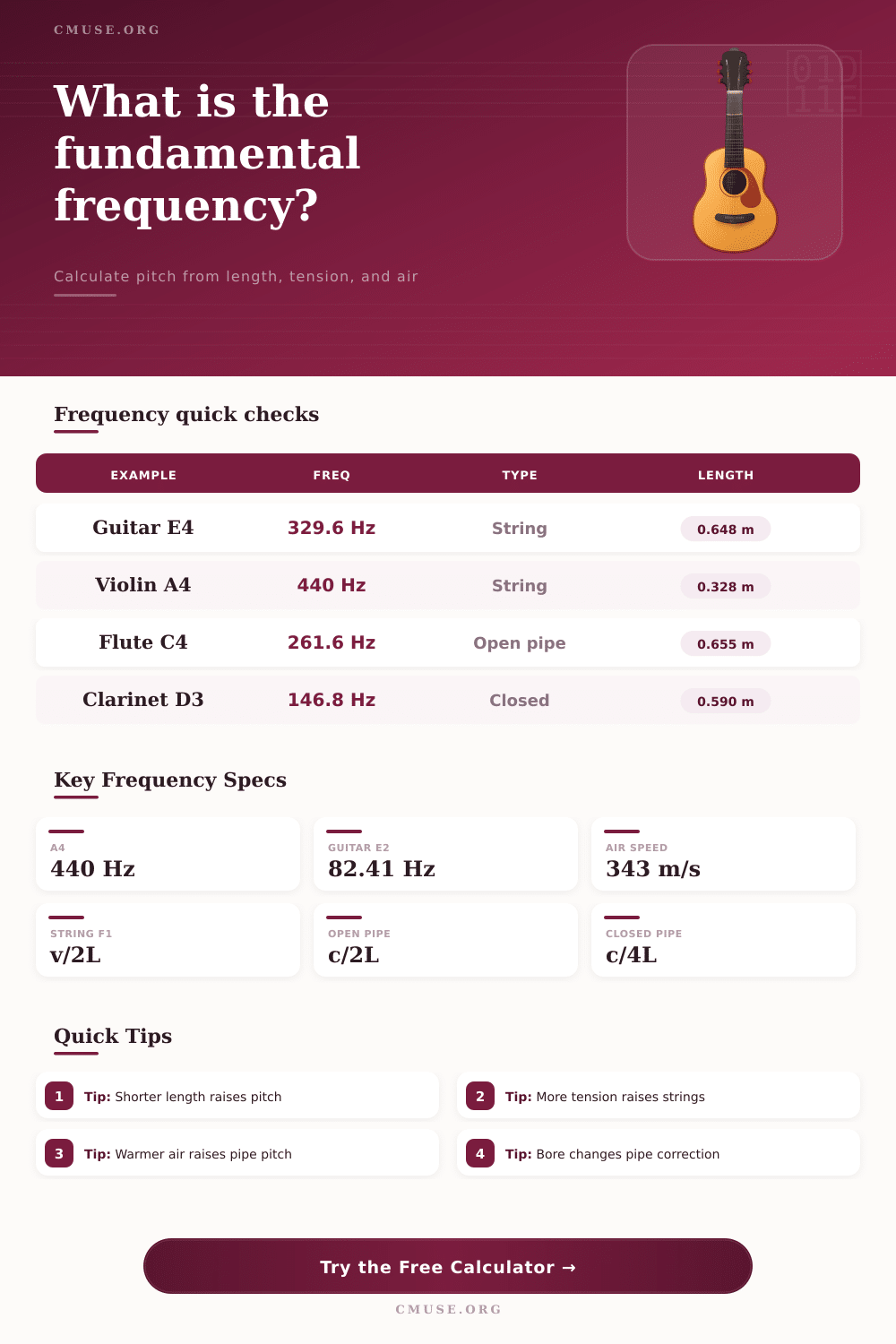
| Guitar low E2 | 82.41 Hz | 0.648 m string | Open 6th string standard tuning |
| Guitar high E4 | 329.63 Hz | 0.648 m string | Open 1st string standard tuning |
| Violin A4 | 440.00 Hz | 0.328 m string | Common orchestral tuning reference |
| Cello A3 | 220.00 Hz | 0.695 m string | Upper open string on cello |
| Concert flute C4 | 261.63 Hz | Open cylindrical air column | Approximate pipe length near 0.65 m before keying details |
| Clarinet written D3 region | 146.83 Hz | Closed cylindrical air column | Quarter-wave behavior gives low fundamentals |
| Note | Frequency | Octave Role | Calculator Use |
|---|---|---|---|
| C2 | 65.41 Hz | Low cello C and bass-range reference | Good low-frequency pipe or string check |
| E2 | 82.41 Hz | Guitar and bass tuning anchor | Useful for long string tests |
| A3 | 220.00 Hz | One octave below concert A | Common monochord and cello reference |
| C4 | 261.63 Hz | Middle C | Useful pipe length benchmark |
| A4 | 440.00 Hz | Concert pitch reference | Nearest-note offset is measured against this tuning |
| C5 | 523.25 Hz | Recorder and treble air-column region | Shows how short pipes reach high fundamentals |
Musical instrument function based off the length of a sound wave within a specific space. The length of a sound wave within a specific space will determine the lowest possible tone that can produced by that musical instrument. Additionally, the length of that sound wave will help to determine the overtones and the timbre of the musical instrument that is producing those tone.
While there are calculators that can calculate each of these values, it is important to understand how each of these variable can affect the frequency of the musical instruments sound. One type of musical instrument that utilizes a vibrating string is one type of musical instrument. When the string of that musical instrument vibrate, it creates a wave that travels along the length of that string.
How Length Affects the Sound of Instruments
The wave reflects off the fixed ends of the string, and completes one cycle of vibration after traveling twice the length of the musical string. You can calculate the lowest frequency of that string by dividing the speed of the wave by twice the length of the string. The speed of the wave along the string is dependent upon the tension of the string and the mass per unit length of that string.
Thus, each of these variables will impact the frequency of the string. A calculator help to show the relationship between each of these variable. Another type of musical instrument is the air column.
Air columns are able to have either open or closed boundaries. Open boundaries allow sound to travel past the ends of the pipe, while a closed pipe creates only odd-numbered harmonics. Because of this difference in harmonics, musical instruments like clarinet and flute can sound different than one another, even if their length are similar.
The calculator that models the air column applies an end correction to the length of the pipe once the user enters the diameter of the bore of the musical instrument. The diameter of the bore is more prominent for wide pipes than for narrow pipes. The temperature of the air within the pipe also affects the frequency of that air column; warmer air causes sound to travel at a faster speed.
Small change in temperature can drastically change the frequency of the air column. Additionally, temperature does not affect vibrating strings in the same way that temperature affects air columns. Each of these variables is calculated separately in the calculator.
A table within the calculator helps to explain the different types of musical instruments. For instance, the high E string on a guitar and the C4 air column on a flute may both have similar speaking lengths. However, the frequency of the vibrating string of the guitar is different than the frequency of air column within the flute.
These examples help to determine the impact of length changes on the intended variable. Many individuals who wish to build or modify their own musical instruments intend to reach a specific target note. However, many of these individuals are not sure of the best method to adjust the length or the tension of the string within their musical instruments to reach that target note.
A calculator can help to remove the guesswork that the individual must perform in these instances; it will reveal to that individual the exact frequency that can be created based upon the length or tension of the string that is selected. Additionally, the calculator may also reveal the nearest note that can be produced with the selected string, and the offset of that calculated frequency from the nearest note. By utilizing the musical instrument calculator, an individual can gain value in that they are able to compare different scenarios for their musical instrument.
For instance, shortening the length of a violin string will increase the pitch of the string; however, shortening the length will also impact the flexibility of that string. Lengthening the length of a pipe will lower the pitch of the air column; however, lengthening that pipe will also impact the way in which the end correction of the pipe changes. The same logic can also be applied to restoring an old musical instrument to its original specifications.
You can measure the length of the musical instrument, and entered it into the musical instrument calculator. Additionally, the calculator can help to determine what the pitch of that string or air column would be if the musical instrument had its original gauge or bore size. The purpose of the musical instrument calculator is to determine the lowest frequency that can exist within the space created for the musical instrument.
Other variable, such as brightness of the tone or strength of the harmonics can be determined based upon the lowest frequency of that instrument. Thus, each of these variables is important in understanding how to adjust the musical instrument to achieve the desired results, all based upon the physics of the instrument, instead of trial and error.