Harmonic Frequency Calculator
Calculate overtone frequencies, wavelengths, nearest equal-tempered notes, cents offsets, interval colors, and relative strength for any musical fundamental.
Preset use: Load a real source, then adjust harmonic count, tuning reference, air temperature, wave medium, and rolloff to inspect the series.
Calculation Breakdown
| Harmonic | Ratio To Fundamental | Natural Interval Color | Equal-Temperament Difference |
|---|---|---|---|
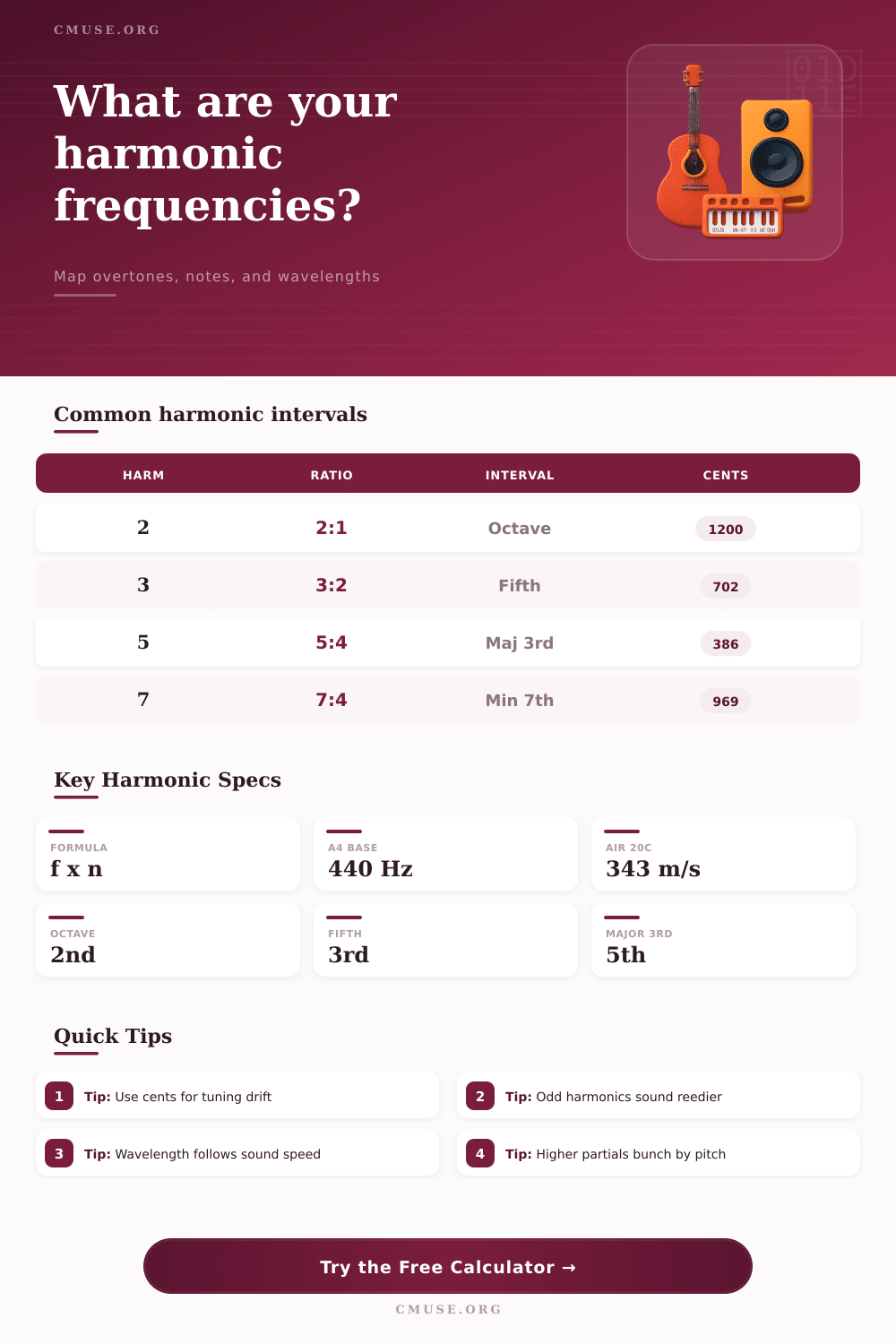
| 2nd | 2:1 | Octave, stable reinforcement | 0 cents from octave |
| 3rd | 3:1, reduced to 3:2 | Perfect fifth, bright and open | +1.96 cents from ET fifth |
| 4th | 4:1 | Two octaves above the fundamental | 0 cents from double octave |
| 5th | 5:1, reduced to 5:4 | Pure major third, smoother than ET | -13.69 cents from ET major third |
| 6th | 6:1, reduced to 3:2 | Octave plus perfect fifth | +1.96 cents from ET fifth class |
| 7th | 7:1, reduced to 7:4 | Harmonic seventh, bluesy and low | -31.17 cents from ET minor seventh |
| 8th | 8:1 | Three octaves above the fundamental | 0 cents from triple octave |
| 9th | 9:1, reduced to 9:8 | Major second above the octave stack | +3.91 cents from ET major second |
| Source | Fundamental | 2nd Harmonic | 5th Harmonic |
|---|---|---|---|
| Double bass or electric bass low E1 | 41.20 Hz | 82.41 Hz | 206.00 Hz |
| Guitar low E2 | 82.41 Hz | 164.81 Hz | 412.03 Hz |
| Cello open C2 | 65.41 Hz | 130.81 Hz | 327.03 Hz |
| Piano middle C4 | 261.63 Hz | 523.25 Hz | 1308.15 Hz |
| Concert A4 | 440.00 Hz | 880.00 Hz | 2200.00 Hz |
| Flute A5 | 880.00 Hz | 1760.00 Hz | 4400.00 Hz |
| Medium | Speed Used | 440 Hz Wavelength | Best Calculation Use |
|---|---|---|---|
| Air at 20 C | 343.4 m/s | 0.780 m / 2.56 ft | Room acoustics, instruments, speaker placement |
| Water | 1482 m/s | 3.368 m / 11.05 ft | Underwater sound comparison |
| Spruce along grain | 5000 m/s | 11.364 m / 37.28 ft | Soundboard material comparison |
| Steel longitudinal | 5120 m/s | 11.636 m / 38.18 ft | String and rod wave comparison |
| Helium | 1007 m/s | 2.289 m / 7.51 ft | Gas speed demonstration |
| Note | Frequency At A4 440 | Likely Harmonic Use | Nearby Source Example |
|---|---|---|---|
| C2 | 65.41 Hz | Low fundamental for strings and organ pipes | Cello open C string |
| E2 | 82.41 Hz | Guitar fundamental and bass second harmonic | Guitar low E string |
| A2 | 110.00 Hz | Vocal and bass overtone anchor | Low male vocal reference |
| C4 | 261.63 Hz | Midrange fundamental with dense upper partials | Piano middle C |
| A4 | 440.00 Hz | Concert tuning reference and test tone | Orchestra tuning note |
| A5 | 880.00 Hz | Bright fundamental or second harmonic of A4 | Flute and violin upper register |
| Analysis Goal | Best Input To Watch | Main Output | Useful Reading |
|---|---|---|---|
| Tuning a resonator | Focus harmonic number | Exact overtone frequency | Compare Hz and nearest note cents |
| Room mode awareness | Fundamental frequency | Wavelength in air | Long waves need large spaces |
| Voice or instrument color | Amplitude rolloff | Relative harmonic strength | Odd and high partials add edge |
| Temperament comparison | A4 tuning reference | Nearest equal-tempered note | Pure harmonic intervals rarely land exactly on ET |
A harmonic frequency calculator is an tool that makes it possible for a person to map the relationship between different overtone of a given fundamental frequency. Each fundamental frequency have a series of overtones associated with it, and these overtone determine the timbre of the instrument, as well as how the instrument is tuned. A harmonic frequency calculator can display these mathematical relationships between the overtones without having to calculate each of these frequency by hand.
To use a harmonic frequency calculator, a person must first input the value of the fundamental frequency of the note being analyzed. Each harmonic are a multiple of the fundamental frequency. Thus, if the user changes the fundamental frequency, the value of each harmonic will change as well.
How to Use a Harmonic Frequency Calculator
The calculator accept values in units of hertz, which can be used to describe any given pitch, whether that pitch is a high note or a low note from an instrument. The fundamental frequency that is input into the calculator must be the same as the fundamental vibration that is being analyzed. Any change in the fundamental frequency will change the value of the overtones.
After the individual enters the fundamental frequency into the calculator, the individual must select the number of harmonic that the calculator will display. The most common selection are the first sixteen harmonics. However, not all instruments has energy in all of the harmonics.
For instance, a flute have energy in many of the overtones, while an acoustic guitar has less energy in the overtones. By adjusting the number of harmonics that the calculator reflects, it is possible to see at which harmonic the strength of the vibration begin to decrease. Furthermore, the calculator can be used to determine which harmonics align with the equal tempered scale and which do not.
Another factor in the calculation of the wavelengths of the harmonics is the temperature of the environment in which the calculation is performed. The speed of sound change according to changes in the temperature in the environment. Thus, the wavelength of the sound change with the change in temperature of that environment.
For instance, if the calculation is being performed in a warmer room then the sound is normaly played, the wavelength will be longer. The harmonic frequency calculator allow for the temperature of the environment to be selected in either degrees Celsius or Fahrenheit. Furthermore, the user can also select the medium in which the sound is traveling in the calculator.
Whether the medium is air, water, or steel will change the wavelength of the sound. However, the harmonic frequency calculator will not change the frequency of the sound. The frequency of a sound is the number of vibrations per second of the object that is emitting the sound, and the harmonic frequency calculator cant change this value.
The information provided by the harmonic frequency calculator is displayed on a series of output cards. Each output card display the frequency of each harmonic as an absolute number. Each output card also display the harmonic as the nearest note in the equal tempered scale.
Additionally, the difference in cents between the natural harmonic and the equal tempered scale can also be displayed. For instance, the fifth harmonic may be calculated as a value that is 14 cents flat of the fifth harmonic in the equal tempered scale. Finally, the calculator can estimate the relative strength of each harmonic.
The strength of each harmonic is displayed as an estimate based on the choice of rolloff of the harmonic; a steeper rolloff will provide more accurate results for the upper harmonics than a gentler rolloff. While a harmonic frequency calculator can account for many of the variables in sound, such as temperature, it cannot account for the variables in the environment in which the sound is occurring. For instance, while the harmonic frequency calculator can account for the material of the vibrating string or the shape of the vibrating space, it will not account for the way that each of these variable will affect the sound that is heard by a listener.
Thus, while a harmonic frequency calculator will remove the necessity of performing the calculations for each of the harmonics, it cannot account for all of the environmental variable for those harmonics. For instance, the tool can be used to test the effects of temperature on the wavelengths of the harmonics. Additionally, the tool can be used to determine how the harmonics relate to the equal tempered scale.
Thus, using such a tool, it is possible to make the mathematical relationships of the overtones of a sound visible, and to utilize that information in the creation of music.