Combination Tone Calculator
Enter two pitches to estimate difference tones, sum tones, cubic distortion products, interval size, note names, and a practical audibility rating for careful listening or audio testing.
Preset use: Load common musical intervals, ear-training pairs, organ-like tests, and audio bench tones, then adjust frequency, level, listener sensitivity, and playback medium.
Calculation Breakdown
| Product | Formula | Where It Appears | Listening Note |
|---|---|---|---|
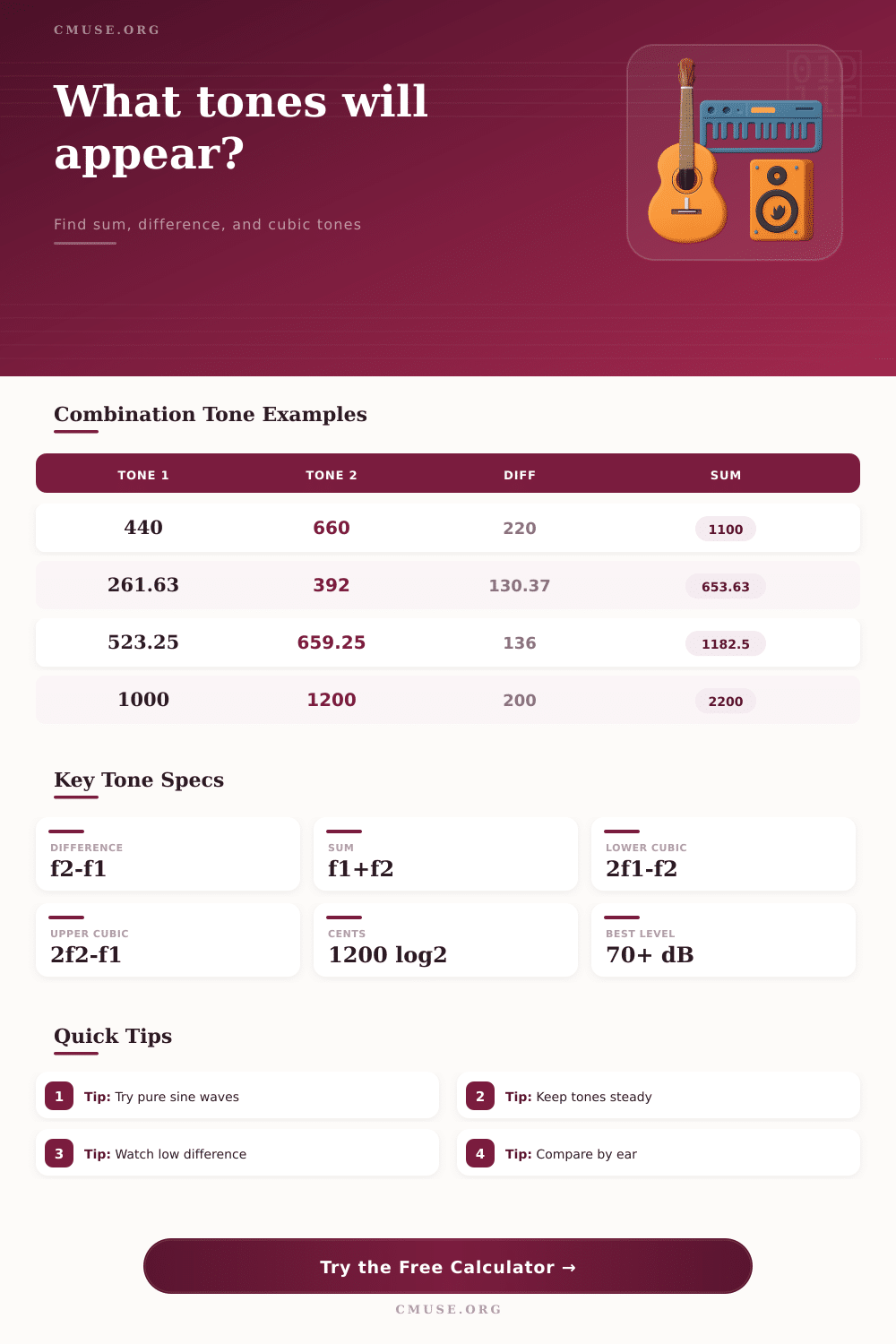
| Difference tone | f2 - f1 | Below the two entered tones | Often the easiest low product to identify with clean sine waves. |
| Sum tone | f1 + f2 | Above both entered tones | Usually less obvious by ear, but measurable in nonlinear systems. |
| Lower cubic | 2f1 - f2 | Below the lower tone when positive | Important in intermodulation distortion tests and tuning checks. |
| Upper cubic | 2f2 - f1 | Above the upper tone | Can fall near real harmonics and make dense tones sound rougher. |
| Second harmonic pair | 2f1, 2f2 | One octave above each tone | Useful for separating ordinary harmonics from combination products. |
| Interval | Example Pair | Difference Tone | Sum Tone |
|---|---|---|---|
| Octave | 440 and 880 Hz | 440 Hz, same as lower tone | 1320 Hz, near E6 |
| Perfect fifth | 440 and 660 Hz | 220 Hz, one octave below lower tone | 1100 Hz, bright upper product |
| Perfect fourth | 440 and 586.67 Hz | 146.67 Hz, below D3 | 1026.67 Hz, near C6 |
| Major third | 523.25 and 659.25 Hz | 136 Hz, low C# region | 1182.5 Hz, upper D region |
| Minor second | 440 and 466.16 Hz | 26.16 Hz, beat-like low difference | 906.16 Hz, high product |
| Context | Best Input | Expected Strength | Use Case |
|---|---|---|---|
| Pure sine waves | Steady tones at matched levels | Strongest perceptual contrast | Ear training and psychoacoustic checks |
| Acoustic instruments | Sustained double stops or organ tones | Moderate, depends on harmonics | Intonation practice and ensemble blending |
| Headphones or IEMs | Clean two-tone signal | Moderate to strong | Private listening tests and transducer checks |
| Studio monitors | Moderate SPL in a quiet room | Moderate, room masking matters | Speaker and room listening experiments |
| Small speaker | Two-tone stress test | Often generated by distortion | Intermodulation distortion diagnosis |
| Test Pair | Frequencies | Main Products | What To Watch |
|---|---|---|---|
| SMPTE IMD style | 60 Hz and 7000 Hz | 6940 and 7060 Hz sidebands | Low-frequency modulation around the high tone |
| CCIF IMD style | 19000 Hz and 20000 Hz | 1000 Hz difference product | Audible 1 kHz product from inaudible high tones |
| Music fifth | 440 Hz and 660 Hz | 220 Hz difference, 1100 Hz sum | Difference tone reinforces the tonal center |
| Close tuning pair | 440 Hz and 442 Hz | 2 Hz difference | Heard mainly as slow beating, not as pitch |
| High treble pair | 3000 Hz and 3600 Hz | 600 Hz difference, 6600 Hz sum | Difference product may be easy to identify |
Combination tones are extra pitch that occur when two steady tone are played at the same time; combination tones are pitches that were not originally played by the sound source. Combination tones arise both within the human ear and within any nonlinear part of a playback chain. Combination tones can be useful in that they can enrich the sounds of musical interval, but they can also be problematic in that they can muddy the sound of a signal that was created with the intention of being clean.
A user can use a calculator to predict the presence of combination tones by entering certain data into the calculator. The calculator require that the user enter the frequencies of the two source tones, the levels of each of those tones, a listening profile, and the type of playback medium that the user will use to play those tones. The frequency data tell the formulas which combination tones to calculate, the level of the tones determine the strength of the nonlinear distortion, the listening profile accounts for the masking and training abilities of the listener, and the medium accounts for the nonlinear distortion that the speakers or headphones will create.
How to Predict Combination Tones with a Calculator
If any of these parameter are changed, the audibility rating of the tones will change as well, since the audibility rating is based off each of these parameters. There are several different types of combination tones, each of which exhibit different behaviors. Difference tones sit below the lowest of the two source frequencies and are usually easy for the human ear to recognize.
For instance, if the interval between the two tones is a perfect fifth, the difference tone will land at a frequency that is one octave lower than the lower of the two source tones. Sum tones are tones that exist at frequencies that are above each of the two source tones, but that are more difficult for the human ear to recognize. Cubic products are combination tones that are calculated using the formulas 2f1 minus f2 and 2f2 minus f1. The lower of the two cubic products usually falls within the range of the original two tones, and can sound like a new bass tone is being played.
The upper cubic product exist at frequencies that are above the original tones. Several other factor can alter the way in which a listener hears combination tones. For instance, playing the tones through small speakers that are driven to high levels will add intermodulation to the sound, in addition to the mechanical distortion of the speakers that is outside of what the calculator can model.
Headphones will reveal faint combination tones that monitors playing the same tones in a treated listening room may be masked by. Listeners who are trained to recognize combination tones can hear tones that are ten or fifteen decibels weaker than tones that casual listeners can hear. Thus, the listening profile can alter the audibility rating of the tones, due to the fact that the listening profile accounts for the training level of the listener.
Tables within the article contain the combination tones that each of the common intervals creates. For instance, octaves contain a difference tone that coincides with the lower of the two tones, meaning that octaves do not appear to contain any combination tones. Intervals of a minor second create a difference tone that is within a few hertz of the original tones, meaning that intervals of a half step sound like they are slowly beating rather than containing a distinct pitch.
In addition to calculating the presence of combination tones, the calculator can also be used to choose test tones for distortion measurements or to calculate the tones that are heard during an intonation exercise. Each of the frequencies to be tested can be entered into the calculator, the combination tone that is the strongest will be calculated along with an audibility score. The playback level or the medium through which the tones are to be played can be changed to calculate how each of these parameter can affect the audibility score.
While the audibility score that is provided will not ensure that the tones will have those characteristics, the audibility score can provide a way to compare the audibility of one pair of tones to another. The same logic that is applied to the creation of sine waves to calculate combination tones can be applied to acoustic instruments. The reason for the inclusion of the medium setting in the calculator is due to the presence of the harmonics of acoustic instruments.
While the medium setting does not replace the necessity for careful listening for the detection of combination tones, it does ensure that the calculations remains in alignment with the parameters of the sound that will be created. The value of calculating the combination tones is that each calculation provides a decision for the listener. For example, the listener can determine if a certain interval will create extra bass tones that is noticeable, or if a certain pair of tones will be clean when played through small speakers.
Thus, each time that these calculations are performed, the extra pitches that are created are no longer a surprise for the listener, and they are a part of the control that the listener have over the sound that is played.