Difference Tone Calculator
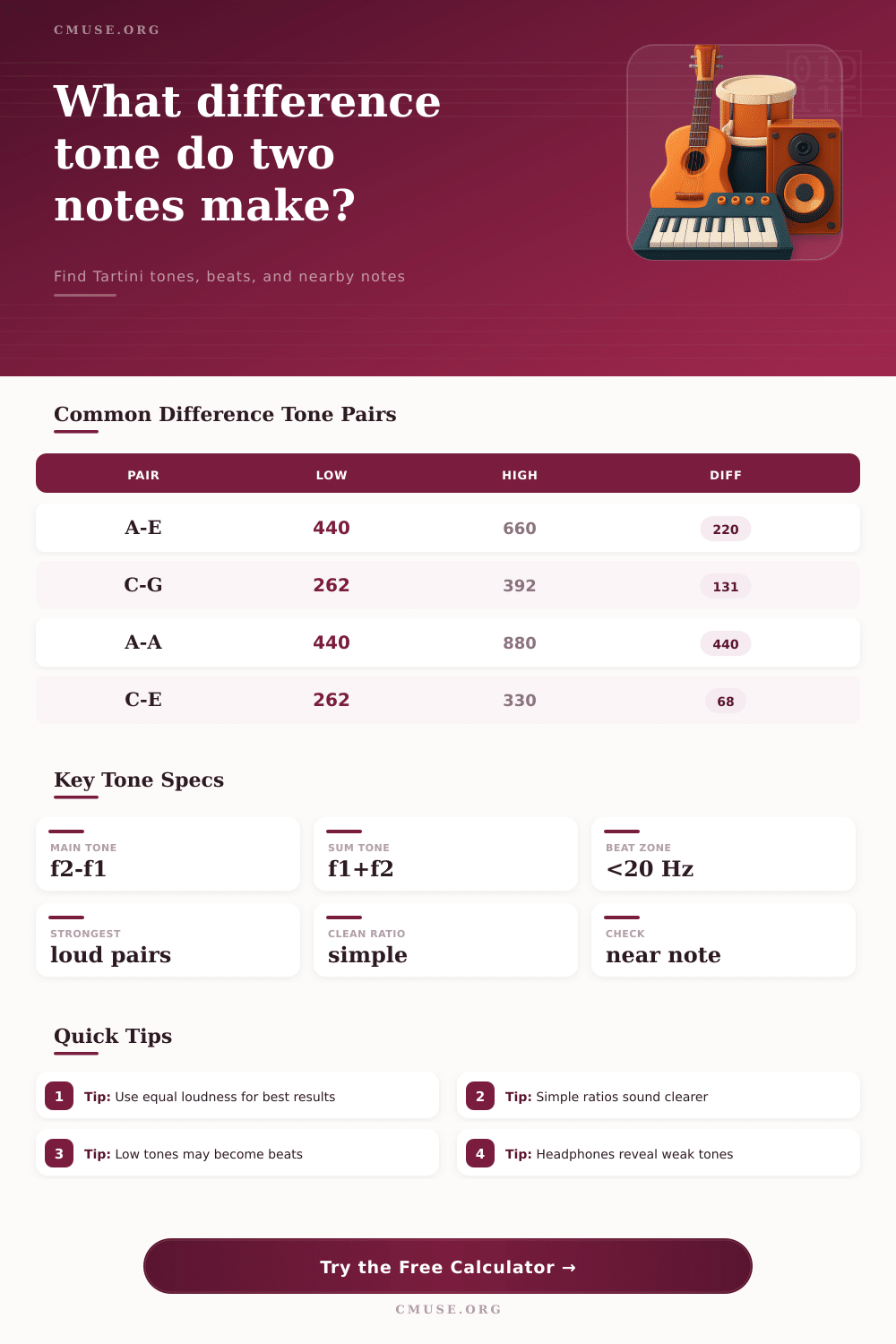
Enter two primary pitches to estimate the Tartini difference tone, sum tone, cubic sidebands, beat behavior, nearest note names, interval ratio, and likely audibility.
Preset use: Load a familiar interval, double stop, organ registration, synth patch, or tuning example, then adjust frequencies and listening levels for your own test.
Calculation Breakdown
| Interval | Simple Ratio | Difference From Lower | Common Result |
|---|---|---|---|
| Octave | 2:1 | 1.000 x lower | Difference repeats the lower note |
| Perfect fifth | 3:2 | 0.500 x lower | Difference is one octave below lower |
| Perfect fourth | 4:3 | 0.333 x lower | Difference is two octaves below upper |
| Major third | 5:4 | 0.250 x lower | Difference sits two octaves below lower |
| Minor third | 6:5 | 0.200 x lower | Difference reinforces the implied root |
| Whole tone | 9:8 | 0.125 x lower | Low difference may be felt as beats |
| Context | Level Adjustment | Best Frequency Zone | Practical Note |
|---|---|---|---|
| Closed headphones | +5 dB | 80 to 1200 Hz | Isolation helps weak combination tones appear |
| Nearfield monitors | 0 dB | 100 to 1000 Hz | Balanced levels and clean tuning matter most |
| Small live room | -4 dB | 120 to 800 Hz | Room modes can mask low difference tones |
| Organ or choir loft | +3 dB | 40 to 700 Hz | Sustained tones make the result easier to hear |
| Loud stage | -8 dB | 120 to 600 Hz | Masking and reflections make precision harder |
| Tone Type | Formula | Example From 440 And 660 Hz | Use In Calculator |
|---|---|---|---|
| Second-order difference | f2 - f1 | 220 Hz | Main Tartini tone card |
| Summation tone | f1 + f2 | 1100 Hz | Bright combination reference |
| Lower cubic difference | 2f1 - f2 | 220 Hz | Shown when result is positive |
| Upper cubic sideband | 2f2 - f1 | 880 Hz | Higher distortion product estimate |
| Close-tone beating | Absolute f2 - f1 | Under 20 Hz | Reported as beats, not a pitch |
| Pair | Primary Frequencies | Difference Tone | Musical Reading |
|---|---|---|---|
| A4 and E5 | 440.00 Hz + 660.00 Hz | 220.00 Hz | A3, a clear octave-below fifth result |
| C4 and G4 | 261.63 Hz + 392.00 Hz | 130.37 Hz | Near C3 when tuned as a pure fifth |
| C4 and E4 | 261.63 Hz + 329.63 Hz | 68.00 Hz | Low C-sharp region in equal temperament |
| 440 Hz and 444 Hz | Close tuning pair | 4.00 Hz | Slow beating instead of a stable pitch |
| 110 Hz and 165 Hz | Bass perfect fifth | 55.00 Hz | Implied A1-style low root support |
A differance tone is a third pitch that a person hears when two musical notes are played at the same time. When two musical notes is played at the same time, a third tone is heard that was not created by either of the original musical notes. This third tone is referred to as a difference tone, and the hearing system of the individual creates the difference tone.
A difference tone dont come from the room in which the sound is made. A difference tone also does not come from the equipment that was used to record the musical notes. The difference tone is created as a result of the way in which the human bodys hearing system processes the two musical notes.
What is a difference tone?
The frequency of the difference tone is correlated with the distance between the two original musical notes. The further apart the two notes are, the lower the pitch of the difference tone. For instance, if the two original notes are a perfect fifth apart, the distance between the two original notes will create a third note that is an octave lower than the lower of the two original notes.
If the two original notes are a major third apart, the resulting difference tone will be a third note that is within the low bass range. If the two original notes are extremely close to each other in terms of the frequency of those musical notes, the resulting third note is referred to as a beating. Beating is the sensation that musicians feel when the two strings upon a musical instrument are not perfectly tuned to the same frequency.
Calculators can be used to determine the frequency of the resultant difference tone. These calculators will report whether the difference tone is a musical note or a series of beat per second. Another factor that affects whether or not an individual can hear the difference tone is the volume of the original musical notes.
If one note is louder than the other, the difference tone will dissapear. In order for individuals to hear the difference tone, the two original musical notes must have the same volume. In order for the difference tone to be heard, the distortion products created by the hearing systems processing of the two original musical notes must be audible to the individual listener.
Separate loudness figure must be provided for each of the original musical notes. These musical notes should be tuned to each other to the extent that they produce audible distortion products. The way in which the musical notes are heard also have an impact on whether or not an individual can hear the difference tone.
For instance, if the music is played through headphones, that difference tone can be heard. However, if the music is played live, the sound reflections will bury the difference tone. These adjustments will have an impact upon whether or not an individual listener can hear the calculated difference tone.
Musicians and instrument makers use the characteristics and properties of difference tones for specific musical purposes. For instance, Baroque violinists tuned their violins so that the difference tone would create the reinforcement of the fundamental (or bass) note of the violin. Organ builders also voiced their organs so that one of the pipes would create a difference tone that created the desired bass tone of the organ without the need to utilize additional pipes to create that tone.
Finally, moddern music producers use the concept of difference tones in processes like FM synthesis and synth stacking. In these instances, the difference tone can add fullness to a synth low end. However, if not controlled properly, it could also create a clash between the synthesized tones.
In order to create the appropriate amount of difference tone, the nearest simple ratio of the two original tones can be determined. This will allow the music producer to understand how close the two tones are to creating the desired and “clean” result. Tables list the difference tones created by different intervals of musical notes.
For instance, the interval of an octave will create a third note that has the same pitch as the starting note. The perfect fourth will create a difference tone that exists two octaves below the higher of the two original musical notes. These intervals are created in such a way that the musicians that use those musical instruments easily recognize and understand them.
Due to the fact that the pitches of musical notes are slightly altered when playing in equal temperament, these difference tones will not always land on the standard musical pitch. A calculator will report how far the difference tone is from the nearest standard pitch within the scale. Finally, there are limits to the range of difference tones that can be heard by individuals.
The difference tone created will be felt rather than heard if it is too low in frequency. Additionally, if the difference tone is too high in frequency, the ear is unable to hear it properly. A tool can be used to calculate whether the difference tone can be heard by an individual by comparing the level of that difference tone to a standard threshold.
The threshold can be adjusted to raise or lower the audibility of the difference tone. However, this standard is only a starting point in determining whether or not the third tone will be heard. Other factors that impact the perception of the difference tone include the acoustics of the listening room, the fatigue of the individual listener, and the spectrum of the original musical tone.
The value of calculating the difference tone between two musical notes is that individuals begin to learn how to hear the difference tone. Once individuals understand how the difference tone behaves, the tone becomes a known and recognized element of the music that is being played.