Interval Beat Frequency Calculator
Estimate beat frequency between two musical notes, compare just and equal-tempered intervals, and inspect partial beating for piano, guitar, voice, organ, and synth tuning.
Preset use: Load a real tuning scenario, then adjust the interval, cents offset, octave placement, and harmonic partials to hear how the beat speed changes.
Calculation Breakdown
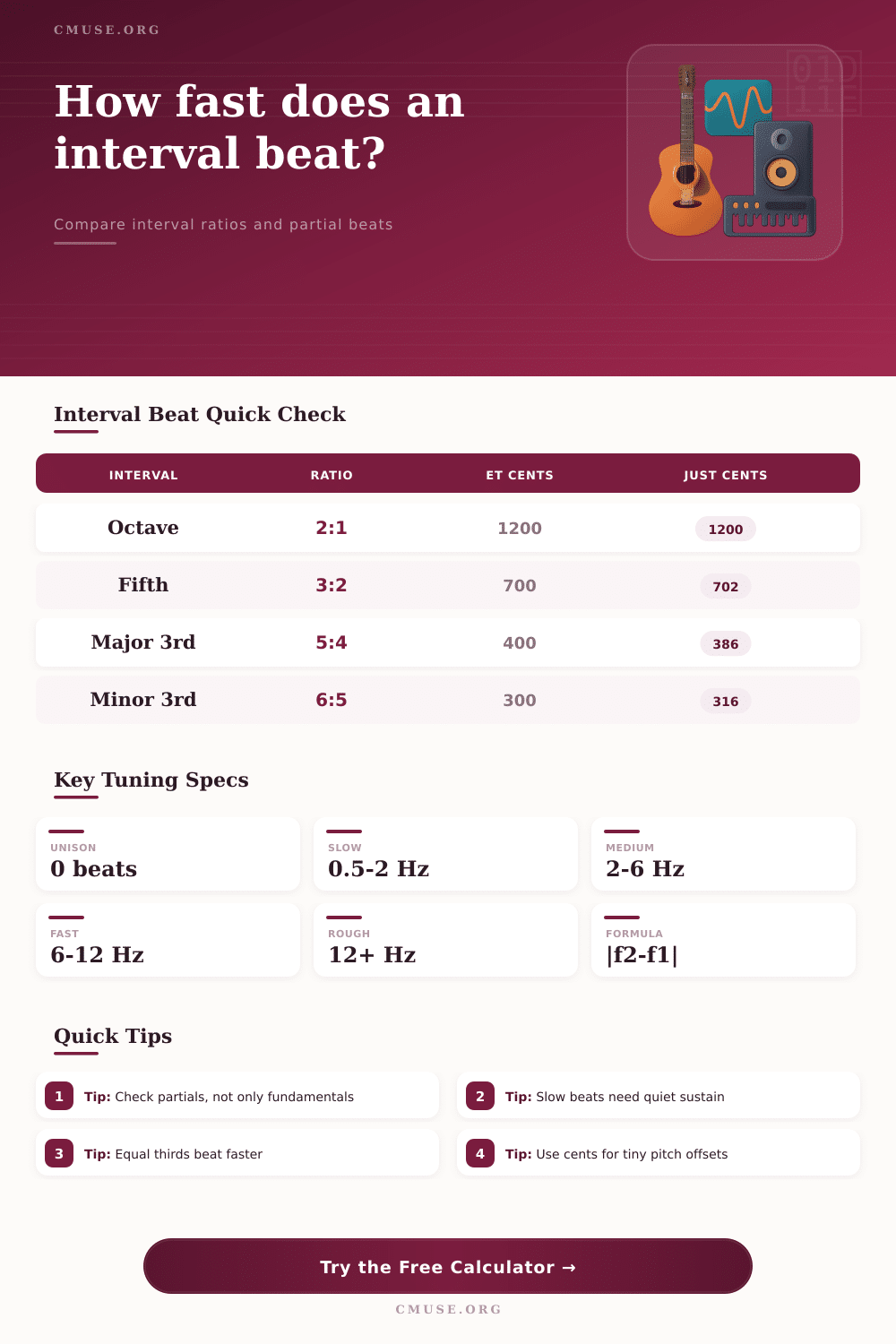
| Interval | Just Ratio | Just Cents | Equal Tempered Cents |
|---|---|---|---|
| Unison | 1:1 | 0.00 | 0 |
| Minor second | 16:15 | 111.73 | 100 |
| Major second | 9:8 | 203.91 | 200 |
| Minor third | 6:5 | 315.64 | 300 |
| Major third | 5:4 | 386.31 | 400 |
| Perfect fourth | 4:3 | 498.04 | 500 |
| Tritone | 45:32 | 590.22 | 600 |
| Perfect fifth | 3:2 | 701.96 | 700 |
| Minor sixth | 8:5 | 813.69 | 800 |
| Major sixth | 5:3 | 884.36 | 900 |
| Minor seventh | 9:5 | 1017.60 | 1000 |
| Major seventh | 15:8 | 1088.27 | 1100 |
| Octave | 2:1 | 1200.00 | 1200 |
| System | Interval Source | Best Fit | Beat Behavior |
|---|---|---|---|
| Just intonation | Small whole-number ratios | Voices, strings, brass, sustained chords | Aligned partials can become nearly beatless |
| Equal temperament | 100 cents per semitone | Piano, fretted instruments, modulation | Fifths and thirds retain planned beats |
| Pythagorean | Stacked 3:2 fifths | Medieval, modal, fifth-based tuning | Fifths are pure while thirds are wide |
| Custom ratio | User-entered numerator and denominator | Microtonal, historical, and experimental work | Beat speed follows the chosen ratio exactly |
| Interval | Partial Pair | Pure Ratio | What To Listen For |
|---|---|---|---|
| Octave | 2nd lower vs 1st upper | 2:1 | Slow waves indicate stretched or compressed octaves |
| Perfect fifth | 3rd lower vs 2nd upper | 3:2 | Pure fifths lock; tempered fifths beat slowly |
| Perfect fourth | 4th lower vs 3rd upper | 4:3 | Listen for a gentle wobble between shared partials |
| Major third | 5th lower vs 4th upper | 5:4 | Equal thirds beat clearly faster than just thirds |
| Minor third | 6th lower vs 5th upper | 6:5 | Beat speed helps separate just and tempered thirds |
| Harmonic seventh | 7th lower vs 4th upper | 7:4 | A pure barbershop seventh can lock strongly |
| Beat Rate | Beat Period | Perception | Typical Tuning Use |
|---|---|---|---|
| 0 to 0.2 Hz | 5 seconds or more | Nearly steady | Fine unisons, octaves, and locked just intervals |
| 0.2 to 1 Hz | 1 to 5 seconds | Slow pulsing | Piano octave checks and careful ensemble tuning |
| 1 to 4 Hz | 0.25 to 1 second | Readable beating | Temperament checks and gentle chorus movement |
| 4 to 8 Hz | 0.125 to 0.25 second | Fast shimmer | Wide thirds, celeste stops, synth detune |
| 8 to 15 Hz | 0.067 to 0.125 second | Roughness | Intentional tension or noticeably mistuned intervals |
| 15 Hz and up | Below 0.067 second | Blended rough tone | More like timbre than countable beats |
Interval beat frequencies is the phenomenon that occurs when two notes are played at the same time. The interval beat frequency is the measurement of how the two musical notes interferes with each other. While musicians often desire to have a clean sound with their instrument, the interval beat frequency often interrupts that clean sound.
Furthermore, it is possible to recognize the presence of interval beat frequency within two notes. In recognizing the beat frequency, it is possible to determine if the musicians instruments is properly tuned, or if they are out of tune with the other musicians playing the same note. To calculate the interval beat frequency between two notes, the first step is to select a lower note that will be played and an upper note that will be played.
What are interval beat frequencies?
Each of these notes will have a frequency, and the absolute difference between each of the frequencies will create a fundamental beat within the two notes. The fundamental beat is a critical measurement of the two notes being played, but the remaining tuning work is based off the comparison of the partials of each of the played note. By calculating and comparing the partials of each of the played notes, it is possible to recognize the tension or calm that exists between the two played notes.
Furthermore, a calculator can perform each of these calculations to determine what beats will occur between the two notes, and if the beats that are heard from the played notes match those calculated by the musician. The tuning systems for musical instruments will alter the sound of the interval beat frequency that is created by two played notes. For instance, equal temperament will result in every musical interval having the same number of cents as the other intervals within the music, and will result in a major third interval being twelve cents wider than it would be in just intonation.
As a result, the interval beat frequency created by equal temperament will have medium beat frequencies that are often accepted by listeners of musical compositions. In contrast, just intonation will create a tuning system that utilizes ratios to each of the tones within a chord, rather than creating each musical interval with the same number of semitones. As a result, there is no gap between each of the notes, and the partials lines up for each chord.
This makes the beat frequency between the two played notes very low or even invisible to the listeners. However, this tuning system often create problems when changing musical keys; a third that is musically pure within one key will have a sour sound within a different musical key, and the third will have a higher interval beat frequency. Thus, musicians must decide between equal temperament and just intonation according to how often they need to change musical keys.
The type of instrument that is being played will influence the perception of interval beat frequency. For instance, some musical instruments has a quick decay in the length of their played notes. Thus, these musical instruments allow for the interval beat frequency between two played notes to be recognized at a faster rate.
In contrast, other musical instruments, such as organs or vocal groups, have a longer sustain for each of the played notes. These musical instruments will make the interval beat frequency between two played notes very obvious to the listeners. The period value for each of the played notes is the length of time for one beat to be complete.
Thus, the period value of the played note makes the difference between the beat frequency for each of the played notes. A pulse that lasts half a second is easily noticeable by the listener, but a pulse that lasts five seconds may be almost invisible to the listener unless the room in which the musicians are playing is quiet. Each of the external factor will alter the actual rate for the interval beat frequency between two played notes.
For instance, the temperature within the performance hall will have an effect upon the rate at which each note vibrate, which will change the interval beat frequency between the two played notes. In addition, the stiffness of the strings of each of the instruments will change the actual rate at which each of the played notes will have an interval beat frequency. Furthermore, a singer or a wind musician will change the actual rate at which each of the played notes will have an interval beat frequency by the adjustment of the pitch.
Each of these factors will change the rate at which each of the played notes have an interval beat frequency, so the safest approach for performers of music is to tune the instrument for the partials that will be played within the performance. Thus, if the musicians tuned the partials instead of just the fundamental frequencies of the played notes, they would of eliminate the surprises that may arise after the performance begins. Furthermore, the principle regarding interval beat frequency can be applied to many different situations.
For instance, it is possible to use an interval beat frequency calculator to determine the relationship between the frequency of each played note. A tool makes the relationship of the interval beat frequency between two played notes visible to those who are playing the instruments, allowing the musicians to decide how much beat frequency exist between the two played notes in their composition.