Meantone Temperament Calculator
Compare meantone comma fractions, tempered fifths, pure-third accuracy, wolf fifth size, generated pitch offsets, and A4-based note frequencies for historical keyboard and ensemble tuning.
Preset use: Load a common historical or practical meantone setup, then adjust the comma fraction, generator count, reference pitch, note spelling, and output octave.
Calculation Breakdown
| Note | Pitch Cents From C | Offset Vs 12-TET | Frequency In Output Octave |
|---|---|---|---|
| C | 0.00 | 0.00 | 261.63 Hz |
| Model | Fifth Size | Major Third | Best Use |
|---|---|---|---|
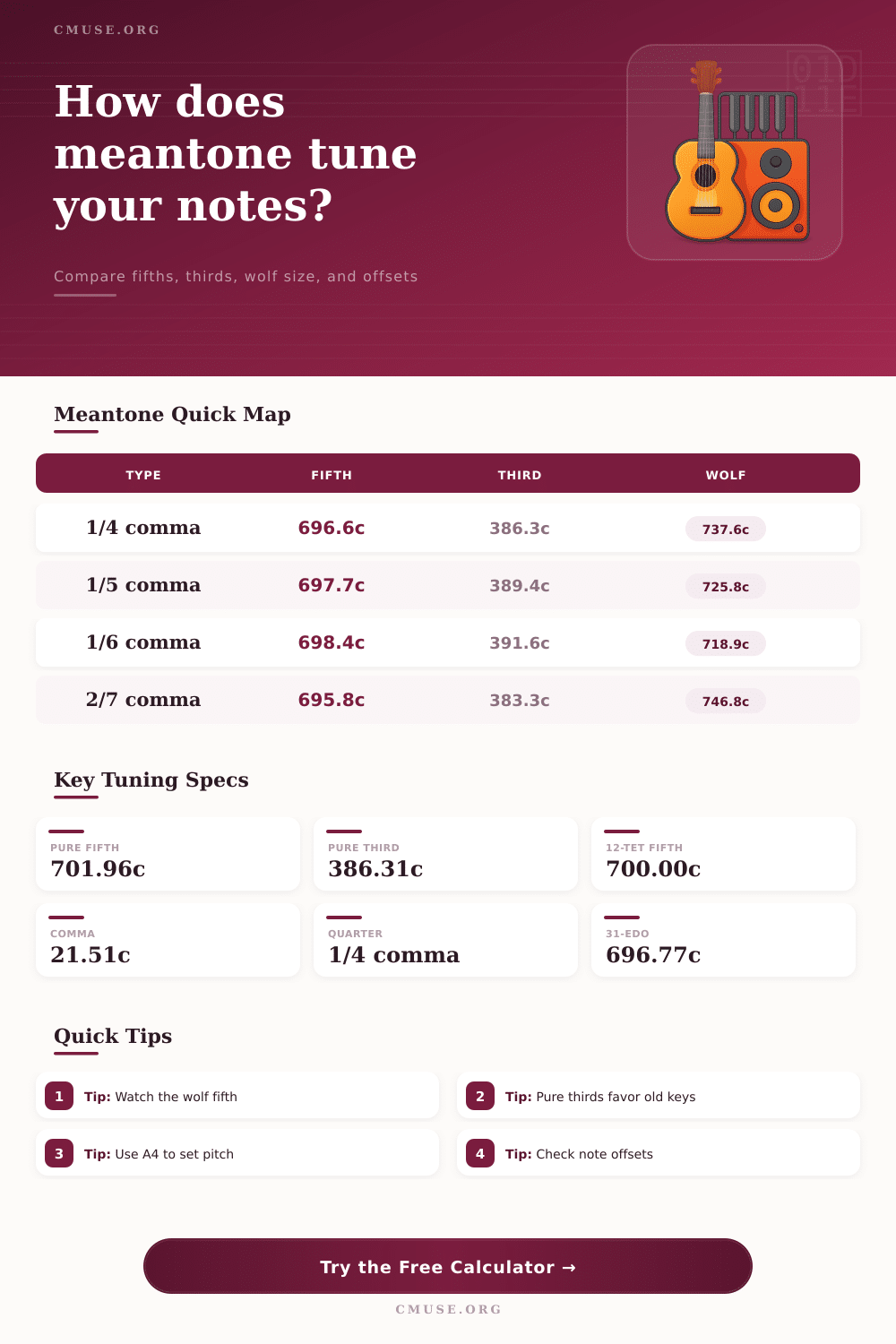
| 1/4 comma | 696.578 cents | 386.314 cents, pure 5:4 | Strong Renaissance and early Baroque third color |
| 1/5 comma | 697.654 cents | 390.617 cents, slightly wide | Less intense wolf with still-sweet thirds |
| 1/6 comma | 698.371 cents | 393.486 cents, wider thirds | Broad key access and softer meantone character |
| 2/7 comma | 695.811 cents | 383.245 cents, narrow third | Very narrow fifth color for special historical tests |
| 31-EDO | 696.774 cents | 387.097 cents | Extended keyboard approximation to quarter-comma meantone |
| Interval | Formula From Fifth | Quarter-Comma Size | Tuning Meaning |
|---|---|---|---|
| Tempered fifth | Pure fifth minus comma share | 696.578 cents | Main generator used around the chain |
| Major third | 4 fifths minus 2 octaves | 386.314 cents | Pure 5:4 in quarter-comma meantone |
| Major tone | 2 fifths minus 1 octave | 193.157 cents | Whole step used five times in the diatonic octave |
| Diatonic semitone | (1200 minus 5 tones) divided by 2 | 117.107 cents | Large E-F or B-C style semitone |
| Chromatic semitone | Major tone minus diatonic semitone | 76.050 cents | Small accidental split between enharmonic notes |
| Tuning | Fifth Character | Major Third Character | Enharmonic Behavior |
|---|---|---|---|
| Quarter-comma meantone | Noticeably narrow, very regular | Pure and beatless in favored keys | Enharmonics differ strongly; wolf is large |
| Sixth-comma meantone | Mildly narrow | Wide but still smoother than Pythagorean | Wolf is smaller and more keys are tolerable |
| 31-EDO meantone | Close to quarter-comma | Very close to just major third | Split accidentals reduce the single wolf problem |
| 12-tone equal temperament | Every fifth is 700 cents | 13.686 cents wider than pure | Enharmonics are identical and modulation is even |
| Pythagorean reference | Pure 701.955-cent fifths | 407.820-cent ditone, very wide | Melodic fifth purity is prioritized over thirds |
| Setup | Reference Pitch | Generator Plan | Practical Result |
|---|---|---|---|
| Renaissance organ | A4 440 or local pitch | 12 notes, quarter-comma fifths | Clean common thirds, strong wolf outside favored keys |
| Baroque chamber pitch | A4 415 Hz | Quarter or sixth-comma chain | Lower reference pitch with historical keyboard color |
| Choir rehearsal | A4 432 to 440 Hz | Quarter-comma for triad checks | Highlights pure major-third alignment for singers |
| Split-key harpsichord | A4 392 or 415 Hz | 19 or 31 generated notes | Separates G# from Ab and reduces enharmonic conflict |
| Modern comparison | A4 440 Hz | 12-TET check mode | Shows how equal temperament trades pure thirds for access |
Meantone temperament are a tuning system that was created due to the desire of Renaissance musicians to have major thirds that didnt beat against each other. In order to achieve this desired sound, though, the musicians had to sacrifice the purity of the perfect fifths within there music. The calculator provided in this tool will measure the compromises of musicians who choose meantone temperament, as well as show the behavior of the chain of fifths with a specific comma fraction that the musician selects.
Within meantone temperament, the fifth is the generator for the tuning system. The fifth is tempered in such a way that each fifth that is created with this temperament is slightly less than the perfect fifth. Each perfect fifth is comprised of stacking interval of the fifth, and each fifth that is selected for meantone temperament contains a subtraction of the syntonic comma.
What Is Meantone Tuning?
The syntonic comma is the interval between the perfect fifths and perfect major thirds. The amount of syntonic commas that is removed from each fifth is correlated with the purity of the major thirds that are created; the more syntonic commas that is removed, the more purely the thirds will be. For instance, if a musician selects a quarter comma as the setting for the meantone temperament, the syntonic comma will be largely removed from the perfect fifths, resulting in major thirds that sound pure.
However, such a setting will also result in the creation of a wolf fifth. Another choice for meantone temperament is the location of the wolf fifth upon the keyboard. If the musician changes the chain anchor of the meantone temperament from C to G or F, the remaining notes will shift on the keyboard, ensuring that the wolf fifth does not interfere with other instruments with fixed pitch.
For instance, a harpsichordist may want to adjust the position of the wolf fifth to ensure that it does not impact the notes necessary to play a certain piece of music. This tool can reveal to the keyboard player how far each key will drift from it’s pure pitch when the musician changes the chain anchor. In addition to the location of the wolf fifth, there are also different options for the spelling of the meantone temperament.
For instance, one historical spelling is known as mixed spelling, wherein an individual writes G sharp notes whenever the music shifts in a sharp direction, yet writes A flat notes for intervals that shift in a flat direction. On a split key keyboard, these keys have different physical meaning. However, on a standard keyboard with twelve tones, the spelling does not impact the sounds that are created.
However, it does alter the labels of the black keys. While many individuals may believe that meantone temperament is only used for early music composition, meantone temperament is actualy used in any ensemble whose music value major thirds above ability to modulate between musical keys. Despite the age of meantone temperament, though, the trade-offs between thirds and fifths is the same as those in the sixteenth century.
Each ensemble gains the ability to have consonant major thirds in certain keys, while losing the ability for other keys to sound pleasant to the ear. The tool allows for each ensemble to hear how other keys may sound strange by adjusting the setting of meantone temperament from a quarter comma to a sixth comma setting or to thirty-one tone equal temperament. The reference pitch for the instrument will also impact the way in which the meantone temperament sound to the listener.
For instance, shifting the reference pitch of A4 from 440 to 415 Hz will shift the instrument to a lower pitch. At lower pitches, the thirds will sound warmer due to the slower beating of the overtones. If the reference pitch is raised, though, the thirds will sound bright.
Each of these adjustments dont mathematically impact the tuning system, yet they do impact the temperaments sound in a performance space. Overall, then, meantone temperament is essentially a negotiation between the ear and the keyboard. By forcing musicians to make a choice as to which intervals will contain that error of the syntonic comma, musicians can understand the historical choices for such a temperament.
It should of been more clear earlier on.