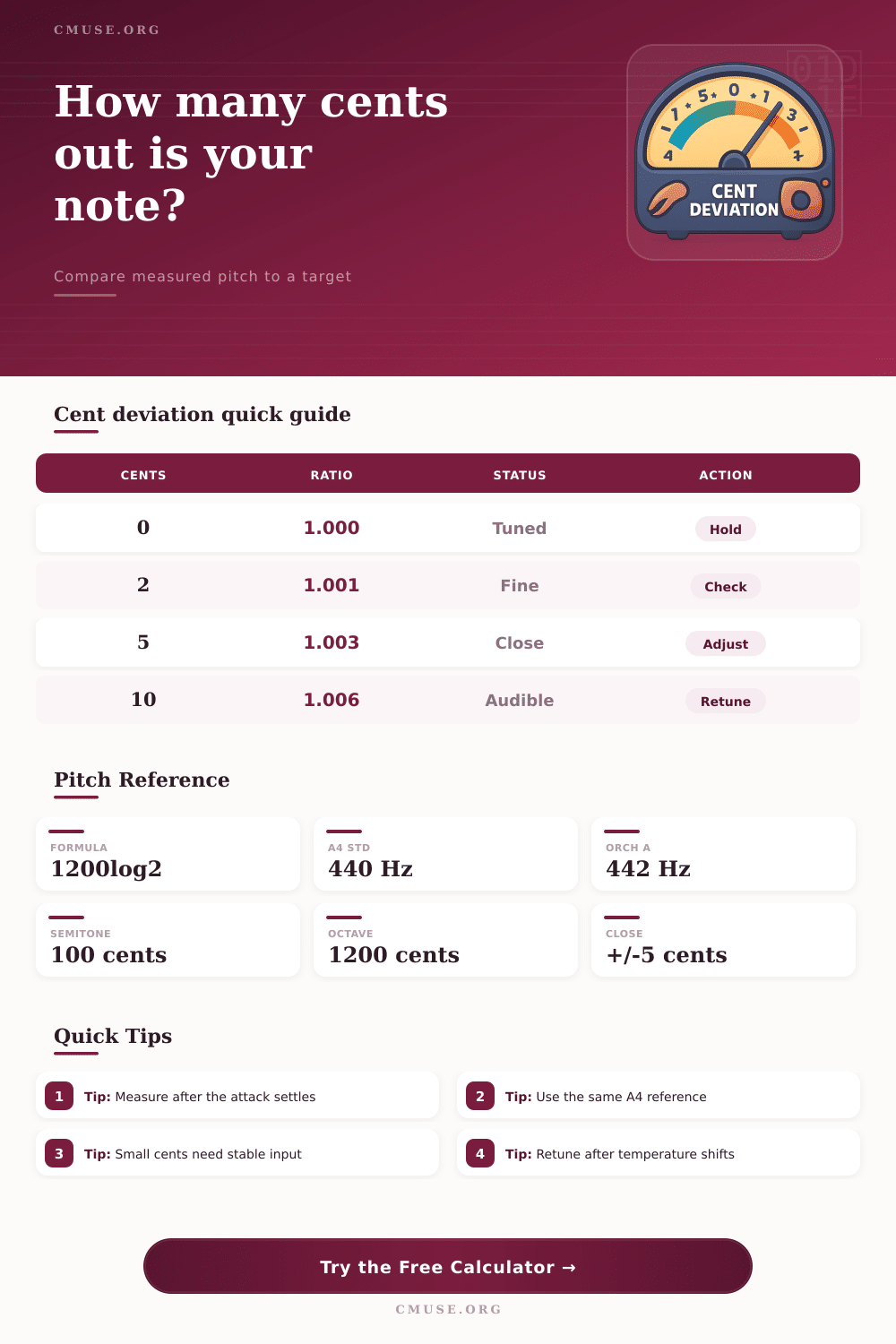
Cent Deviation Calculator
Compare a measured pitch to an equal-tempered target note, account for A4 calibration and transposition, and see how many cents sharp or flat the sound is.
Preset use: Load a common tuning check, then adjust the measured frequency, A4 reference, tolerance, and instrument profile to match your tuner or analyzer reading.
Calculation Breakdown
| Cent Change | Frequency Ratio | Approx Change At 440 Hz | Typical Meaning |
|---|---|---|---|
| 1 cent | 1.000578 | 0.25 Hz | Very fine tuner movement, often near display jitter |
| 2 cents | 1.001156 | 0.51 Hz | Audible to trained ears on sustained tones |
| 5 cents | 1.002892 | 1.27 Hz | Common practical tolerance for many instruments |
| 10 cents | 1.005793 | 2.55 Hz | Clearly sharp or flat in exposed unison checks |
| 50 cents | 1.029302 | 12.89 Hz | Quarter-tone distance from the target pitch |
| 100 cents | 1.059463 | 26.16 Hz | One equal-tempered semitone |
| Note | At A4 = 440 Hz | At A4 = 442 Hz | Typical Check |
|---|---|---|---|
| C4 | 261.63 Hz | 262.81 Hz | Middle C piano and keyboard verification |
| E2 | 82.41 Hz | 82.78 Hz | Standard guitar low E string |
| A3 | 220.00 Hz | 221.00 Hz | Voice, viola, and lower ensemble tuning |
| A4 | 440.00 Hz | 442.00 Hz | Concert tuning fork or reference tone |
| C6 | 1046.50 Hz | 1051.27 Hz | Flute and high melody intonation checks |
| E5 | 659.26 Hz | 662.25 Hz | Guitar high E at the 12th fret octave |
| Use Case | Typical Tolerance | Best Reading Method | Recommendation |
|---|---|---|---|
| Electronic test tone | 1 to 2 cents | Frequency counter or stable tuner | Use exact Hz and avoid noisy microphone input |
| Piano unison check | 2 to 4 cents | Strobe or high-resolution tuner | Let the attack settle before reading |
| Guitar open string | 3 to 6 cents | Clip tuner or direct input tuner | Pick gently and mute sympathetic strings |
| String ensemble | 5 to 10 cents | Sustained reference and ear check | Account for vibrato and section blend |
| Voice intonation | 8 to 15 cents | Average over held vowel | Use stability width as much as exact cents |
| Preset | Target | A4 Reference | Why It Matters |
|---|---|---|---|
| A4 Concert 440 | A4, 440.00 Hz | 440 Hz | General tuner calibration and tuning fork checks |
| Orchestra A 442 | A4, 442.00 Hz | 442 Hz | Common brighter orchestral reference in some halls |
| Guitar Low E | E2, 82.41 Hz | 440 Hz | Low strings show larger Hz shifts for the same cents |
| Violin A String | A4, 440 or 442 Hz | 440-442 Hz | Primary string-family ensemble reference pitch |
| Flute C6 | C6, 1046.50 Hz | 440 Hz | High notes change more Hz per cent than low notes |
A cent deviation calculator measure the distance between the frequency that is measured and a target pitch in cents. A cent is a unit that describe one of one hundred equal parts into which a semitone is divided. These calculator is helpful in that they can take a measured frequency and convert that to a cent value to determining whether the frequency is close to the target pitch.
To use a cent deviation calculator, several input must be made. First, the user must enter the target note and the octave of that note. Additionally, the user must enter the A4 reference frequency as most musical ensemble dont use 440 Hz for A4. Different musical ensembles uses different reference frequencies for A4, so it is essential to ensure that the cent deviation calculator use the correct A4 reference frequency for accuracy in the calculations.
How to Use a Cent Deviation Calculator
Finally, the measured frequency must be entered into a calculator. Once the user has entered these values, the calculator will output the cent offset and, optionally, allow the user to set a tolerance for deviation. A person must understand that several physical factor may impact the pitch of a musical note that a cent deviation calculator cannot account for.
For instance, the temperature can impact the pitch of a wind instrument. The way that a person plays a musical instrument can also impact the pitch of a note played on that instrument. Additionally, a piano note may start with a higher pitch then the settled pitch of that note.
The same can be true for a guitar if the force with which a person presses the musical string impact the pitch of that string. While a cent deviation calculator may help to provide a stable reading for a musical note, a person must determine if the deviation in pitch is from the instrument or the playing of the instrument. The relationship between frequency and cents are essential to understand the purpose of a cent deviation calculator.
The cents unit describe the ratio between two frequencies. Therefore, a deviation in cents results in a larger change in the measured frequency of high pitches then it does in low pitches. Thus, a five-cent deviation in frequency from a high pitch will result in a more larger change in hertz than a five-cent deviation from a low pitch.
The cent deviation calculator will show both the frequency and cent deviation for a person to understanding the relationship between these two values. Transposition and instrument profile can also impact the cent deviation calculator readings. For instance, a clarinet or a horn may play at a different frequency then the note written on the musical staff, so the reader of a cent deviation calculator must also input the offset of the note the instrument play.
Additionally, a two-cent deviation on a synthesizer will have a different effect on the sound then the same deviation on a choir. Reference tables exist that show common deviations in cents and the resulting frequencies of those deviations. These tables lists the cents deviations for common musical situations.
These reference tables exist for ease of comparing the output of the cent deviation calculator with a musical standard. Finally, a cent deviation calculator is a tool to assist a person in making musical decision. A note may be within the deviation tolerance yet sound incorrectly to listeners due to the other notes in the piece sounding differently tuned.
Additionally, a note may be outside the deviation tolerance yet sound musically correct due to the way that a person plays the instrument or the physical space in which the sound is play. It could of been better if more information was provided. Dont forget that its important to use teh right tools.
The calculator should of been used for more than just one single note. A lot of musicians finds that they can use it to help with tuning. It is actually a very useful tool for moddern music.
Youll find that the results are very comfortablly accurate.