Double Harmonic Scale Calculator
Build double harmonic, Byzantine, Hungarian minor, and Persian scale forms with note spelling, semitone steps, augmented seconds, octave range, temperament, and frequency estimates.
Preset use: Load a real double harmonic family scenario, then adjust root, spelling, octave, tuning, temperament, instrument view, and range.
Calculation Breakdown
| Degree | Note | Interval | Frequency |
|---|---|---|---|
| 1 | E4 | Root | 329.63 Hz |
| 2 | F4 | b2 | 349.23 Hz |
| 3 | G#4 | 3 | 415.30 Hz |
| 4 | A4 | 4 | 440.00 Hz |
| Scale Form | Formula | Semitone Set | Common Use |
|---|---|---|---|
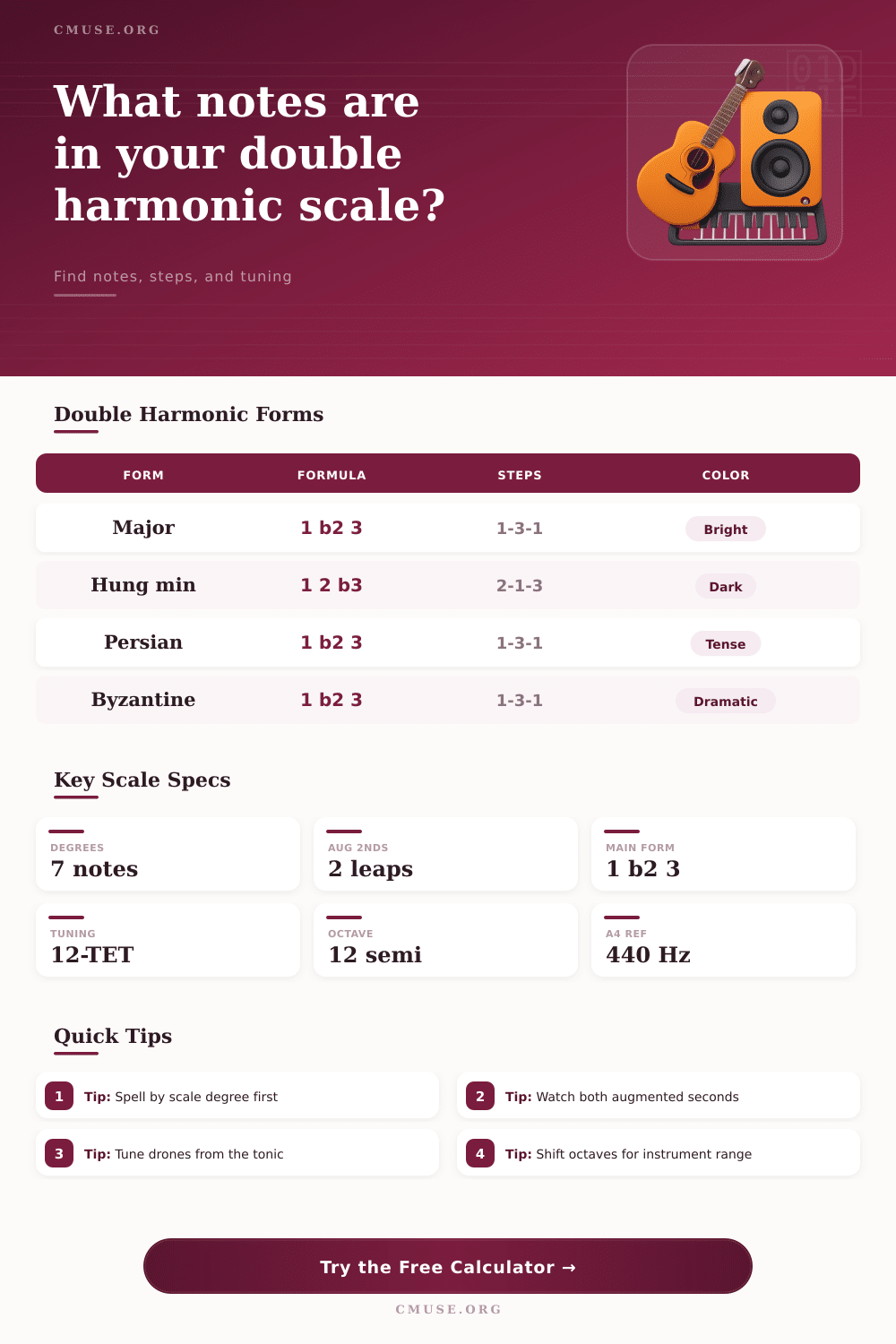
| Double harmonic major / Byzantine | 1 b2 3 4 5 b6 7 | 0, 1, 4, 5, 7, 8, 11 | Bright tonic with two dramatic augmented seconds |
| Hungarian minor family | 1 2 b3 #4 5 b6 7 | 0, 2, 3, 6, 7, 8, 11 | Minor tonic with raised fourth and leading tone |
| Persian scale form | 1 b2 3 4 b5 b6 7 | 0, 1, 4, 5, 6, 8, 11 | Chromatic center with a flattened fifth color |
| Mode 5 of double harmonic major | 1 b2 3 4 5 b6 b7 | 0, 1, 4, 5, 7, 8, 10 | Dominant color related to Hijaz-type sounds |
| Scale Degree | Equal-Temperament Semitones | Just-Ratio Reference | Drone Practice Ratio |
|---|---|---|---|
| 1 Root | 0 | 1/1 | 1/1 tonic drone |
| b2 or 2 | 1 or 2 | 16/15 or 9/8 | Close lower neighbor or whole step |
| 3 or b3 | 4 or 3 | 5/4 or 6/5 | Major or minor third against tonic |
| 4 or #4 | 5 or 6 | 4/3 or 45/32 | Fourth color or tritone color |
| 5 or b5 | 7 or 6 | 3/2 or 64/45 | Fifth anchor or flattened fifth |
| b6 | 8 | 8/5 | Minor sixth color tone |
| 7 or b7 | 11 or 10 | 15/8 or 9/5 | Leading tone or dominant seventh |
| Instrument View | Useful Root Octave | Scale Focus | Calculation Note |
|---|---|---|---|
| Piano / keyboard | C3 to C5 | Finger crossing near half steps | Equal temperament frequencies match fixed keys |
| Guitar / fretted instrument | E2 to E5 | Position shifts around augmented seconds | Sharps or flats may be easier by fretboard shape |
| Violin / bowed string | G3 to E6 | Intonation against tonic and fifth drones | Just-ratio view helps slow tuning practice |
| Oud / fretless plucked string | C3 to C5 | Phrase shapes with close b2 motion | Drone ratios show tonic-centered color tones |
| Voice / choir | A2 to A5 | Leading tone and augmented-second placement | Range span helps pick a comfortable tonic |
| Example | Form | Notes | Signature Step |
|---|---|---|---|
| C Byzantine | Double harmonic major | C Db E F G Ab B | Db to E and Ab to B |
| E Hijaz Kar-style | Double harmonic major | E F G# A B C D# | F to G# and C to D# |
| D Hungarian minor | Hungarian minor family | D E F G# A Bb C# | F to G# and Bb to C# |
| E Persian form | Persian scale form | E F G# A Bb C D# | F to G# and C to D# |
| A Byzantine | Double harmonic major | A Bb C# D E F G# | Bb to C# and F to G# |
The double harmonic scale contain seven notes, but what makes this scale unique is that it contains two interval that are three semitones in width. These intervals that are three semitones in width is known as augmented seconds. These augmented seconds give the double harmonic scale a sense of tension.
Musicians use this scale for dramatic effect, but they use a twelve-tone system when they play the double harmonic scale. The calculator allow the user to choose the root note that they would like to use for this scale. Additionally, the calculator allow the user to choose one of four main forms of the scale.
Double Harmonic Scale and Calculator
Finally, the calculator allows the user to choose a point of reference for the tuning of the scale. Understanding how these affect the scale will allow the user to understand how the augmented second can end up being either major or minor scales. The Byzantine mode, which is also known as the double harmonic major scale, include the same interval as the tonic and the major third.
However, instead of using the second and sixth note of the scale, the Byzantine mode use a leading tone that resolves into the octave. Using the flattened second note create a friction within the other notes of the Byzantine scale. Guitarists may use this scale because the three semitone leap will end up on a single string on the guitar.
However, keyboard players will have to cross fingers on an instrument that does not use the three-semitone leap as common in major or minor scales. Other forms of the scale exist. The Hungarian minor scale move the raised fourth note into the scale.
This changes the color of the scale created by the augmented second note. The Persian form of the scale feature a flattened fifth note, which give the scale a darker quality in the center of the scale. Mode five of the double harmonic scale features a lowered seventh note, giving it a dominant flavor to the scale while using the same augmented second note as the Byzantine mode.
Each of these mode will change the chords that are stable within the scale to the chord tensions created by these scales. How the notes are spelled within the calculator is important. Using seven distinct letters for the scale notes will avoid the use of double sharps or double flat in the scale.
Additionally, a user can choose to use either sharps-only or flats-only notation; however, this will change the visual pattern of the scale. This visual change is important for giving the music to singers or music copyists who are very used to conventional musical notation. The choice of tuning reference will affect how the user practice the scale.
Using equal temperament will work well for instruments such as the piano or fretted guitar. Just-ratio or drone settings will work best for singers or those who play instruments without frets. The frequency spread shown on the calculator will allow the user to make sure that the octave range of the scale fit the instrument being used.
The two instance of the augmented seconds will impact how the music is phrased. Violin and oud players can use the contrast between the flattened second and the major third as a melodic ornament. Additionally, the leap from the flattened sixth to the leading tone can be used dramatic within violin or oud melodies.
Singers may shorten these long interval; shortening these intervals will change the color of the double harmonic scale without changing the identity of the scale. The reference tables included in the calculator will allow the user to see how each form of the double harmonic scale relate to the other forms. These tables will show how each scale’s interval relate in equal temperament, just-ratio, and drone practice.
These charts will assist the musician when switching to another musical instrument or explaining the different scale to other musicians who may be using the same scale. The more that the musician use this calculator to generate the different forms of the double harmonic scale, the more that they will become familiar with the tension of the scale. If the user regularly utilizes the double harmonic scale generator, they will be able to hear the two augmented seconds before they even see them on paper.
This will allow the musician to compose or improvise music that use the double harmonic scale more quickly.