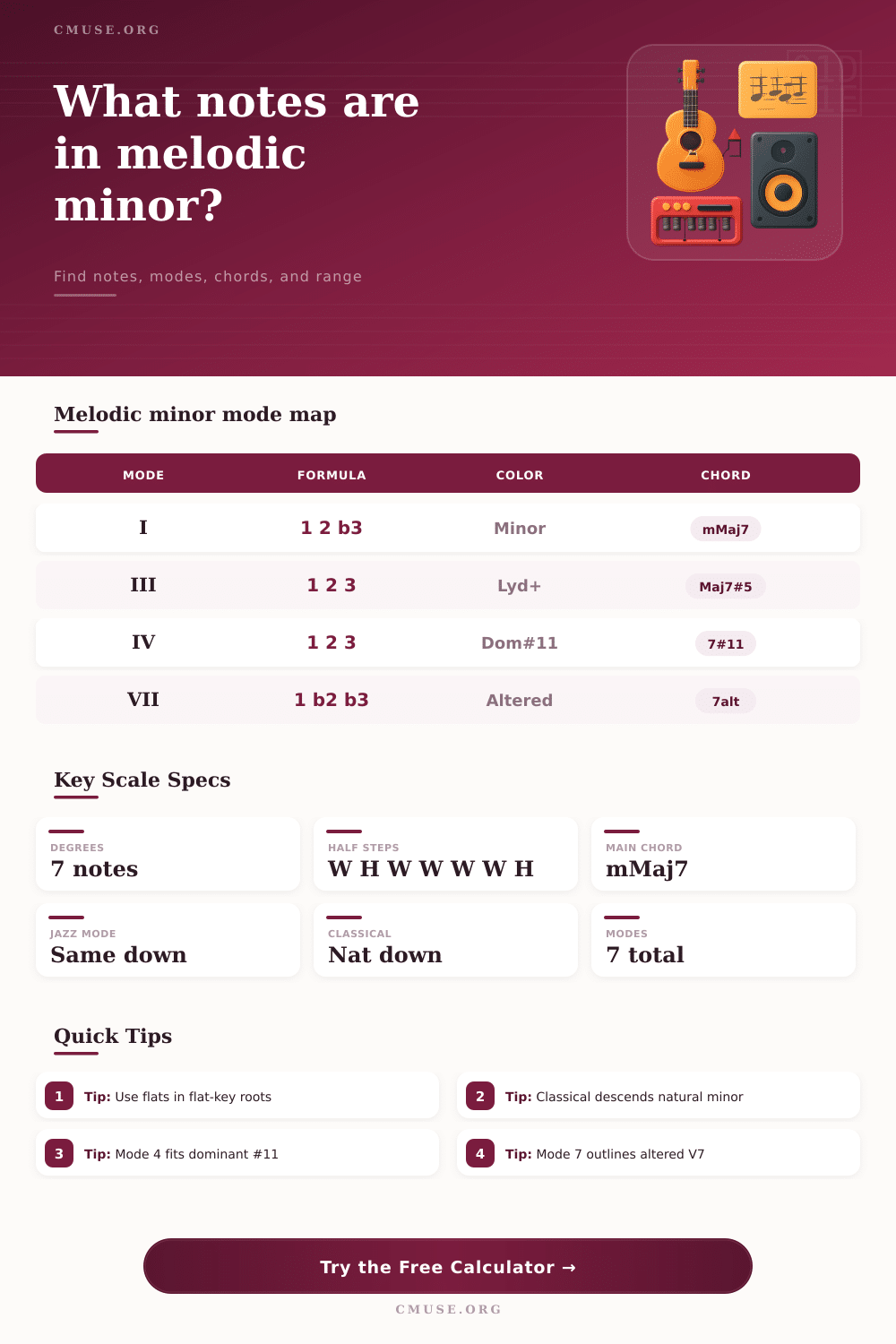
Melodic Minor Scale Calculator
Calculate melodic minor notes, mode formulas, diatonic chord qualities, parent scale, MIDI range, and practice timing from any tonic.
Preset use: Load a classical, jazz, or modal melodic minor situation, then adjust spelling, direction, octave, span, and practice tempo.
Calculation Breakdown
| Mode | Common Name | Formula | Typical Chord Sound |
|---|---|---|---|
| I | Melodic minor, jazz minor | 1 2 b3 4 5 6 7 | Minor-major 7, tonic minor with natural 6 and 7 |
| II | Dorian b2, Phrygian #6 | 1 b2 b3 4 5 6 b7 | Minor 7 with flat 9 color |
| III | Lydian augmented | 1 2 3 #4 #5 6 7 | Major 7 sharp 5, cinematic augmented major |
| IV | Lydian dominant | 1 2 3 #4 5 6 b7 | Dominant 7 sharp 11 |
| V | Mixolydian b6 | 1 2 3 4 5 b6 b7 | Dominant 7 flat 13 |
| VI | Locrian #2 | 1 2 b3 4 b5 b6 b7 | Half-diminished with natural 9 |
| VII | Altered, super Locrian | 1 b2 #2 3 b5 b6 b7 | Altered dominant with b9, #9, b5, b13 |
| Degree | Triad Quality | Seventh Quality | Scale Function |
|---|---|---|---|
| I | Minor | mMaj7 | Tonic minor color with leading tone |
| II | Minor | m7 | Pre-dominant minor sound |
| III | Augmented | Maj7#5 | Lydian augmented color center |
| IV | Major | 7 | Lydian dominant or backdoor dominant color |
| V | Major | 7 | Dominant with b13 available from the mode |
| VI | Diminished | m7b5 | Half-diminished color with natural 9 mode |
| VII | Diminished | m7b5 | Altered dominant parent relationship |
| Scale Form | Ascending Notes | Descending Notes | Best Calculation Use |
|---|---|---|---|
| Classical melodic minor | 1 2 b3 4 5 6 7 | 1 b7 b6 5 4 b3 2 1 | Instrument exams, notation drills, voice-leading exercises |
| Jazz melodic minor | 1 2 b3 4 5 6 7 | 7 6 5 4 b3 2 1 | Improvisation, chord-scale choices, modern harmony |
| Melodic minor modes | Rotated from parent melodic minor | Usually same note set down | Dominant altered, Lydian dominant, half-diminished sounds |
| Natural minor comparison | 1 2 b3 4 5 b6 b7 | b7 b6 5 4 b3 2 1 | Checking the classical descending form |
| Root | Melodic Minor Notes | One-Octave MIDI Range | Common Practice Target |
|---|---|---|---|
| C | C D Eb F G A B C | 60-72 at C4 | Piano and theory baseline key |
| A | A B C D E F# G# A | 57-69 at A3 | Classical minor scale exams |
| Eb | Eb F Gb Ab Bb C D Eb | 63-75 at Eb4 | Horn-friendly jazz minor color |
| F# | F# G# A B C# D# E# F# | 66-78 at F#4 | Altered-dominant parent study |
| Bb | Bb C Db Eb F G A Bb | 58-70 at Bb3 | Flat-key melodic minor fluency |
The melodic minor scale can behave in two differently ways depending on the genre of music that a person is creating: classical music or jazz music. When a person use the melodic minor scale for classical music, the scale employ the raised sixth and seventh note in the ascending melodic minor scale. However, those same raised sixth and seventh notes is dropped in the descending portion of the melodic minor scale.
Jazz musician, however, use the raised sixth and seventh degree of the scale in both the ascending and descending portion of the melodic minor scale. The melodic minor scale calculator allow a person to choose both the tonic of the melodic minor scale and the form of that melodic minor scale (classical or jazz). For jazz mode, the sixth and seventh notes will be raise.
Melodic Minor Scale: Classical vs Jazz and the Calculator
For classical modes, the natural minor scale are utilized for the descending portion of the melodic minor scale. The form of the melodic minor scale will determine the output of the calculator, the modes that is shown, and the chord qualities that are shown. Each of the modes can be selected with the melodic minor scale so that a person can choose which mode will be play.
Each mode is simply a rotation of the parent melodic minor scale so that they should be treated as such rather than as separate scale. For instance, the second mode of the melodic minor scale create a Dorian scale with a flat second note. This mode is often used for chords with a dark color.
Additionally, the fourth mode of the melodic minor scale create the Lydian dominant scale, which is used over a dominant seventh chord that contains a sharp eleven. Furthermore, the seventh mode create the altered scale, which contains all of the tension of a dominant chord. Because each mode begin on a different note of the melodic minor scale, the calculator can determine the key of each mode.
It is far more efficient for a musician to memorize the various mode of the melodic minor scale (which all share the same set of notes) than to memorize each mode individually. The spelling of each of the note of the melodic minor scale will impact the way in which the melodic minor scale is played. For melodic minor scales that contain flat, the flats will be utilized because they are easier to read for wind instrument.
For scales that contain sharps, the sharps will be utilized to make the notation more easily to read. For remote keys that require double sharps or flats, the calculator will provide the notation necessary to play those scales. The calculator can also provide an estimate of the length that it will take for a person to practice the scale with certain tempo and rhythms.
By setting a tempo and a rhythm, the calculator can calculate the time that it will take for a person to complete one pass through the melodic minor scale. This information will help a person to understand if the melodic minor scale will be effective within a certain musical phrase, or if it will be necessary to shorten the melodic minor scale. Furthermore, the calculator can also provide information regarding how much faster the melodic minor scale will be played with triplets and sixteenth note as compared to eighth notes.
The different note durations will allow a musician to more efficient resolve melodic lines over a chord progression. The classical scale and the jazz melodic minor scale will train the ears of musicians in different ways. Those who use the classical scale will use the natural minor scale when descending from the melodic minor scale to reinforce the resolution of chords in classical music.
Jazz musicians will use the raised sixth and seventh notes of the melodic minor scale because those raised notes create the tension for chords that will resolve to the following chord in the chord progression. Each of these methods is correct and valid for different type of music. The calculator allows for musicians to see the difference between each form of the melodic minor scale.
The melodic minor scale allows for each musician to connect to the sound of minor tones while also including the dominant tension created by major sixth. For instance, the melodic minor scale will create a minor major seventh chord on the tonic note, and it will create an altered dominant chord a half step above the tonic scale. These chords allow for a musician to move from the stable color to the unstable colors created by the dominant seventh chord.
Once a musician learns the parent scale and each of the mode created by the melodic minor scale, they can master the movements between these different colors. The melodic minor scale consist of seven notes, but can be used in a variety of musical situations. The melodic minor scale can be used for classical music exams, jazz improvisation, and in a variety of other musical context.
Each of these situations will be covered with the same process for each scale. Each musician will have to determine which form of the melodic minor scale to use, which key it originate from, and which rotation of the melodic minor scale will be used for which chord. The calculator remove the need for mathematics from each of these processes.