Harmonic Minor Scale Calculator
Spell harmonic minor scales, rotate all seven modes, build diatonic triads or seventh chords, locate cadence tones, and map practical instrument positions.
Preset use: Load a common classical, jazz, flamenco, film, metal, or guitar context, then adjust spelling, mode, octave, chord stack, cadence focus, and instrument range.
Calculation Breakdown
| Mode | Common Name | Formula | Typical Chord Color |
|---|---|---|---|
| 1 | Harmonic minor | 1 2 b3 4 5 b6 7 | Minor major 7, tonic minor with leading tone |
| 2 | Locrian natural 6 | 1 b2 b3 4 b5 6 b7 | Half-diminished with natural 13 color |
| 3 | Ionian augmented | 1 2 3 4 #5 6 7 | Major 7 sharp 5 and augmented tonic color |
| 4 | Dorian sharp 4 | 1 2 b3 #4 5 6 b7 | Minor 7 with bright raised fourth tension |
| 5 | Phrygian dominant | 1 b2 3 4 5 b6 b7 | Dominant 7 with flat 9 and flat 13 |
| 6 | Lydian sharp 2 | 1 #2 3 #4 5 6 7 | Major 7 sharp 11 with raised second color |
| 7 | Super Locrian bb7 | 1 b2 b3 b4 b5 b6 bb7 | Fully diminished leading-tone vocabulary |
| Degree | Triad Quality | Seventh Quality | Primary Function |
|---|---|---|---|
| i | minor | minor major 7 | Tonic color with raised seventh tension |
| ii | diminished | minor 7 flat 5 | Predominant pull into dominant harmony |
| III | augmented | major 7 sharp 5 | Bright chromatic color from raised seventh |
| iv | minor | minor 7 | Minor subdominant preparation |
| V | major | dominant 7 | Strong cadence back to i |
| VI | major | major 7 | Flat-six contrast and sequence color |
| vii | diminished | diminished 7 | Leading-tone substitute for V7 |
| Parent Key | Scale Notes | Dominant V7 | Leading Tone |
|---|---|---|---|
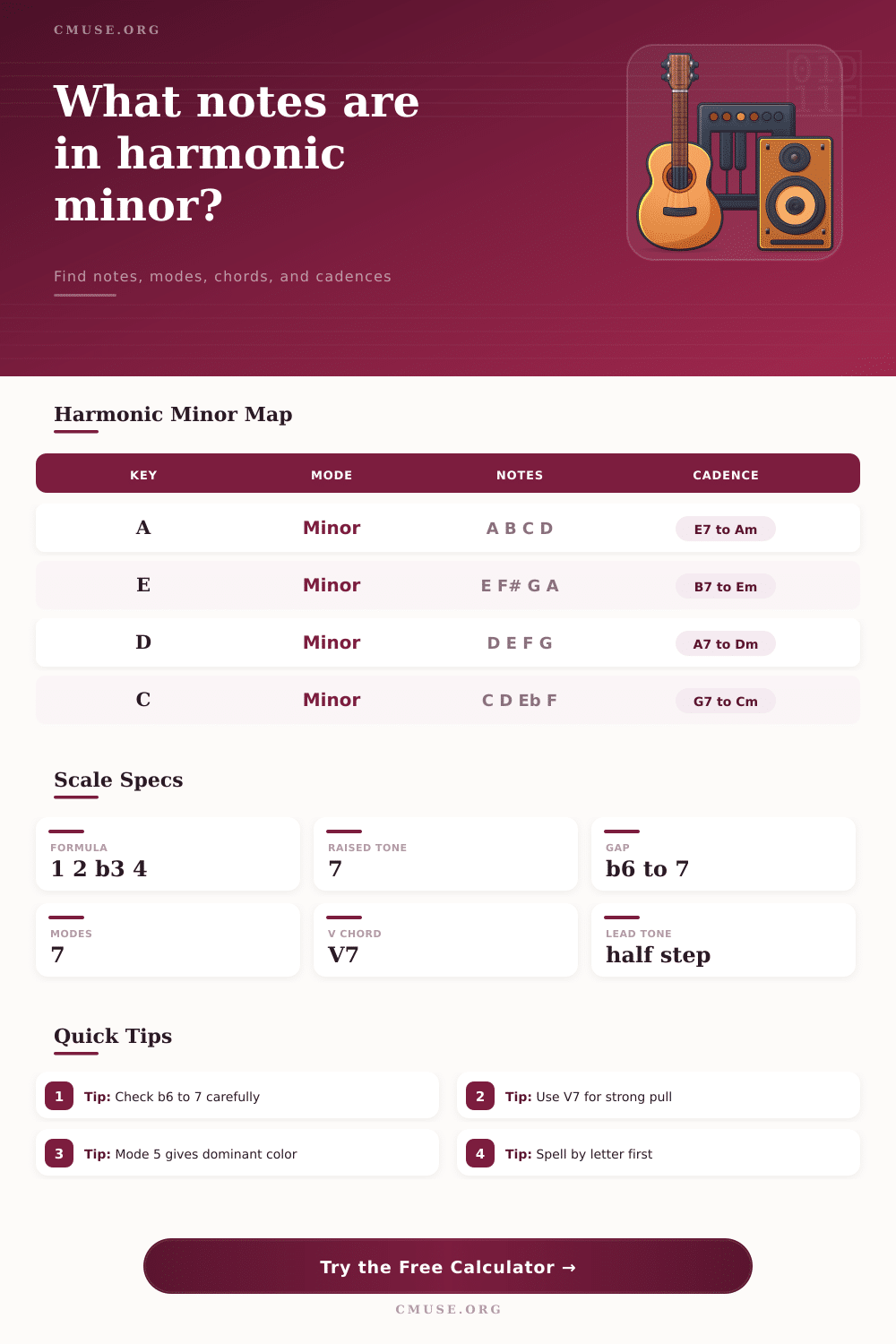
| A harmonic minor | A B C D E F G# | E G# B D | G# resolves to A |
| E harmonic minor | E F# G A B C D# | B D# F# A | D# resolves to E |
| D harmonic minor | D E F G A Bb C# | A C# E G | C# resolves to D |
| G harmonic minor | G A Bb C D Eb F# | D F# A C | F# resolves to G |
| C harmonic minor | C D Eb F G Ab B | G B D F | B resolves to C |
| F# harmonic minor | F# G# A B C# D E# | C# E# G# B | E# resolves to F# |
| Layout | Position Logic | Best Use | Calculator Output |
|---|---|---|---|
| Piano keyboard | One octave from selected starting octave | Reading scale spelling and cadences | Shows note names with octave labels |
| Guitar standard | Six-string fret scan in the selected window | Metal, classical, jazz, and fusion lead lines | Lists matching frets on each string |
| Bass standard | Four-string fret scan with low-register roots | Minor-key bass lines and dominant approaches | Shows compact fret ranges and root locations |
| Violin or mandolin | Fifths tuning across four strings | String writing, fiddle color, and mandolin shapes | Maps the same pitch class set by string |
| Nearest tonic box | Centers the window near the first visible tonic | Practicing resolution into the modal tonic | Highlights whether the tonic is inside the range |
The harmonic minor scale contain seven notes and is slightly differ from the natural minor scale. The harmonic minor scale contains a raised seventh degree. On the natural minor scale, the seventh degree contain a whole step from the tonic note.
However, on the harmonic minor scale, the seventh degree contains a half step from the tonic. This half step create a leading tone that pulls the note up to the tonic note. Because of this, the harmonic minor scale contains more tension then the natural minor scale.
How the Harmonic Minor Scale Works
The raised seventh degree within the harmonic minor scale also alters the chords within the scale. For example, within a key of A minor, the natural minor scale contains a G natural. However, within the harmonic minor scale, the G is raised to a G sharp.
This altered chord allow for the fifth degree of the scale to contain a dominant seventh chord that resolve to the tonic. This resolution creates a feeling of completion within the music. The harmonic minor scale contains seven different modes.
Each mode use the same notes as the scale but begins on a different note. For instance, the fifth mode of the harmonic minor scale are the Phrygian mode. The Phrygian mode use the raised seventh note of the harmonic minor scale as the third note in the mode.
The use of this note give the scale a sound that is often associate with Middle Eastern or Spanish music. Other modes include the third mode, which contains an augmented tonic note. The use of the same notes allows for each mode to be played by simply changing the tonic note.
When using the harmonic minor scale in music composition, the composer must use the correct spelling of the notes. The notes must be spelled correctly to maintain there alphabetical order. Using the incorrect spelling of the notes may make the music difficultly to read by other musicians.
Additionally, spelling the correct notes ensures that the raised seventh degree is a legitimate note in the scale. Finally, spelling the correct notes will make it easier for the composer to transpose the composed music. Cadences using the harmonic minor scale use different cadences than other scales.
For instance, a V7 chord that resolve to a i chord is a classical cadence. Additionally, a musician can use a leading tone diminished seventh chord to substitute for the dominant seventh chord. In both instances, the leading-tone diminished seventh chord will resolve its raised seventh degree to the tonic note.
Cadences create different level of tension within music. Therefore, the choice of which cadence to use can determine whether the music should be tense or resolve. The layout of musical instruments impact how the harmonic minor scale can be played.
For instance, the layout of the notes of the harmonic minor scale on a guitar differ from the layout of the same scale on a piano. When playing the scale, the instrument should be practiced within the specific register in which it will be played. A scale calculator can be used to determine the individual notes of the harmonic minor scale and the chords that is created by the scale.
Using the scale calculator, the specific notes of any given key can be viewed for the harmonic minor scale. Additionally, the calculator also display how the raised seventh degree alters the chords within that key. Once the individual notes and chords are understood, the composer can decide on their use of the tension create by the raised seventh degree of the scale.
The harmonic minor scale contains more options for the musician to create tension within their music than the natural minor scale. Therefore, using the harmonic minor scale, the composer must decide how to utilize these more additional options for creating tension within their music.