Pentatonic Scale Calculator
Build major, minor, suspended, Japanese, and blues-colored pentatonic scales with note names, formulas, modal rotations, relative pairs, and practical fretboard box positions.
Preset use: Load a common pop, rock, blues, jazz, folk, or guitar shape, then adjust the root, spelling, rotation, blue note, octave, and fretboard view.
Calculation Breakdown
| Pattern | Semitone Formula | Degree Formula | Common Color |
|---|---|---|---|
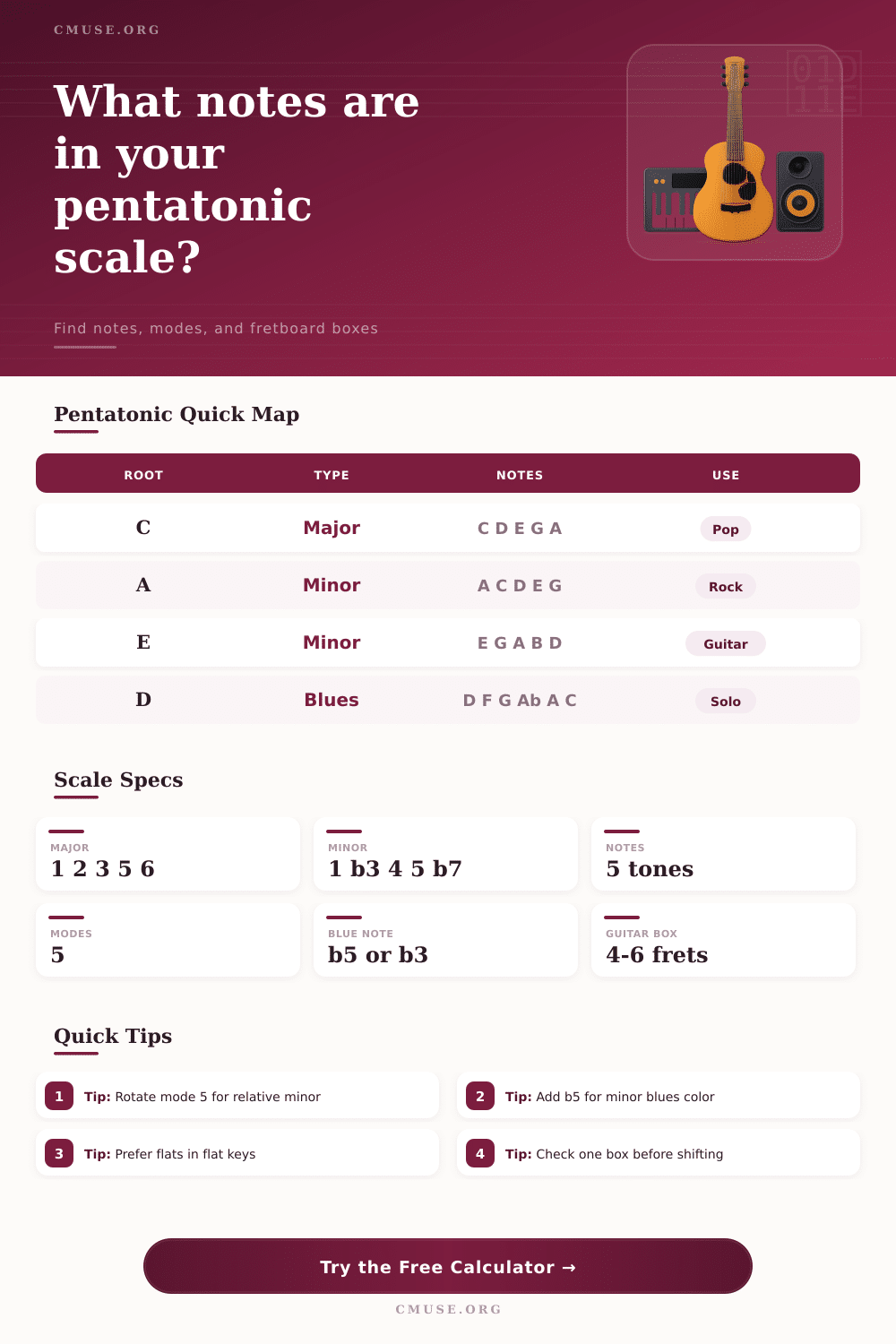
| Major pentatonic | 0 2 4 7 9 | 1 2 3 5 6 | Bright pop, folk, country, hymn-like lines |
| Minor pentatonic | 0 3 5 7 10 | 1 b3 4 5 b7 | Rock, blues, soul, modal minor melody |
| Suspended pentatonic | 0 2 5 7 10 | 1 2 4 5 b7 | Open sus and dominant-sus improvisation |
| Yo scale | 0 2 5 7 9 | 1 2 4 5 6 | Open folk color without a third |
| Hirajoshi | 0 2 3 7 8 | 1 2 b3 5 b6 | Compact Japanese pentatonic color |
| In-sen | 0 1 5 7 10 | 1 b2 4 5 b7 | Darker suspended Japanese color |
| Kumoi | 0 2 3 7 9 | 1 2 b3 5 6 | Minor color with a natural sixth |
| Iwato | 0 1 5 6 10 | 1 b2 4 b5 b7 | Dissonant suspended tritone color |
| Parent Scale | Scale Notes | Relative Pair | Typical Use |
|---|---|---|---|
| C major pentatonic | C D E G A | A minor pentatonic | Pop hooks, simple piano voicings |
| G major pentatonic | G A B D E | E minor pentatonic | Country guitar and vocal melody |
| D major pentatonic | D E F# A B | B minor pentatonic | Fiddle, mandolin, bright guitar parts |
| F major pentatonic | F G A C D | D minor pentatonic | Horn-friendly flat-key writing |
| Bb major pentatonic | Bb C D F G | G minor pentatonic | Brass, saxophone, gospel color |
| E minor pentatonic | E G A B D | G major pentatonic | Open-position guitar and bass riffs |
| Box View | Fret Window | Best For | Calculation Behavior |
|---|---|---|---|
| Open / first position | 0 to 4 | Open guitar, bass, mandolin, ukulele shapes | Shows every scale tone in the first four frets |
| Nearest root box | Root minus 2 to plus 3 | Fast movable scale shape around the tonic | Finds the lowest nearby root and centers a small box |
| 5th fret box | 5 to 10 | Mid-neck guitar and bass practice | Scans six frets from the fifth position |
| 9th fret box | 9 to 14 | Higher lead lines and closed-position shapes | Scans six frets from the ninth position |
| 12th fret box | 12 to 17 | Octave-repeat guitar visualization | Mirrors open-position relationships one octave up |
| Full 0-12 scan | 0 to 12 | Finding every available root and scale tone | Lists all matching frets through the octave repeat |
| Type | Avoided Tensions | Strong Chord Fit | Blue-Note Choice |
|---|---|---|---|
| Major pentatonic | 4 and 7 in major | Major, 6, 6/9, add9 | Add b3 for major blues passing color |
| Minor pentatonic | 2 and b6 in natural minor | Minor, m7, power chord, sus blends | Add b5 for minor blues vocabulary |
| Suspended pentatonic | 3 and 6 | 7sus, 9sus, quartal harmony | Usually keep the set clean |
| Yo scale | 3 and 7 | Sus, add9, open fifth drones | Avoid blue notes unless blending styles |
| Hirajoshi | 4 and b7 | Minor add9 with b6 color | Keep the close half-step color exposed |
| In-sen | 3 and 6 | Phrygian-sus and dominant-sus colors | Blue notes can overcrowd the pattern |
The pentatonic scale is a musical scale that contains only five note. The pentatonic scale is useful because it remove the two notes that create the strongest tension within a musical key. By removing those potentially tension filled notes, the pentatonic scale allows melodies and solos to contain a sense of clarity.
When using the pentatonic scale for a song or solo, there is many variables that must be considered. The first is the root note for the song. It is also necessary to choose whether the pentatonic scale will be a major or minor pentatonic scale.
How to Use the Pentatonic Scale Calculator for Guitar
Additionally, musician may also consider whether they would like to include a blue note in the scale. Other considerations include the octave for the song and the part of the fretboard that is most comfortabley for the guitarist to play the notes. In order to make it easier for guitar players to decide on these variables, the calculator will perform the mathematics calculation for the pentatonic scale once the guitarist has decided on each of these variables.
It will save the guitarist from having to calculate the rotations of the intervals of the pentatonic scale by theirselves. The parent root note for a pentatonic scale will determine the pitch class that will compose the pentatonic scale. The pattern selector will determine the intervals for the pentatonic scale.
This allow guitar players to select the type of pentatonic scale that they would like to use, such as major or minor pentatonic scale or even other variants of pentatonic scales, such as Japanese and folk pentatonic scales. Players who wish to write pentatonic scale for transposing instruments or whose songs use flat keys will select the spelling preference. Mode rotation will allow jazz and folk guitar player to change the type of pentatonic scale that they play from a major pentatonic scale to a minor pentatonic scale, for example, without having to move there fingers on the guitar fretboard.
The blue note option allow guitarists to add extra notes to the pentatonic scale. For example, adding a flat five to a minor pentatonic scale create a blues passing tone. Adding a flat three to a major pentatonic scale create a major blues sound.
These added blue notes are not part of the pentatonic scales structural notes, which is why they are an optional setting on the pentatonic scale calculator. The position choice for the pentatonic scale on the fretboard are also important. Using the open position box for pentatonic scale notes works well for songs that remain in the first position on the guitar fretboard.
However, it can become awkwardley for guitar players when they must move to a different position on the fretboard. The pentatonic scale calculator will map out the pentatonic scale across different windows on the calculator. The pentatonic scale calculator will display which layout for the pentatonic scale has multiple root within the frets that the guitarist uses for the song.
It is a common mistake to believe that all pentatonic scales can be used interchangeable in a song. While a relative major pentatonic scale and a relative minor pentatonic scale use the same pitch class, they imply different chord and evoke different emotion when played. The pentatonic scale calculator will show the relationship between the major and minor pentatonic scales to help guitarists decide what type of sound they would like to create for their song.
Additionally, the calculator will show which notes in the pentatonic scale are skipped. Seeing which notes are skipped within the pentatonic scale will allow guitarists to understand why certain chords dont appear to belong to that scale. Although the pentatonic scale calculator allow guitarists to easily create pentatonic scale pattern for their songs, the guitarist must still consider how the pentatonic scale will interact with the remainder of the song.
The calculator provide the raw material for the pentatonic scale; however, it is up to the guitarist to decide how that scale will interact with the other element of the song. One useful habit for guitarists is to run the same root note through two different pentatonic scale patterns. Another useful habit is to run the same root note through two different mode rotations for the pentatonic scale.
By comparing the two pattern, guitarists can better understand the personality of the pentatonic scale. The pentatonic scale works because it removes friction for guitarists and songwriters to play solos and write melodies. When guitarists understand the type of friction that the pentatonic scale remove, the decision process for creating pentatonic scales becomes much more simpler.