Exotic Scale Calculator
Transpose uncommon scales, rotate modal step patterns, inspect altered degrees, compare against familiar collections, and generate octave note maps for writing, arranging, and practice.
Preset use: Load a real scale, then change root, spelling, mode rotation, octave span, and comparison target to examine its note content and interval color.
Calculation Breakdown
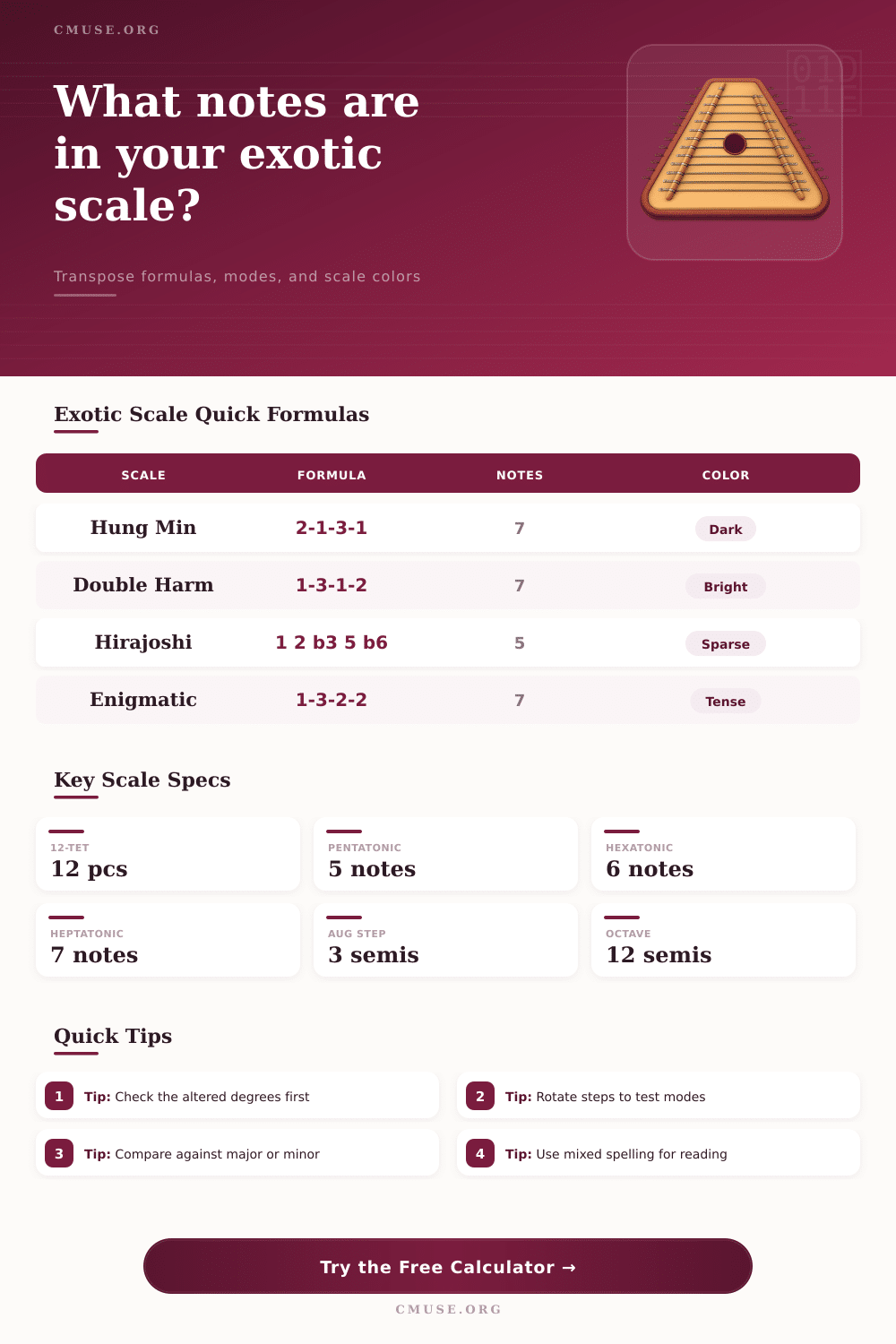
| Scale | Interval Formula | Step Pattern | Common Color |
|---|---|---|---|
| Hungarian minor | 1 2 b3 #4 5 b6 7 | 2-1-3-1-1-3-1 | Minor with raised 4 and leading tone |
| Double harmonic major | 1 b2 3 4 5 b6 7 | 1-3-1-2-1-3-1 | Symmetric augmented-second color |
| Byzantine | 1 b2 3 4 5 b6 7 | 1-3-1-2-1-3-1 | Same pitch formula as double harmonic major |
| Persian | 1 b2 3 4 b5 b6 7 | 1-3-1-1-2-3-1 | Double harmonic color with lowered 5 |
| Neapolitan minor | 1 b2 b3 4 5 b6 7 | 1-2-2-2-1-3-1 | Minor scale with flat 2 and major 7 |
| Enigmatic | 1 b2 3 #4 #5 #6 7 | 1-3-2-2-2-1-1 | Very bright altered dominant tension |
| Scale | Interval Formula | Step Pattern | Useful Anchor Tones |
|---|---|---|---|
| Hirajoshi | 1 2 b3 5 b6 | 2-1-4-1-4 | Root, b3, 5, b6 |
| Insen | 1 b2 4 5 b7 | 1-4-2-3-2 | Root, b2, 4, b7 |
| Iwato | 1 b2 4 b5 b7 | 1-4-1-4-2 | Root, b2, b5, b7 |
| Pelog | 1 b2 b3 5 b6 | 1-2-4-1-4 | Root, b2, b3, 5 |
| Ukrainian dorian | 1 2 b3 #4 5 6 b7 | 2-1-3-1-2-1-2 | b3, #4, 6, b7 |
| Altered Degree | Semitone | Sound Tendency | Scales That Feature It |
|---|---|---|---|
| b2 | 1 | Close upper-neighbor tension above the tonic | Double harmonic, Insen, Iwato, Persian |
| b3 | 3 | Minor color or blues-adjacent gravity | Hungarian minor, Hirajoshi, Pelog |
| #4 / b5 | 6 | Tritone center, bright or unstable axis | Hungarian minor, Iwato, Persian |
| b6 / #5 | 8 | Dark sixth or augmented-fifth pressure | Double harmonic, Pelog, Enigmatic |
| 7 | 11 | Strong leading tone into the tonic | Hungarian minor, Persian, Neapolitan minor |
| Use Case | Scale Choice | Example Root | Starting Notes |
|---|---|---|---|
| Dark minor lead line | Hungarian minor | A | A B C D# E F G# |
| Bright dramatic cadence | Double harmonic major | C | C Db E F G Ab B |
| Sparse pentatonic texture | Hirajoshi | E | E F# G B C |
| Tritone-centered motif | Iwato | D | D Eb G Ab C |
| Altered dominant color | Enigmatic | G | G Ab B C# D# F F# |
Exotic scale fall outside of the realm of major and minor scale that musicians learn in their earliest years. These scale contain interval that are different than the musician’s fingers and to the musician’s ears. Some exotic scale contain only one altered note, such as a raised fourth or a lowered second.
These type of intervals can make a melody sound tense or luminous. In order to succesfully use exotic scale within the music you compose, a musician must understand how the alterations to the major and natural minor scale move to a new key and how those alteration behave within each mode. For this purpose, the exotic scale calculator allow the user to perform the calculation associated with exotic scales once the musician has chosen the root of the scale, the exotic scale’s step pattern, and the collection to which it will be compare.
How to Use Exotic Scales and the Scale Calculator
The root will determine the tonic of the scale that the exotic scale is based upon. Mode rotation can help to shift the exotic scale’s step pattern so that a new note within the scale becomes the tonic of the scale. Finally, by comparing the exotic scale to another scale within music, such as a major scale, musicians can understand another type of exotic scale.
Many exotic scales have been used in music from different region of the world for many centuries before the existence of music theory textbook that contain information regarding these scale. For instance, Hungarian minor scale are often found in Eastern European folk music due to its characteristic raised fourth and major seventh note. Double harmonic major scale are often used in Middle Eastern and Mediterranean music for its characteristic bright edge created by the augmented second between the second and third scale degree of the scale.
Japanese pentatonic scale, such as Hirajoshi or Insen, are often used within traditional form of Japanese music, such as koto and shakuhachi music due to their use of fewer notes than the other scale so that the player can shape the music with these notes. By loading an exotic scale into the tool and rotating it to each mode, musicians can understand which tonic of which scale best establish the exotic scale as the home note of the piece. The musical work begin after the exotic scale appears as the melody.
The altered degree of the exotic scale will impact the chords surrounding the exotic scale note. For instance, a flat second degree above the root of the scale will create tension between that scale note and the major third of the scale. The same is true of the raised fourth note of the exotic scale; it will impact the music in different ways depending on the chord that come beneath the raised fourth note.
In these cases, the calculator will make note of how the exotic scale’s altered degree will impact the music, but it is up to the musician to decide whether the musical line require tension or whether it needs to have a gentler color. In addition to these change, the musician can change the preference with which the altered note are spelled out in the score. In some instance, altering the spelling of the exotic scale will make the musical passage easy to read than if the exotic scale were left as is.
In addition to the altered scale, musicians can also alter the range of the exotic scale that is displayed on the page. By extending the exotic scale to two or three octave, the musician will have different consideration for each instrument with which they play the exotic scale. For instance, on a guitar, each octave of the exotic scale may have different fingerings from another octave within the same scale.
However, on a piano, the grouping of black keys will change with each extended octave of the exotic scale. By selecting the desired range of the exotic scale with octaves, musicians can see the exotic scale in its entirety and understand whether the melodic line is appropriate for that range of the instrument. Some of the most common mistake made by musicians using exotic scale is treating the exotic scale as if it should always use its original tonic note, even if they are not the tonics of the melodies with which they wish to use that exotic scale.
Additionally, musicians may make the same mistake in all octave of the exotic scale, leading to issue like double sharps that are challenging for other musicians to read. To fix these issue, musicians can use the mode rotation and altered degree functions of the tool to determine which exotic scale should be used in what mode with what tonic note. The goal for musicians who use exotic scale on musical composition and line is not to collect as many exotic scale as possible.
Instead, musicians should seek to understand how exotic scale alteration impact the music that they already play. Based off the understanding of exotic scales’ altered degree, musicians can decide whether the tension or brightness that exotic scale provide to their music is appropriate for the melodic line that they are composing.