Church Mode Calculator
Build Ionian, Dorian, Phrygian, Lydian, Mixolydian, Aeolian, and Locrian scales from any final, then compare parent keys, characteristic tones, modal chords, cadence options, and chant-style references.
Preset use: Load a real modal writing situation, then adjust the final, mode, spelling, register, harmony format, cadence focus, and melody anchor.
Calculation Breakdown
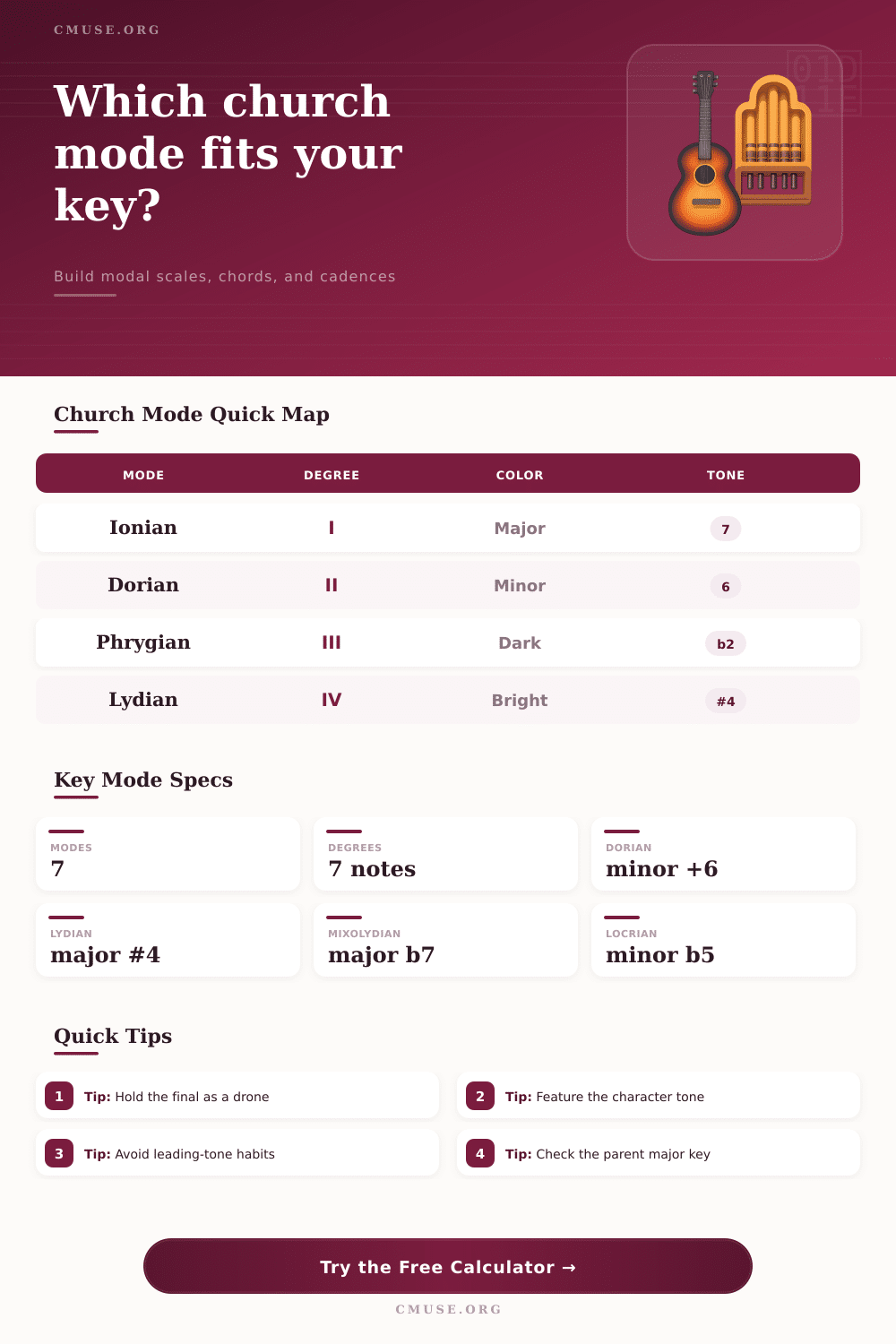
| Mode | Major Scale Degree | Interval Formula | Characteristic Color |
|---|---|---|---|
| Ionian | I | 1, 2, 3, 4, 5, 6, 7 | Stable major seventh pull |
| Dorian | II | 1, 2, b3, 4, 5, 6, b7 | Minor mode with natural 6 |
| Phrygian | III | 1, b2, b3, 4, 5, b6, b7 | Dark half-step above final |
| Lydian | IV | 1, 2, 3, #4, 5, 6, 7 | Bright raised fourth |
| Mixolydian | V | 1, 2, 3, 4, 5, 6, b7 | Major mode with flat 7 |
| Aeolian | VI | 1, 2, b3, 4, 5, b6, b7 | Natural minor color |
| Locrian | VII | 1, b2, b3, 4, b5, b6, b7 | Unstable diminished final chord |
| Mode | Tonic Chord | Useful Modal Chords | Cadence Shape |
|---|---|---|---|
| Ionian | I major or Imaj7 | IV, V, vi, ii | I - IV - V - I |
| Dorian | i minor or i7 | IV, bVII, ii, v | i - IV - i |
| Phrygian | i minor or i7 | bII, bvii, iv | i - bII - i |
| Lydian | I major or Imaj7 | II, vii, V | I - II - I |
| Mixolydian | I major or I7 | bVII, IV, v | I - bVII - I |
| Aeolian | i minor or i7 | bVI, bVII, iv, v | i - bVII - bVI - i |
| Locrian | i diminished or m7b5 | bII, iv, bVI | i dim - bII - i dim |
| If Final Is C | Parent Major Key | Mode Degree | Shared Key Signature |
|---|---|---|---|
| C Ionian | C major | I | No sharps or flats |
| C Dorian | Bb major | II | Bb, Eb |
| C Phrygian | Ab major | III | Bb, Eb, Ab, Db |
| C Lydian | G major | IV | F# |
| C Mixolydian | F major | V | Bb |
| C Aeolian | Eb major | VI | Bb, Eb, Ab |
| C Locrian | Db major | VII | Bb, Eb, Ab, Db, Gb |
| Preset Type | Mode Center | Main Result | Secondary Result |
|---|---|---|---|
| Gregorian chant line | D Dorian | D E F G A B C | A reciting tone |
| Renaissance close | G Mixolydian | G A B C D E F | F natural color |
| Minor folk melody | A Aeolian | A B C D E F G | F and G colors |
| Floating film cue | F Lydian | F G A B C D E | B raised fourth |
| Modern modal vamp | C Dorian | C D Eb F G A Bb | A natural sixth |
| Dark riff writing | E Phrygian | E F G A B C D | F flat second |
Church modes exists in music as a means of creating melodies and harmonies that dont use the major and minor scales. Major and minor scales includes a leading tone, which resolves to the final note of the scale. Church modes, however, do not use a leading tone.
Instead, each mode include a different type of distinguishing note that gives each mode its characteristic color to the music that utilizes that mode. Furthermore, each type of distinguishing note alter the way that music based off that mode is to be felt and in what ways that musical phrase land. The calculator can perform the same type of musical calculation for you that you would otherwise have to manually perform yourself.
How to Use Church Modes
Each of the inputs that you make to the calculator reflect the decision that a musician makes when creating music. For instance, each type of church mode include a different type of note that is located outside of the final note of that mode. If Dorian mode is chosen, for instance, the mode will include the natural sixth note as a way to differentiate Dorian from Aeolian mode.
If Lydian mode is chosen, the note located at the fourth of the scale will be raised, creating a bright sound to the music that utilizes that mode. The field for the parent key will display the major scale that contains the notes of the chosen church mode. This field is helpful in determining the type of accidentals that will be utilized to create chord for that mode.
Each of the cadence options allow for the depiction of how different era of music incorporated the final note of that mode. For instance, the Renaissance era used plagal cadences, whereas moddern modal vamps often do not use any cadence at all. Each of these options allow for individuals to hear which type of cadence may enhance the mood of the music that is being create.
Additionally, each of the options for the reciting tone allow individuals to understand in which mode the chant utilized that note for it’s lyrics. Furthermore, each of the church modes also have an impact upon the color of chords that are created within that mode. For instance, Dorian mode utilize a tonic minor chord in addition to a major IV chord, creating a bright sound.
Mixolydian mode utilize major chords in place of tonic chords, but replaces the leading tone with a flat seventh note. Each of these types of chords is represented in the comparison table for each mode. Furthermore, these types of chords exist in each of the tables due to the nature of each mode and the type of chords that each mode support.
Thus, individuals can make decisions about which voicing to use for each type of chord to highlight the Locrian mode, for instance. Finally, music based upon church modes is often not contained to that specific mode throughout entire works of music. For instance, a melody may exist within Phrygian mode for the majority of its length, but may borrow the raised sixth from Dorian mode for only a single phrase.
Each of the clean version of each mode are provided by the calculator to allow individuals to make decisions about where within music they would like to change modes. Furthermore, each of the types of church modes can be utilized in tasks beyond creating music that exists within a single mode at a time. For instance, old music can be transcribed from one mode to another, as can melodies be created over drones.
Each of the modes have notes that are located a fifth below each of the final notes of each mode, as well as notes that are located a reciting tone below each final note of each mode. Both of these notes can be targeted within musical phrases. However, individuals will still have to make a decision about the amount of tension that is created before the notes return to the final note of that mode.
Each of the modes require some patience to allow listeners to become accustomed to the character tone of that mode. For instance, Locrian mode contains a diminished fifth note that create the instability of the mode. Utilizing that note too early within a composition may create the sound of a melody that contains a minor scale with a wrong note.
However, utilizing that same note in a drone over the final note of that mode allows the flat fifth to be utilized in the middle of musical phrases, which listeners will accept as a type of musical color. An additional benefit of incorporating modes to music is the flexibility that each mode provide performers. Once individuals understand how each mode is constructed, they can move from one mode to another within a composition, maintaining the original melody.
Furthermore, the use of the calculator to determine each of these element removes the need for individuals to utilize arithmetic to determine these elements. Instead, they can focus upon the decision of which musical color will best enhance their compositions.