Diatonic Chord Calculator
Build scale-based triads, sevenths, and ninth chords from a key or mode, then check chord spelling, Roman numeral, inversion, scale degrees, and harmonic function.
Preset use: Load a common harmonic job, then change the tonic, mode, degree, chord size, inversion, spelling preference, and octave range.
Calculation Breakdown
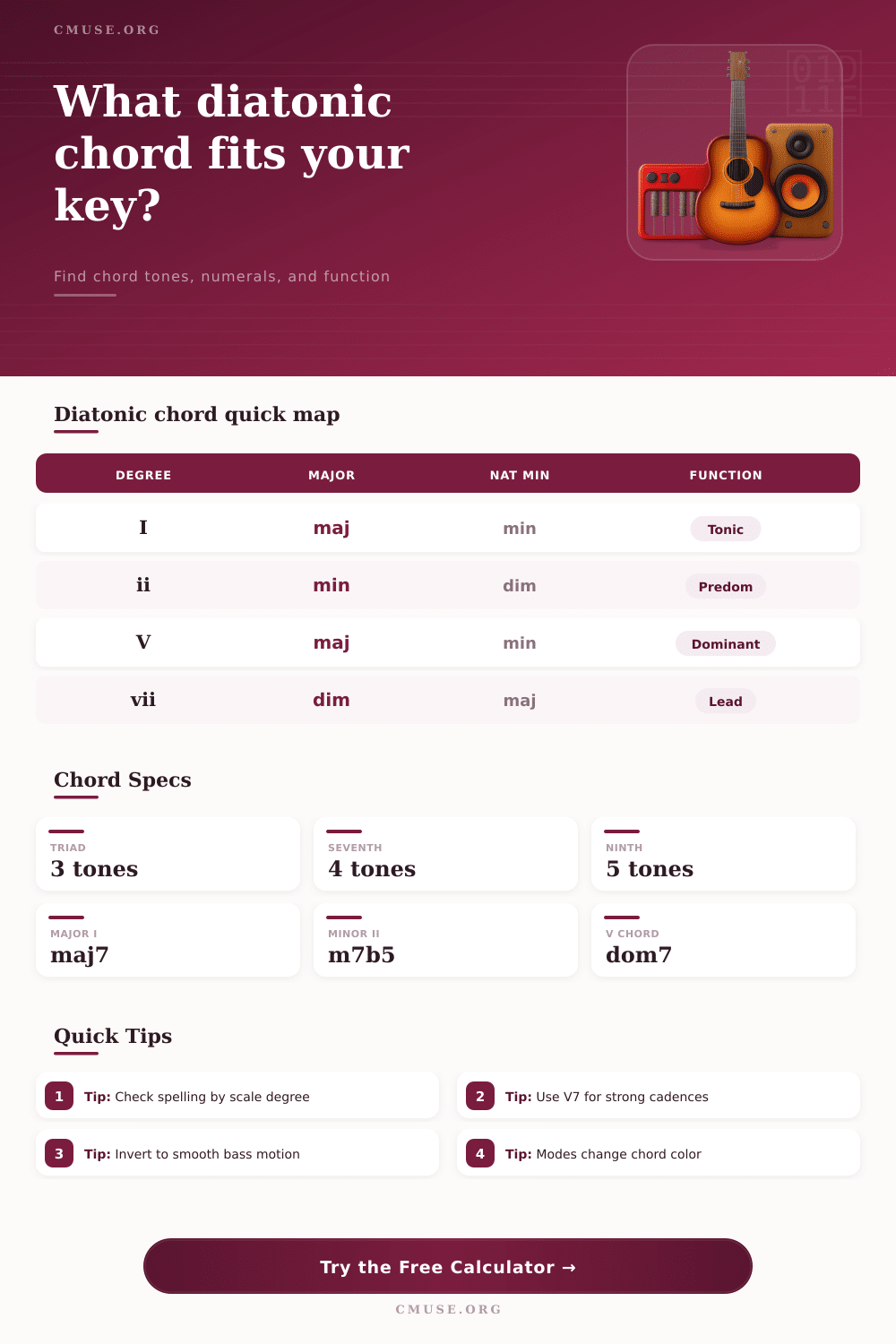
| Degree | Major Key Triad | Natural Minor Triad | Common Function |
|---|---|---|---|
| 1 | I major, Imaj7 | i minor, i7 | Tonic center or home chord |
| 2 | ii minor, ii7 | ii diminished, ii half-diminished 7 | Predominant approach to V |
| 3 | iii minor, iii7 | III major, IIImaj7 | Tonic extension or mediant color |
| 4 | IV major, IVmaj7 | iv minor, iv7 | Subdominant or predominant area |
| 5 | V major, V7 | v minor, v7 | Dominant in major, softer dominant in minor |
| 6 | vi minor, vi7 | VI major, VImaj7 | Relative-minor color or submediant |
| 7 | vii diminished, vii half-diminished 7 | VII major, VII7 | Leading-tone pull or subtonic color |
| Mode | Scale Formula | Signature Chord Color | Useful Diatonic Check |
|---|---|---|---|
| Ionian / Major | 1 2 3 4 5 6 7 | Imaj7 and V7 | Stable tonic plus strong dominant |
| Dorian | 1 2 b3 4 5 6 b7 | i7 with natural 6 | IV major separates it from natural minor |
| Phrygian | 1 b2 b3 4 5 b6 b7 | bII major | Second degree chord is the modal color |
| Lydian | 1 2 3 #4 5 6 7 | Imaj7#11 | Second degree is major instead of minor |
| Mixolydian | 1 2 3 4 5 6 b7 | I7 | Tonic chord is dominant seventh quality |
| Aeolian / Minor | 1 2 b3 4 5 b6 b7 | i7 and bVImaj7 | Minor tonic with no raised leading tone |
| Locrian | 1 b2 b3 4 b5 b6 b7 | i diminished | Tonic triad contains a lowered fifth |
| Position | Triad Bass | Seventh Bass | Figured-Bass Shortcut |
|---|---|---|---|
| Root position | Root | Root | 5/3 for triads, 7 for sevenths |
| 1st inversion | Third | Third | 6 for triads, 6/5 for sevenths |
| 2nd inversion | Fifth | Fifth | 6/4 for triads, 4/3 for sevenths |
| 3rd inversion | Not used | Seventh | 4/2 or 2 for seventh chords |
| 4th inversion | Not used | Ninth chord only | Ninth in the bass for extended stacks |
| Progression Job | Key Example | Chord Degrees | What To Verify |
|---|---|---|---|
| Pop loop | C major | I V vi IV | All four triads stay inside the major scale |
| Jazz turnaround | Eb major | ii7 V7 Imaj7 | Second, fifth, and first degrees form the cadence |
| Minor cadence | E harmonic minor | i iv V7 i | Raised seventh creates a major V chord |
| Modal vamp | D Dorian | i7 IV7 | Natural sixth keeps the IV chord major |
| Mixolydian groove | Bb Mixolydian | I7 bVII | Tonic dominant quality comes from flat seventh |
A diatonic chord are a chord that uses the notes from a specific scale. When composing music, musicians must use notes from the scale for the chord to sound good. When musicians lose track of the notes in a scale, espeshially when the key changes, a diatonic chord tool becomes very helpful in determine the proper chord notes for the scale that a musician chooses.
A diatonic chord is create by taking every other note in the scale chosen by the musician. Additionally, a diatonic chord always starts on a specific degree of the scale chosen by the musician. For instance, the first degree of a major scale create a major chord, but the first degree of a natural minor scale creates a minor chord.
Diatonic Chords and How a Chord Calculator Helps
The difference between these two types of chords is that the third note of a minor chord is a half step lower than the third note of a major chord. The calculator will do the math for the musician to determine the correct chords for the scale chose by the musician. Each mode contains its notes, but each mode also changes the chords that are created from those scales.
For instance, the Dorian mode features the sixth note of the scale as a natural note and lowers the seventh degree of the natural minor scale. As a result, the chord that is created on the fourth degree of the scale is a major chord rather than a minor chord. The same is true for the Phrygian mode.
The Phrygian mode feature lowers the second degree of the scale, changing the chord created on that second degree to a major chord. These alteration of the notes of the modes create the differences in the sounds that is created from the modes. Each chord in a progression has a specific function within that song.
There are tonic chords, predominant chords, and dominant chords. Tonic chords establish a sense of rest for the listener, dominant chords create a pull on the listener for the next chord in the progression, and predominant chords prepares the ear for the pull that a dominant chord will create. By choosing a specific degree and mode for the chord that a musician creates, the chord calculator will tell a musician not only the quality of the chord but its function in the song.
This information is helpful to understand that a chord that is minor on the fifth degree of the scale will not resolve in the same manner than a major chord on the fifth degree of the scale. This information allows a musician to understand if a chord progression for their song needs to feature more tension or if it need to relax. The inversions of a chord change the order of the chord notes.
However, using inversions does not change the identity of a chord. For example, if the musician moves the third note of a chord to the bass of the chord, the arrival of the chord may be softer and the transition between two chords may be smoother. Chord calculators show the bass note of a chord created through inversions.
Additionally, chord calculators also keep track of how many notes is in a chord. This information is helpful for musicians who want to add a seventh note or a ninth note to a chord without creating a chord note that already exists in the scale. The most common mistake made by musicians is using the chord symbol as the chord that should be used within a song.
For instance, a G7 chord can have a dominant function if it is within the key of C major. However, a G7 chord within the key of F major is actualy a borrowed chord from another key. The degree of the scale that it is on and the mode of the scale determine the function of a chord within a song.
Using the chord symbol alone does not determine the function of that chord within the song. To avoid confusion in writing chord progressions, check the parent scale of the chord and the Roman numeral associate with it. The assumption is that each mode contains only one note that is changed from the major scale.
However, this is not always true. For instance, the Lydian mode raises the fourth degree of the major scale. As a result, the chord on the second degree of the scale becomes a major chord rather than a minor chord.
This changes the flavor of that chord from predominant to one of floating notes. These signature flavors of the modes can be found in reference materials on modes and there alterations to the major scale. Musical compositions do not always remain in the same mode.
A song may move from one mode to another mode within the song. For instance, a verse of a song may use the Dorian mode and the chorus may borrow a note from the harmonic minor scale to create a different chord progression. Using a chord calculator to test out the different versions of the chord will allow musicians to decide whether a song needs to feature more brightness or gravity in its chord progressions.
Additionally, the chord calculator results can show the theoretical, strict spelling of the chord notes. Some readers of chord progressions may want each note of a chord to be represented in the musical key that it is played in. A chord calculator application or tool can be used to check the math for musicians.
However, it is up to the musician to decide if the function of the chord that is used in a song is appropriate for the music that they are producing. For instance, it is up to the musician to decide if the chord should be inverted to help the bass line of the song. However, a chord calculator will remove the arithmetic for musicians so that they can make their own musical and artistic decisions for their compositions.