Parallel Key Calculator
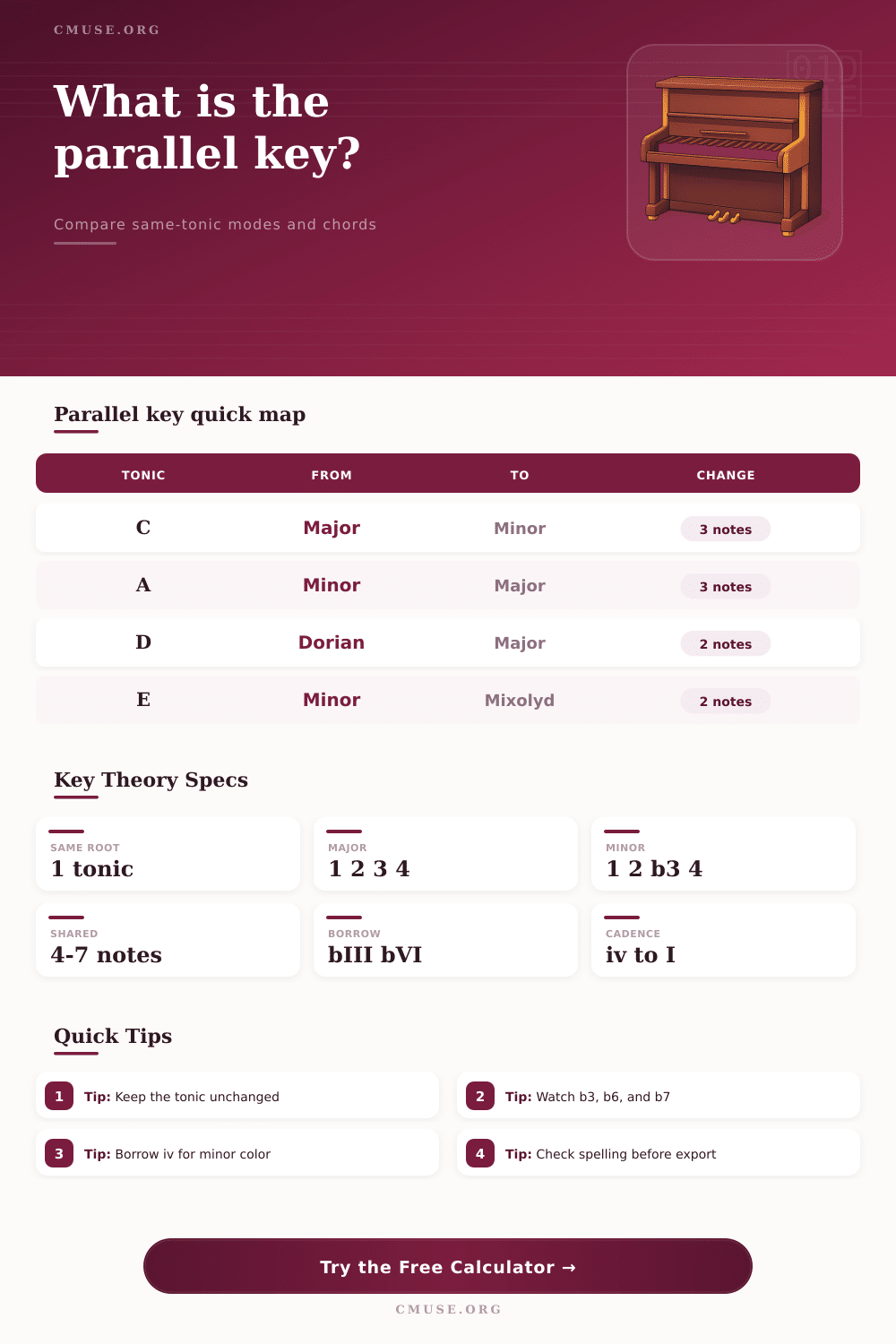
Compare same-tonic major, minor, and modal keys, then see changed scale degrees, key signatures, shared notes, borrowed chords, and melody-note fit.
Preset use: Load a common composition, arranging, film cue, or songwriting move, then adjust the tonic, source mode, target mode, chord depth, and melody note.
Calculation Breakdown
| Mode Or Key | Scale Formula | Compared With Major | Common Parallel Use |
|---|---|---|---|
| Major / Ionian | 1 2 3 4 5 6 7 | No altered degrees | Bright home key and default diatonic set |
| Natural minor / Aeolian | 1 2 b3 4 5 b6 b7 | b3, b6, b7 | Minor-mode contrast and classic modal mixture |
| Harmonic minor | 1 2 b3 4 5 b6 7 | b3, b6 | Minor tonic with leading-tone dominant |
| Melodic minor ascending | 1 2 b3 4 5 6 7 | b3 | Minor color with major sixth and seventh |
| Dorian | 1 2 b3 4 5 6 b7 | b3, b7 | Minor color with a brighter natural sixth |
| Phrygian | 1 b2 b3 4 5 b6 b7 | b2, b3, b6, b7 | Dark parallel color and flat-two gestures |
| Lydian | 1 2 3 #4 5 6 7 | #4 | Bright film, jazz, and suspended major color |
| Mixolydian | 1 2 3 4 5 6 b7 | b7 | Dominant-flavored major and rock harmony |
| Borrowed Chord | In C Major Example | Source Degree | Typical Function |
|---|---|---|---|
| i | Cm | b3 from minor | Direct color change from tonic major to tonic minor |
| ii° | Ddim | b6 in the chord | Minor predominant color before V or I |
| bIII | Eb | b3 and b7 color | Mediant mixture and film-score lift |
| iv | Fm | b6 against major tonic | Classic borrowed predominant before I |
| bVI | Ab | b6 foundation | Stable dramatic color and deceptive motion |
| bVII | Bb | b7 foundation | Backdoor, rock, and mixolydian-adjacent color |
| Comparison | Same Tonic? | Signature Relationship | Best Reading |
|---|---|---|---|
| Parallel major and minor | Yes | Minor has 3 more flats or 3 fewer sharps | Same root, different third, sixth, and seventh |
| Relative major and minor | No | Same key signature | Different tonic inside the same note collection |
| Modal parallel | Yes | Depends on mode formula | Same root with one or more modal degrees altered |
| Enharmonic parallel | Yes by pitch | May spell differently | Useful when smart spelling chooses flats or sharps |
| Picardy third | Yes | Minor phrase resolves to major tonic | Only the final tonic third changes to major |
| Writing Situation | Parallel Move | Primary Result | Secondary Result |
|---|---|---|---|
| Pop chorus lift | A minor to A major | C# and F# brighten the hook | Keep E as a stable dominant anchor |
| Film cue dark turn | C major to C minor | Eb, Ab, and Bb change the color | Borrow iv or bVI for transition bars |
| Jazz modal vamp | D Dorian to D minor | Bb replaces B natural | i, iv, and bVII remain easy pivots |
| Rock dominant color | E major to E Mixolydian | D natural replaces D# | bVII to I becomes available |
| Classical cadence color | F minor to F major | A natural creates Picardy color | C major V stays available in both |
Parallel keys uses scales that have the same tonic note, but they change the scale degree surrounding that tonic note. Composers use the concept of changing scale degree but maintaining the tonic note of a scale. For example, the composer can change a C major scale to a C minor scale.
The result of this change in scale is felt in the music composed with these change scale degrees; the emotional quality of the music change. Through the calculator, the composer can understand the changes that occur to create a new scale through mathematical calculation. Each of the element of a scale can be selected; the tonic note, the starting notes for the scale, and the destination key for that scale.
Parallel Keys and the Key Calculator
Each of the modes for the scale can be selected; the mode that will be used for the source scale, and the target mode for the new key. Scale degrees change between the source and target scale mode; however, the tonic remains the same and the number of sharps and flats in the scale change according to the target mode. Changes in the number of sharps and flats changes the number of notes within the scale that must be respelled to change key.
Each of the scale that contain shared notes can be recognized by those shared notes between the source and target keys. Within a scale contain 7 pitches, 4 of which are shared between the source and target keys. The calculator shows these shared notes for the composer to determine which scale notes can remain within the music, and which notes within the melody must be changed according to the new scale.
Additionally, borrowed chord can be used within these scales. For example, a chord from a parallel minor scale can be used within a composition that is using the parallel major key; however, the borrowed chords will only sound correct if the composer has established the home key for the composition. The calculator make it possible for the composer to determine which chord are borrowed chords.
The calculator allows the composer to also test melodies to determine how each note within that melody will interact with the new mode for the composition. Each of the notes within a melody may be within the new mode, or each of the notes may lie outside of the new mode for that composition. Notes outside of the mode will create tension within the music.
For instance, the arranger can check each of the notes in a melody to determine if they belongs to the mode for the scale; if they do not belong, the arranger will know that an accidental is required for that note. For example, if a melody contains an F natural in the key of C major, the arranger will know if the F natural must be changed to an F flat when changing mode to C minor. Thus, the calculator will prevent accidental clash for the musicians that are to play the composition.
Another decision that the composer must make is for how long to stay in that parallel key. Staying in the key for a short time will create one effect to the composition, but staying in that key for a long time may create the feeling of a completely different composition. The calculator includes a setting to determine for how many bar the composer must look to proofread the music following a change of keys.
While many composer or musicians may make mistakes when using keys, understanding the difference between one type of key and another can help the composer avoid mistake. For instance, the mistakes include treating the concept of parallel keys and relative keys as if they are the same. While scales within parallel keys will contain the same tonic note, relative keys will have the same key signature.
Thus, if a composer chooses a relative key instead of a parallel key, that tonic will move, and it will no longer be the center of the composition. Additionally, another mistake is to forget borrowed chords must resolve according to the target mode for the music. Overall, the benefit of using parallel keys is that a single tonic note allow a composer to create many different emotion from the music.
Because the tonic will remain the same for the composition, the listener wont have to find the tonic for each section of the composition. Thus, the calculator helps the composer to avoid the arithmetic calculation of the keys, and focus upon the emotion that they wish to extract from the music for the listener.