Key Signature Flats Calculator
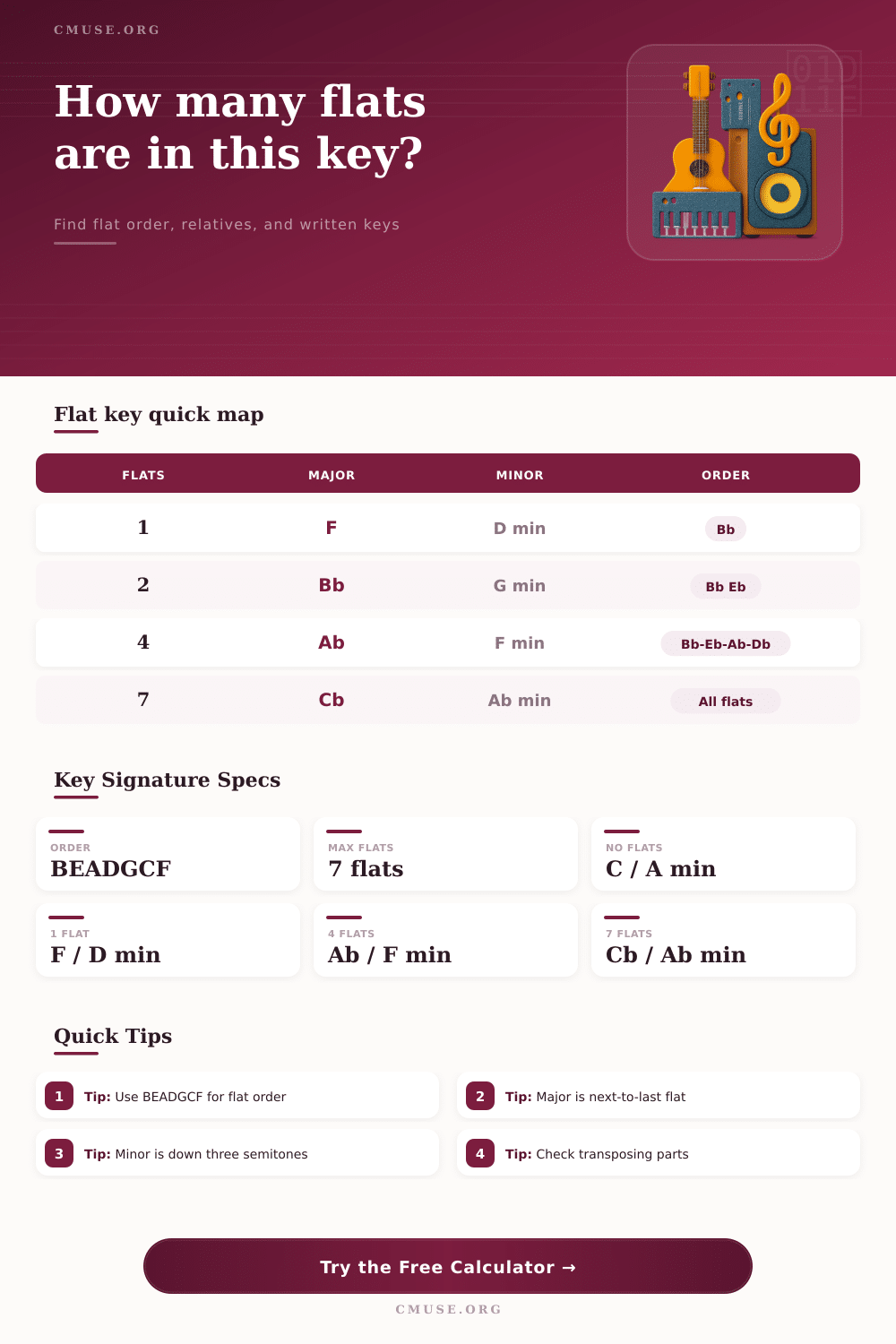
Find the flat count, order of flats, relative key, modal parent, enharmonic choice, and transposed written key for flat-side major, minor, and modal signatures.
Preset use: Load a real flat-side signature, minor key, mode, or transposing-instrument example, then adjust the key and notation inputs for your score.
Calculation Breakdown
| Flats | Major Key | Relative Minor | Flats In Order |
|---|---|---|---|
| 0 | C major | A minor | No sharps or flats |
| 1 | F major | D minor | Bb |
| 2 | Bb major | G minor | Bb, Eb |
| 3 | Eb major | C minor | Bb, Eb, Ab |
| 4 | Ab major | F minor | Bb, Eb, Ab, Db |
| 5 | Db major | Bb minor | Bb, Eb, Ab, Db, Gb |
| 6 | Gb major | Eb minor | Bb, Eb, Ab, Db, Gb, Cb |
| 7 | Cb major | Ab minor | Bb, Eb, Ab, Db, Gb, Cb, Fb |
| Mode | Parent Major Relationship | Example Flat Signature | Useful Reading |
|---|---|---|---|
| Major / Ionian | Same tonic as parent major | Ab major has 4 flats | The named key is the parent key. |
| Natural minor / Aeolian | Parent major is up a minor third | F minor uses Ab major | Same signature, different tonic center. |
| Dorian | Parent major is down a whole step | F dorian uses Eb major | Minor color with raised sixth. |
| Phrygian | Parent major is down a major third | G phrygian uses Eb major | Minor color with lowered second. |
| Mixolydian | Parent major is down a perfect fifth | Bb mixolydian uses Eb major | Major color with lowered seventh. |
| Instrument Type | Written Shift | Concert F Major Reads As | Flat Check |
|---|---|---|---|
| C instrument | No shift | F major | 1 flat |
| Bb clarinet or trumpet | Write up M2 | G major | No flats, 1 sharp |
| Eb alto or bari sax | Write up M6 | D major | No flats, 2 sharps |
| F horn | Write up P5 | C major | 0 flats |
| A clarinet | Write up m3 | Ab major | 4 flats |
| Rule Or Clef | What To Read | Flat Sequence | Best Use |
|---|---|---|---|
| Order of flats | Names added left to right | Bb, Eb, Ab, Db, Gb, Cb, Fb | Writing or checking any flat signature. |
| Major key shortcut | Use the next-to-last flat | Works from 2 through 7 flats | Fast reading for Bb through Cb major. |
| Treble clef | Common high staff placement | B, E, A, D, G, C, F | Piano right hand, violin, flute, trumpet parts. |
| Bass clef | Common low staff placement | B, E, A, D, G, C, F | Bass, cello, trombone, piano left hand. |
| Alto and tenor clefs | Same letter order, clef-specific lines | B, E, A, D, G, C, F | Viola, bassoon, cello, trombone reading. |
When you write a musical part for a clarinet or a horn, you must understands the key signature for the music. The key signature will tell you the accidentals for each part of the music, the range of that musical part, and whether or not the range for that instrument is comfortable within the music score. Calculating the number of flats for a musical piece can be challenging, but using a flats calculator will make the process more easier for you.
The patterns of flats within a musical score follow a fixed order. The order of flats for a musical score will always use the following notation: Bb, Eb, Ab, Db, Gb, Cb, and Fb. These are the flats that will show up for each major key signature for flats.
How to Use a Flats Calculator
A flats calculator will use this order to calculate the number of flats for a specific tonal center and mode. If a person knows the number of flats in a piece of music, they can find the major key by examining the tonic of the next-to-last flat. This trick will only work for musical keys with two or more flats.
Minor keys uses the same number of flats as their relative major keys. However, the tonic note for minor keys starts three semitones lower than the major keys. Therefore, F major have the same key signature as D minor.
The modes become more challenging for musicians to calculate the number of flats needed for each mode, but the order for flats does not change for the following modes: Dorian, Phrygian, and Mixolydian. For each of these modes, the flats for the mode will use the flats for the major key that is one whole step above the tonic for that mode. For F Dorian, the flats calculator will use the flats for the key of Eb major.
The same is true for the Mixolydian and Phrygian modes. Calculating the number of flats can become difficult with transposing instruments because the notes written on the musical score for the instrument might not match the notes that the conductor hears the instrument play. For instance, the Bb clarinet parts written for G major will sound one whole step lower for the players.
The flats that the players see will not equal the flats for the concert pitch notes. A flats calculator will include an instrument offset that helps the composer or the arranger to compare the written key of the music for the transposing instrument with the concert pitch for that instrument. This is important to understand when copying the score for the musicians to follow along.
It will help the composer to determine if the music will be easier to read for the musician if it is written with an enharmonic spelling. The flats calculator will include reference material that helps musicians understand the relationships between the different modes and the transposing instruments. The tables will include a modal parent table and a transposing grid.
Using the modal parent table, a musician can understand the reason that both G Phrygian and Bb Mixolydian use the flats for the key of Eb major. The transposing grid will show the relationship between the written and concert pitch for notes played on a transposing instrument. For example, the Eb alto sax players will write the music in D major, but the concert pitch will be F major.
These tables will assist musicians in quickly understanding the relationships between these keys. These tools will not replace musical thinking, but they will ensure that musicians do not miscount the number of flats for the key in question. Some of the most common error when using flats for music keys are using flats as a decoration for the music.
Many musicians will make the mistake of assuming that every minor key add an extra flat compared with its relative major key. Additionally, some musicians will forget the order of the flats when changing the clef for the musicians. A flats calculator will help prevent these errors because it will show the number of flats, the order of flats, and relative keys all at once.
Additionally, the flats calculator will remind musicians of the effect that the spelling of a note will have on the readability of the music for the musician. The fastest way to use a flats calculator will be to first enter the tonal center that the musician will play. After that, the musicians will choose the mode for the music.
Finally, the instrument will adjust for the player. The flats calculator will provide the flat count, the ordered list of flats, the relative key for the music, and the transposed key for the transposing instrument. With this information, the composer will be able to decide if the part for the musician will need to be rewritten with a different spelling for the notes.
Additionally, they will be able to choose the mode for the music prior to delivering the musical score to the players. The flats calculator is specifically helpful when a composition contain different sections of music or when many different instruments is playing from the same score. If the tonal center for the music changes, the musical part will change.
The composer must maintain the order of flats, the major key parent, and the written transposition for the instruments. If musicians maintain these elements, they will save themselves time from rewriting the musical part. The flats calculator is specifically made for musicians to maintain these elements.