Pitch Class Clock Calculator
Plot notes on a 12-position chromatic clock, convert them to pitch-class integers, and compare interval vectors, complements, transpositions, inversions, normal forms, and prime forms.
Preset use: Load a common scale, chord, symmetric collection, or set-class example, then adjust tonic, notation, transposition, inversion, and custom pitch classes.
Calculation Breakdown
Selected Pitch Classes
Calculate to see the set around the chromatic clock.
| Pitch Class | Sharp Spelling | Flat Spelling | Clock Position |
|---|---|---|---|
| 0 | C | C | 12 o'clock |
| 1 | C# | Db | 1 o'clock |
| 2 | D | D | 2 o'clock |
| 3 | D# | Eb | 3 o'clock |
| 4 | E | E | 4 o'clock |
| 5 | F | F | 5 o'clock |
| 6 | F# | Gb | 6 o'clock |
| 7 | G | G | 7 o'clock |
| 8 | G# | Ab | 8 o'clock |
| 9 | A | A | 9 o'clock |
| 10 | A# | Bb | 10 o'clock |
| 11 | B | B | 11 o'clock |
| Collection | Interval Pattern | Cardinality | Typical Clock Shape |
|---|---|---|---|
| Major scale | 0,2,4,5,7,9,11 | 7 | Two half-step gaps, five whole-step moves |
| Minor pentatonic | 0,3,5,7,10 | 5 | Open five-note shape with no semitone pairs |
| Blues scale | 0,3,5,6,7,10 | 6 | Pentatonic frame plus adjacent 5-6-7 cluster |
| Whole-tone scale | 0,2,4,6,8,10 | 6 | Perfectly even every-other-position hexagon |
| Octatonic scale | 0,2,3,5,6,8,9,11 | 8 | Alternating two-step and one-step pattern |
| All-interval 0146 | 0,1,4,6 | 4 | Compact tetrachord containing all interval classes |
| Operation | Formula | What Changes | What Stays Comparable |
|---|---|---|---|
| Tn Transposition | p + n mod 12 | All notes move by the same semitone distance | Interval vector, prime form, clock shape |
| In Inversion | n - p mod 12 | Clock shape reflects around an axis | Interval vector and set class |
| Complement | 12-tone aggregate minus set | Shows all excluded pitch classes | Chromatic total and missing-tone count |
| Normal form | Most compact rotation | Reorders the set for compact reading | Pitch-class content remains identical |
| Prime form | Best transposed normal or inversion | Removes transposition and inversion identity | Set-class comparison across keys |
| Vector Slot | Interval Class | Semitone Distance | Common Sound Reference |
|---|---|---|---|
| ic1 | Minor second / major seventh | 1 or 11 | Adjacent chromatic friction |
| ic2 | Major second / minor seventh | 2 or 10 | Whole-step motion and seventh color |
| ic3 | Minor third / major sixth | 3 or 9 | Minor-third cells and sixth spans |
| ic4 | Major third / minor sixth | 4 or 8 | Major-third color and augmented divisions |
| ic5 | Perfect fourth / perfect fifth | 5 or 7 | Quartal, dominant, and open-fifth weight |
| ic6 | Tritone | 6 | Symmetric axis and maximum clock split |
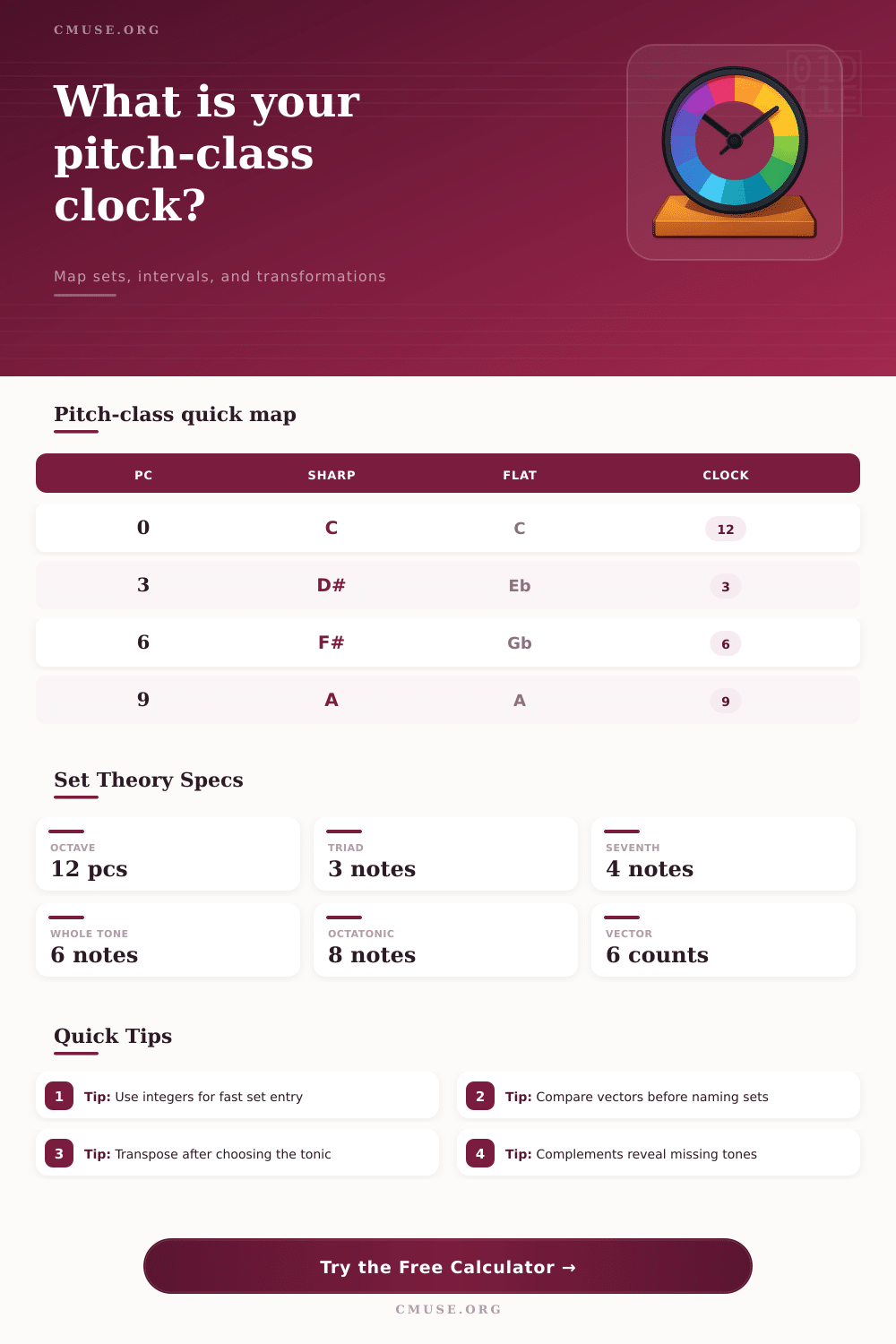
Pitch class set theory exist within a twelve-tone universe and utilizes the pitch class clock to display each of the twelve position on the clock at once. By placing scales or chord onto the pitch class clock, it is possible to understand the pattern of each of those sets of intervals. For instance, whole tone will place the notes into every other position of the clock to form a hexagon, while a major scale will leave two empty spot beside each other on the clock.
These visual difference help to reveal the way in which a collection of pitch classes will behave if it is transposed or inverted. For these reason, composers and music theorist utilize the pitch class clock to gain information regarding the way in which a collection of pitch class will behave. The calculator will perform the arithmetic for you after you have chosen a collection of your own.
How to Use the Pitch Class Clock
The calculator will return to you the interval vector, the normal form, the prime form, and the complement of the chosen collection. These output help to allow for the comparison of different collection of pitch classes from different key, or even from different composer. For instance, two different collection may appear to be entirely different, but they may have the same prime form.
If two collection have the same prime form, then they are considered to be of the same set class, and they can often be substituted for one another. The interval vector return information regarding the number of times that each interval class exist within the collection. One of the benefit of the pitch class clock is that it makes it easy to recognize symmetry within the collections of pitch classes.
Collections like whole tones and octatonic scales, for instance, exhibit rotational symmetry; each symmetrical collection will map to itself after certain transposition of its intervals. The calculator report the number of symmetry of a collection, so that musicians can easily recognize when they may be writing or analyzing a collection with rotational symmetry. This information is helpful to musicians when they are creating music with rotational symmetry themselves, or when they are analyzing music that rely upon rotational symmetry of those collections.
The reference table show which number corresponds to each of the pitch class note name. These table are helpful for musicians who are more familiar with the names of the note than with the number of those notes. These table reveal transpositions, inversions, and complements.
Transpositions move each note of a collection by the same interval; inversions reflect the collection around a specific axis. The complement of a collection demonstrate the notes that is missing from that collection; these missing notes may themselves form its own collection. Many composer utilized the concept of complements to their collections of pitch classes; the pitch classes of a composition exclude the other pitch classes that would define its complement.
Many people treat the prime form as if it is an end in itself. However, the prime form may be better understood as a sorting tool for the collections of pitch classes. By finding the most compact rotation of a collection, and by finding which of the inverted form of that collection is the most compact, the calculator create a single label for a collection of pitch classes.
This single label represent all of the different way of creating that collection; each label is used to classify that type of collection. Given this label of a collection, it is possible to understand whether two musical passage are of the same set class, or if they are merely similar in some way. The same logic can be applied to changing mode within a musical piece, or even to changing the spelling of a collection of pitch classes.
For instance, changing the tonic of a musical piece will create a rotation of that collection on the pitch class clock; altering the notation for sharps and flats will not impact the integer of that collection. These separate function allow for musicians to experiment with the notation of a collection of pitch classes without changing the collection of the pitch classes themselves. Such separation of function is an aid to musicians that wish to understand the difference between the enharmonic notation of the same collection.
Working with pitch class clock changes the way that musicians think about and listen to music. By becoming aware of which interval class are dominant within a certain passage, musicians can begin to hear the music in terms of the distribution of interval class within that composition. The interval vector for that musical passage will indicate the distribution of those interval class.
While the interval vector will not indicate the order in which the musical event occur within a passage, it will indicate the material of which that passage is constructed. These count of interval for each interval class can eventually become a type of stylistic fingerprint of a composer. The benefit of utilizing the pitch class clock is in its use as a thinking tool for musicians.
By selecting a collection, musicians can observe how each transformation of that collection change over time, and create decision about music based off those observation. Thus, the number and form that the calculator returns are only tool to help musicians make there own choice and decision.