Forte Number Calculator
Convert notes or pitch-class integers into a Forte set-class label, prime form, interval vector, complement, and comparison result for post-tonal analysis.
Preset use: Load a known chord, scale, row segment, or set-theory collection, then change spelling, duplicate handling, comparison set, and complement view.
Calculation Breakdown
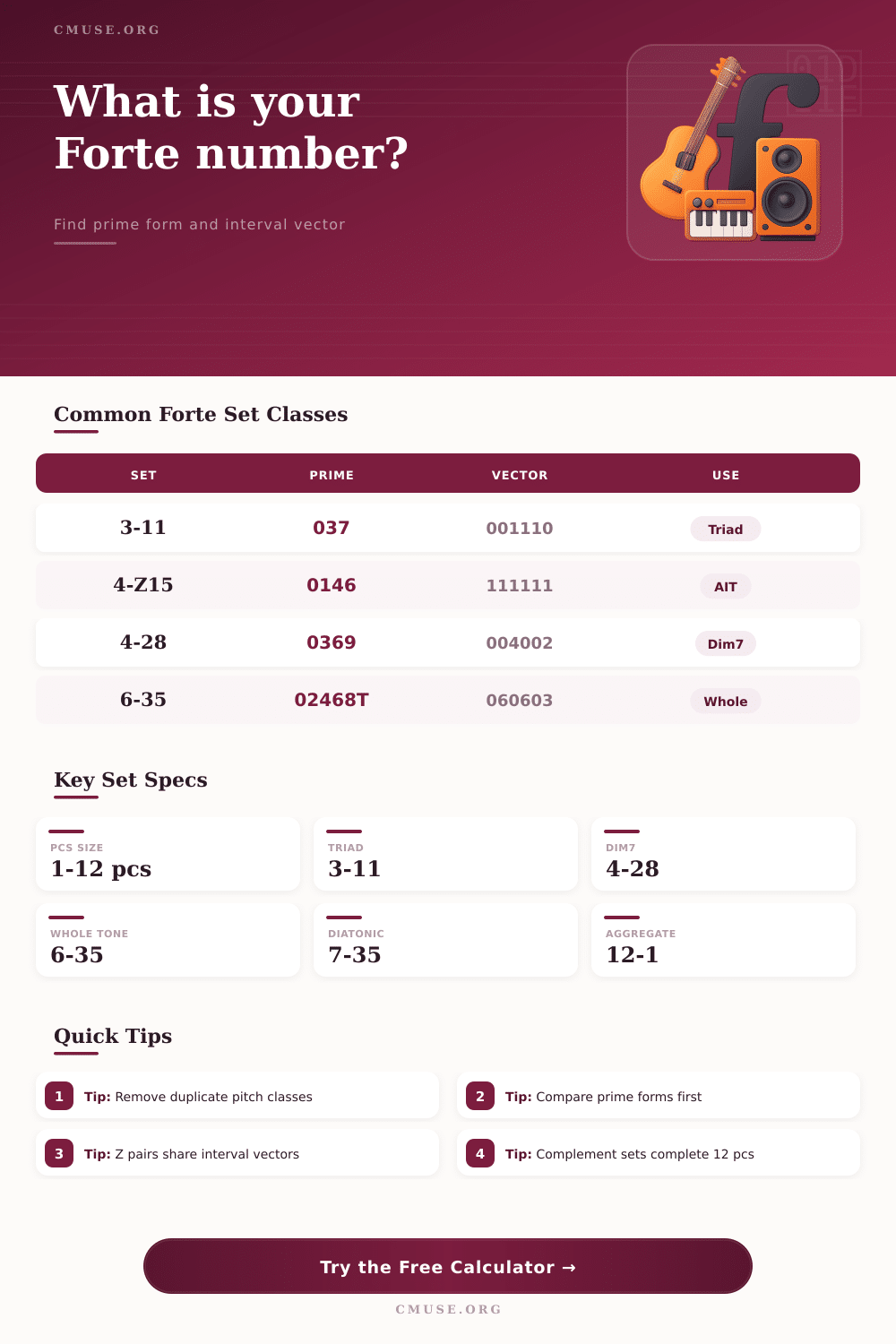
| Forte Number | Prime Form | Interval Vector | Typical Musical Use |
|---|---|---|---|
| 3-1 | [0,1,2] | <2,1,0,0,0,0> | Chromatic trichord, dense semitone cell |
| 3-11 | [0,3,7] | <0,0,1,1,1,0> | Major and minor triad set class |
| 4-Z15 | [0,1,4,6] | <1,1,1,1,1,1> | All-interval tetrachord, Z-related to 4-Z29 |
| 4-27 | [0,2,5,8] | <0,1,2,1,1,1> | Dominant seventh and half-diminished seventh class |
| 4-28 | [0,3,6,9] | <0,0,4,0,0,2> | Fully diminished seventh, symmetric cycle |
| 6-35 | [0,2,4,6,8,10] | <0,6,0,6,0,3> | Whole-tone hexachord |
| 7-35 | [0,2,4,7,9] | <2,5,4,3,6,1> | Diatonic collection, complement of 5-35 |
| Vector Slot | Interval Class | Semitone Content | Analytical Meaning |
|---|---|---|---|
| IC1 | Minor 2nd / major 7th | 1 or 11 semitones | Chromatic adjacency and cluster density |
| IC2 | Major 2nd / minor 7th | 2 or 10 semitones | Scale-step spacing and whole-tone content |
| IC3 | Minor 3rd / major 6th | 3 or 9 semitones | Triadic minor-third and diminished patterns |
| IC4 | Major 3rd / minor 6th | 4 or 8 semitones | Major-third, augmented, and tonal color |
| IC5 | Perfect 4th / perfect 5th | 5 or 7 semitones | Fourth/fifth support and diatonic openness |
| IC6 | Tritone | 6 semitones | Symmetric opposition and octatonic pressure |
| Item | What It Measures | Calculator Output | Use In Analysis |
|---|---|---|---|
| Forte number | Cardinality plus catalog order | Example: 4-Z15 | Fast set-class identification across transpositions |
| Prime form | Most compact zero-based representative | Example: [0,1,4,6] | Compare unordered pitch-class collections |
| Tn equivalence | Same set shifted by n semitones | Path such as T5 | Checks transposed motives without inversion |
| TnI equivalence | Same set after inversion and transposition | Path such as T2I | Standard Forte set-class grouping |
| Z relation | Same vector, different set class | Z-pair label when known | Finds similar interval content with different prime form |
| Preset | Pitch Classes | Expected Forte Number | What To Notice |
|---|---|---|---|
| Major Triad | C E G | 3-11 | Major and minor triads reduce to the same set class |
| All-Interval Tetra | C C# E F# | 4-Z15 | Every interval class appears exactly once |
| Diminished Seventh | C Eb Gb A | 4-28 | Symmetric thirds create strong T3/T6/T9 invariance |
| Whole Tone | C D E F# G# A# | 6-35 | Only even pitch classes and tritone pairs appear |
| Octatonic Set | C Db Eb E Gb G A Bb | 8-28 | Complement is the diminished seventh set class |
Forte number are compact labels that can be used to describe which pitches appears in a passage of music. Each Forte number is associated with a particular set of pitch, regardless of the specific way in which those pitches may be spelled or voiced. Because each set of pitches has a permanent Forte number, Forte numbers can be used to compare motives from different musical pieces.
A Forte number contains information regarding that set of pitches. The Forte number reveals information about the size of that set and the position of that set within a catalog of all possible set class of music. Sets are cataloged according to their most compact form, which is referred to as the prime form.
Forte Numbers and the Pitch Set Calculator
If a set is assigned a Forte number, then the prime form of that set is also known. The Forte number also contains an interval vector for that set of pitches. This interval vector counts the number of times each interval class are represented within the set.
The interval counts contained in the interval vector help to determine the sound that the musical passage will create. The calculator performs the mathematical operations after the entry of the pitch classes to be analyzed. The calculator will remove any duplicate pitch classes from the entry.
The calculator will find the normal order of the pitches, and it will determine the size of the collection and its inversion. The smaller of the two form will be the prime form of that set of pitches. Based off the prime form of that set, the Forte number and interval vector can be found.
Additionally, the calculator can find the complement of the set of pitches. The complement of a set is the set of pitch class that remain after removing the pitch classes contained within the analyzed set. If the complement of a set is also found, it will be another Forte collection.
Additionally, the calculator can compare two collections of pitches. If the two sets of pitches are of the same set class, have the same interval counts, or are of both the same set class and have the same interval counts, the calculator will reveal this. This function of the calculator is helpful in determining the relationship between two musical motive.
While many people believe that the calculation of the Forte number is the end of the analysis of a musical motive, two different sets can have different Forte numbers yet have the same interval vector. These interval vectors are referred to as the Z-related pairs in music theory. The calculator will reveal to the musicians these sets of Z-related pairs so that the musician can decide if the similarity of these interval vectors is important to the music analysis.
Additionally, two different sets of pitches may appear to be entirely different from one another. However, if one set is reduced to the other through inversion, both of those sets of pitches belongs to the same set class. The definition of equivalence between two collections is important in music analysis.
The equivalence may be based on transposition of the music collections alone, or it may be based on the assumption that both transposition and inversion may be used to establish equivalence between two collections. The calculator allows for each of these definition of equivalence to be tested to determine how the classification of that set of pitches is affected by the different definitions of equivalence. The definitions of equivalence dont alter the music that is analyzed, but they do alter the other collections that are classified as being related to the analyzed collection of pitches.
This flexibility in the calculator in relation to the concept of equivalence is helpful for comparing a row segment to a chord. Additionally, the flexibility of this parameter of the calculator in relation to the concept of equivalence is again helpful for determining whether a musical motive that contains certain pitch has the same interval counts as its inverted form. The calculator determines the complement of the pitches that are analyzed.
If the pitches that are not contained in the analyzed collection of pitches are revealed, these pitch classes will form another Forte collection. The original collection of pitches and its complement will total all twelve pitch classes within music. By revealing both the original collection of pitches and the complement of those pitches, the calculator allows for musicians to reveal symmetrical relationship between the pitches.
The calculator will automatically calculate the complement of the original collection of pitches, so musicians dont have to determine the pitches that will create the complement of the analyzed collection of pitches themselves. Two tables are included in the article that contain examples of some of the most common and well-known collections in music theory. Each of the entries in these tables contains the most common name for the collection of pitches, the Forte number of that collection, and the interval vector for that collection.
These examples are included to help musicians learn of the relationship between these common musical collections. By using the calculator a variety of different sets of musical pitches, musicians may begin to recognize which vectors of intervals is associated with different characteristics of musical sounds. Those musical sounds that contain a variety of instances of interval class 1 tend to have a chromatic sound to them.
Those musical sounds that contain a variety of instances of interval class 3 and interval class 4 tend to have a triadic sound to them. Although the calculator does not replace the act of listening to music for musicians, the Forte number does provide a language for describing the sounds created by musical pitches. In the final step in the process of calculating the Forte number of a collection of pitches, the musician must decide what that Forte number mean for the piece of music that is being analyzed.
The Forte number does not determine the sound that a musician’s composition must create. However, the Forte number will indicate to the musician which collections of pitches can be used to compare the different motives contained within the same piece of music. If two musical passages have reduced to the same set class, it is evidence that the composer created the two musical passages with the same collection of pitches.
If the two musical passages have different set classes yet have similar interval vectors, it is possible to discuss the resemblance of the sounds created by the two musical passages without stating that the two collections of pitches are equivalent to one another. Eventually, the step of calculating the Forte number will become second nature to musicians who use the calculator. The calculator removes the mathematics of the calculation from musicians minds, allowing them to focus upon the interpretation of the results of the calculation.