Interval Class Calculator
Calculate pitch-class distance, interval class, inversion/complement, and Forte-style interval vectors for note pairs, chords, rows, and pitch-class sets.
Preset use: Load a real music-theory example, then adjust the note pair, octave handling, notation, and set text for your own analysis.
Calculation Breakdown
| Interval Class | Semitone Content | Common Interval Names | Example From C |
|---|---|---|---|
| IC0 | 0 or 12 | Unison, octave, repeated pitch class | C to C |
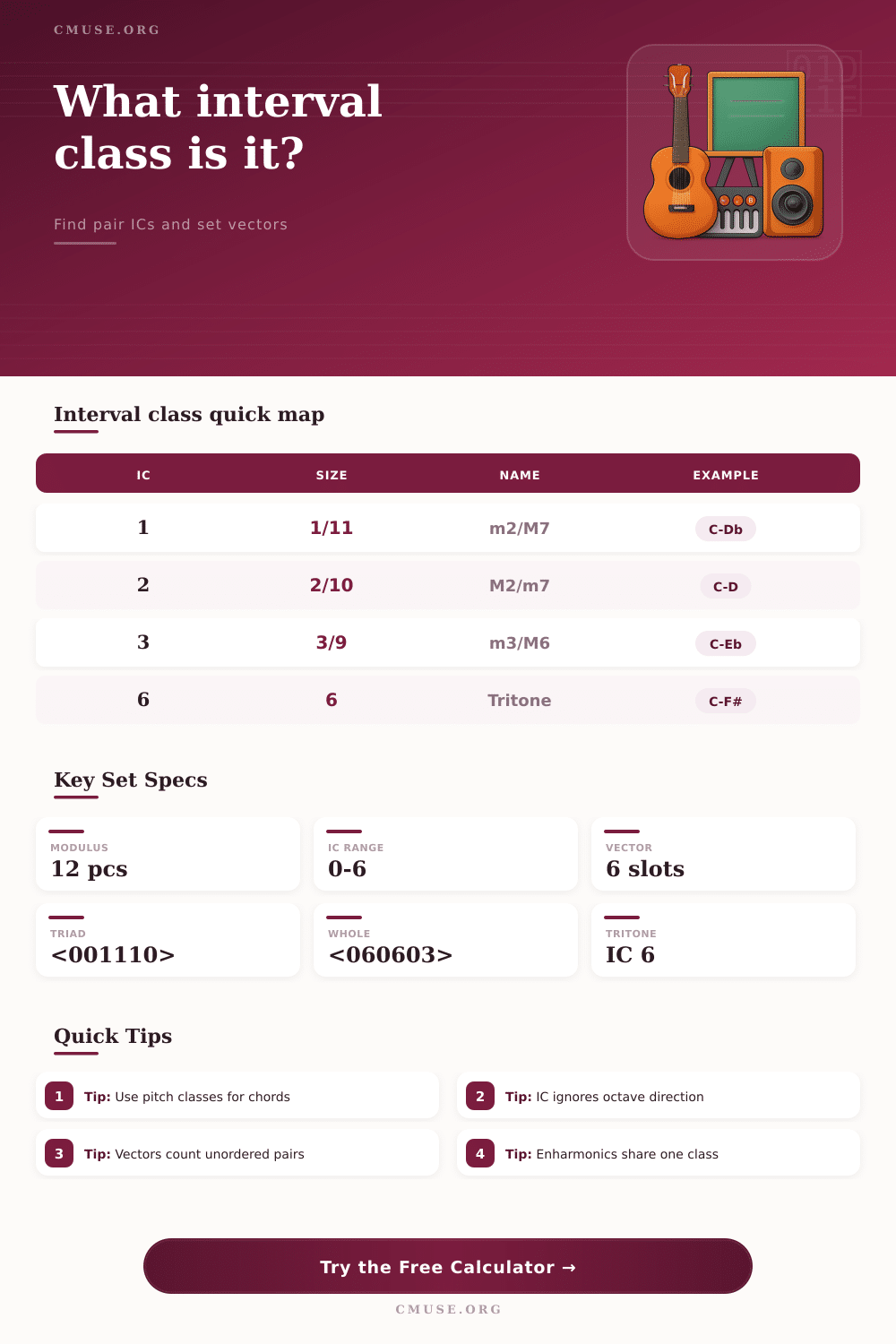
| IC1 | 1 or 11 | Minor second, major seventh | C to Db or B |
| IC2 | 2 or 10 | Major second, minor seventh | C to D or Bb |
| IC3 | 3 or 9 | Minor third, major sixth | C to Eb or A |
| IC4 | 4 or 8 | Major third, minor sixth | C to E or Ab |
| IC5 | 5 or 7 | Perfect fourth, perfect fifth | C to F or G |
| IC6 | 6 | Tritone, augmented fourth, diminished fifth | C to F# or Gb |
| Set Type | Pitch Classes | Interval Vector | Reading |
|---|---|---|---|
| Major or minor triad | 0, 4, 7 or 0, 3, 7 | <001110> | One each of IC3, IC4, and IC5 |
| Dominant seventh | 0, 4, 7, 10 | <012111> | One tritone plus two third-class intervals |
| Diminished seventh | 0, 3, 6, 9 | <004002> | Four IC3s and two tritones |
| Whole-tone hexachord | 0, 2, 4, 6, 8, 10 | <060603> | Only even interval classes appear |
| Diatonic collection | 0, 2, 4, 5, 7, 9, 11 | <254361> | Major scale pitch-class balance |
| Analysis Mode | What It Measures | Formula Basis | Best Use |
|---|---|---|---|
| Directed pitch-class interval | Ordered motion from first pitch class to second | (B - A) mod 12 | Melodic contour, row intervals, ordered transformations |
| Interval class | Smallest distance between two pitch classes | min(n, 12 - n) | Forte analysis, inversion-equivalent comparison |
| Octave-aware semitones | Actual register distance between two entered notes | (octaveB - octaveA) x 12 + (B - A) | Keyboard spacing, voicing span, transcription checks |
| Interval vector | Counts every unordered pair in a set by IC1 through IC6 | All i < j pairs, folded by interval class | Chord, scale, row segment, and set-class comparison |
| Preset | Pair | Set Text | Expected Focus |
|---|---|---|---|
| Minor 2nd | C to Db | C Db | IC1 semitone tension |
| Tritone | C to F# | C F# | IC6 symmetry under inversion |
| Major Triad | C to E | C E G | <001110> consonant triad profile |
| Dominant 7th | C to Bb | C E G Bb | <012111> with one tritone |
| Whole-Tone Cell | C to F# | C D E F# | Even-interval color with IC2 and IC4 |
| Chromatic Cluster | C to D# | C C# D D# | Dense IC1 and IC2 content |
Music theory students often encounter confusion when they first learn about interval class in music theory students studies. An interval class refer to the distance between two notes. However, the interval class remains the same irrespective of the ascending or descending distance between those two notes.
By learning about interval class, music theory students learn to think about music in a different way. The interval class calculator present musical results for the entered pitch classes. This calculator allow music theory students to focus on the musicality of the intervals rather than the mathematics behind these intervals.
What are interval classes and interval vectors?
The interval class calculator work because each interval class reduces the distance between two notes to a number between zero and six. For instance, both the ascending major third and the descending minor sixth reduces to interval class four. Thus, each of these two intervals are of the same interval class.
This reduction of intervals into a common interval class reflect the way a listener hear intervals when they are inverted. For instance, moving up a third and moving down a sixth in harmony will sound the same to a listener. The interval class calculator provides both the directed interval and the interval class so that music theory students can study both representations of these relationships in music theory.
Interval vectors extend the concept of interval classes to sets of musical notes. Rather than asking how far one note is from the next, music theory examine how many pair of notes in a set belong to each interval class. Each set of notes has its own interval vector, which function as a musical fingerprint.
Two different set of notes can sound related to one another when they have the same interval vector. The interval class calculator calculates these vectors once the music theory student enters the set of notes into the calculator. The interval vector calculator determine whether to count repeated pitch class within that set or to treat the set as a collection of unique musical members.
This impacts the interval vector if the set includes unisons or octaves. The reference table on the page indicate the common name for each interval class. For instance, interval class five include perfect fourths and perfect fifths.
These intervals behave in a similar fashion because perfect fourths and perfect fifths is inversions of each other. Thus, perfect fourths and perfect fifths shares the same interval class. Interval class six is unique because a tritone do not have its own inverted interval.
Because there is no inversion for this interval class, it is special in both tonal and atonal music. A composer may use a tritone in music to indicate either more maximum tension or maximum symmetry in their composition. The interval class calculator allow music theory students to study the relationship between two chords that may seem unrelated on the page.
For instance, a dominant seventh chord and a half-diminished seventh chord has no relationship on the staff notation staff paper. However, there interval vectors may have similarities. By entering these two chords into the interval class calculator, music theory students can study how similar or different the two chords is.
A music theory student may use this instrument when transcribing music from a recording or arranging music for a performance. By entering the notes into the calculator, each in its appropriate octaves, the music theory student can use the octave-aware mode to see the actual span of the pitch classes. That information can be deselected to study the abstract concept of the interval classes of the studied music.
Many people believe that interval classes and interval vectors is used for studying post-tonal music. However, interval classes can describe tonal music as well. A ii-V-I chord progression will contain a different distribution of interval classes than a sequence of chromatic notes.
The interval vector for these examples can be compared to study the differences in the chord progressions. Not only can people compare the interval vector of two sections within a song, but they can study the interval vector of two different songs. The interval class calculator is valuable to music theory students because it performs the mathematics of music theory for them.
When music theory students no longer have to worry about the mathematics behind the intervals, they can focus on more important question of music theory. For instance, music theory students can study which interval classes are dominant in a chord progression. Another question is where the tritone notes appear in the studied chord or progression.
Furthermore, music theory students can study how the interval vector change with the addition or removal of a note from a chord progression. Such questions can help music theory students understand the effect of their musical ideas. The numbers may be of little importance to music theory students, but the musical relationships are of the most utmost importance.