Interval Vector Calculator
Count unordered pitch-class interval classes IC1 through IC6, compare a target vector, inspect complement behavior, and summarize the set's interval balance.
Preset use: Load a real theory collection, then change notes, transposition, duplicate handling, spelling, or target vector before calculating.
Calculation Breakdown
IC1 semitone pairs
IC2 whole-tone pairs
IC5 fourth/fifth pairs
interval profile label
| Class | Semitone distances | Common name | Reading cue |
|---|---|---|---|
| IC1 | 1 or 11 | Minor second / major seventh | Chromatic adjacency, leading-tone bite, dense cluster pressure |
| IC2 | 2 or 10 | Major second / minor seventh | Whole-tone motion, suspended color, scale-step energy |
| IC3 | 3 or 9 | Minor third / major sixth | Minor-triad and diminished-triad weight |
| IC4 | 4 or 8 | Major third / minor sixth | Major-triad, augmented, and bright tertian weight |
| IC5 | 5 or 7 | Perfect fourth / perfect fifth | Quartal, quintal, dominant, and open harmonic weight |
| IC6 | 6 | Tritone | Symmetry marker; IC6 folds onto itself under inversion |
| Collection | Pitch-class example | Interval vector | Typical reading |
|---|---|---|---|
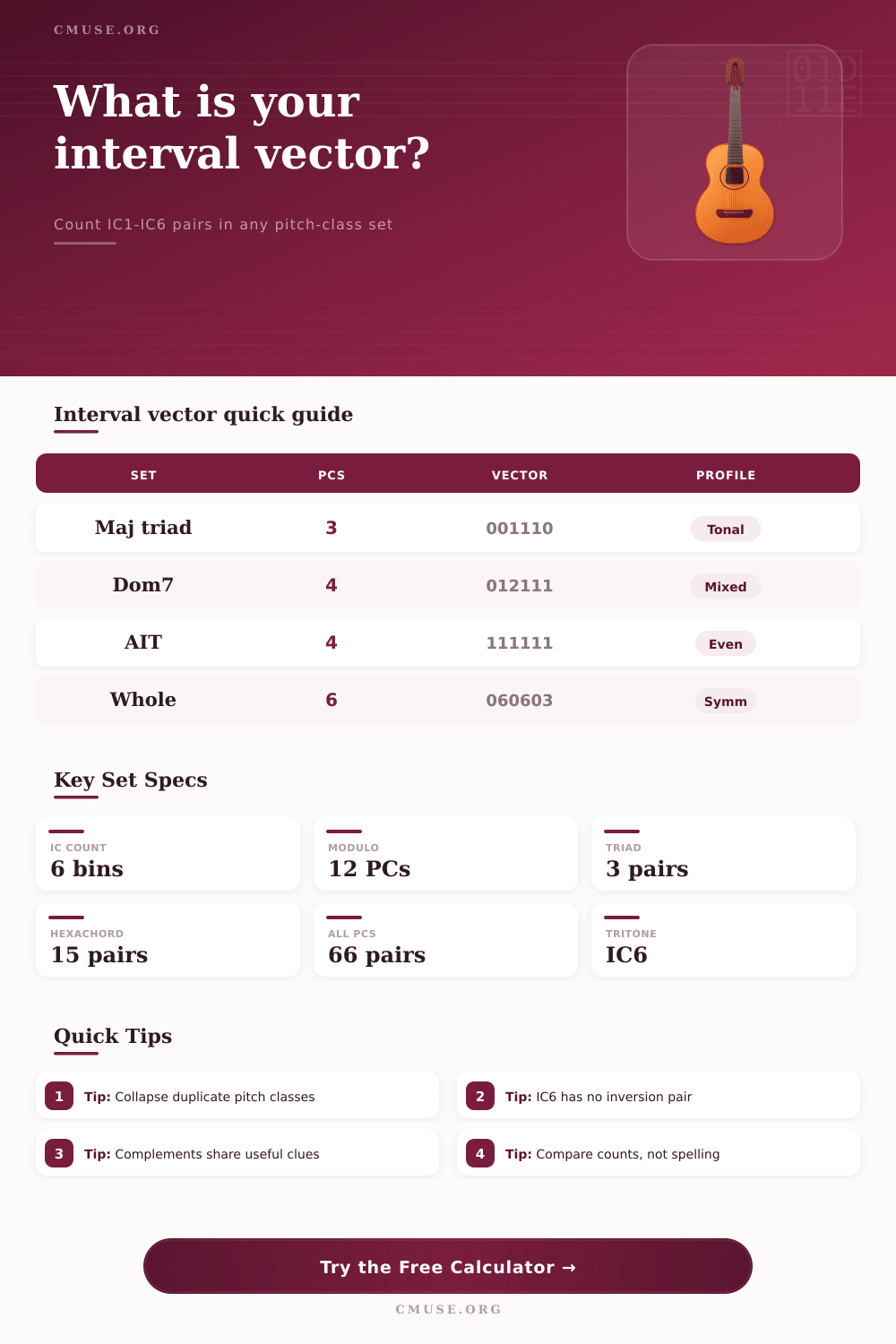
| Major or minor triad | 0, 4, 7 / 0, 3, 7 | <001110> | One third-type pair plus a fifth-type pair |
| Diminished seventh | 0, 3, 6, 9 | <004002> | Equal minor thirds with two tritones |
| Dominant seventh | 0, 4, 7, 10 | <012111> | Mixed tertian and tritone behavior |
| All-interval tetrachord | 0, 1, 4, 6 | <111111> | Exactly one pair in every interval class |
| Whole-tone hexachord | 0, 2, 4, 6, 8, 10 | <060603> | Only even interval classes appear |
| Diatonic collection | 0, 2, 4, 5, 7, 9, 11 | <254361> | Scale-step rich, but not fully symmetrical |
| Cardinality | Pair formula | Total vector counts | Useful check |
|---|---|---|---|
| 3-note set | 3 x 2 / 2 | 3 pairs | Triads and trichords must sum to 3 |
| 4-note set | 4 x 3 / 2 | 6 pairs | Tetrachord vectors must sum to 6 |
| 5-note set | 5 x 4 / 2 | 10 pairs | Pentachord vectors must sum to 10 |
| 6-note set | 6 x 5 / 2 | 15 pairs | Hexachord vectors must sum to 15 |
| 7-note set | 7 x 6 / 2 | 21 pairs | Diatonic-scale vectors must sum to 21 |
| 12-note set | 12 x 11 / 2 | 66 pairs | Aggregate vector is <12,12,12,12,12,6> |
| Analysis task | Best input | Result to watch | What it reveals |
|---|---|---|---|
| Check triadic content | Chord tones or sonority | IC3, IC4, IC5 | Whether thirds and fifths dominate the set |
| Measure cluster density | Adjacent notes or scale segment | IC1 and IC2 | How much semitone and whole-tone pressure is present |
| Find symmetry clues | Even or repeating collections | IC6 plus repeated counts | Whether tritone or equal division shapes the set |
| Compare two collections | Set plus target vector | Vector distance | How close the interval content is, regardless of transposition |
| Study complements | Any set under 12 PCs | Complement vector | How the unused pitch classes redistribute interval classes |
Music theory involve asking certain questions about the sounds that comprise music. Music theory often involve the analysis of chords and collections of musical note. When analyzing a collection of musical notes, one may want to know the interval content of that collection of notes.
The interval vector is a musical concept that can be used to determine the interval content of a collection of musical notes. The interval vector count the number of musical interval of each class from one through six within a collection of musical notes. The interval vector is useful in that it ignore the specific spelling of the musical notes within a collection and there registers.
What an interval vector is and how to use an interval vector calculator
Thus, the interval vector is a representation that consider only the interval classes of the musical notes within that collection. The interval class are intervals that have the same distance within an octave. For instance, the minor second and major seventh are both placed into the same interval class because they have the same distance within an octave.
Additionally, the major third and minor third interval classes are both considered the same, as are the perfect fourth and perfect fifth interval classes. The tritone interval is also placed into its own interval class. Because there are only six interval class, any pitch-class set will produce a six digit interval vector.
Thus, the six digit interval vector will remain the same for any number of transpositions of that initial collection of musical notes, and the six digit interval vector will remain the same regardless of the inversions of that initial collection of musical notes. Thus, interval vectors can be used to compare the interval content between two different collection of musical notes, even if the two collections use different musical notes. Calculating the interval vector for a collection of musical notes can become difficult if the collection contain more than four or five different notes.
Furthermore, it can be difficult to determine how to handle duplicate musical notes within the collection or how to handle the remaining notes within the twelve-tone system. Thus, an interval vector calculator can make this process easier for individuals who would like to calculate the interval vector for a collection of musical notes. An interval vector calculator allow individuals to enter the collection of musical notes to be analyzed.
Additionally, the calculator may allow for individuals to indicate whether duplicate musical notes within the collection should be combined into a single note, to select the transposition level for the collection of musical notes, to enter the interval vector that the musical notes are to be target by. Furthermore, the calculator may also provide as an output the number of each type of interval that is contained within the collection of musical notes, the dominant interval class for the collection, and a profile label for the collection of musical notes. Another element of the output of an interval vector calculator is a complement vector.
The complement vector display the interval content of those musical notes that were not included within the initial collection of musical notes. A six-note collection of musical notes and it’s complement will have different interval vectors, but the interval vector of the collection and the interval vector of its complement will relate to each other in some way. Thus, by comparing these two interval vectors for a collection of musical notes, individuals can determine in what ways those musical notes are arrange within the twelve-tone system.
The interval vector is a musical concept that focus on the interval content of a collection of musical notes. As such, it consider each of the interval classes within that collection of musical notes. In contrast, traditional music analysis often focus on the perfect fifth and the major third within a collection of musical notes.
Because the interval vector consider each of the interval classes within the collection of musical notes, it is easier to use the interval vector to determine whether a collection of musical notes contains many tritones, or if the collection contain few semitones. This consideration of each of the interval classes within a collection of musical notes is especially important within atonal music, wherein each of the intervals within a collection of musical notes is considered to be equally important. The interval vector does not contain all of the information regarding the specific collection of musical notes.
For instance, the interval vector does not contain information regarding the register of each of the musical notes within the collection. Additionally, the interval vector does not contain information regarding the voicing of the musical notes. Furthermore, the interval vector does not contain information regarding the timbre of the musical notes.
Additionally, the interval vector does not contain information regarding the order of the musical notes within a melody. Thus, the interval vector contains information regarding the collection of musical notes as a whole, rather than regarding any other aspect of those musical notes. The profile label for the collection of musical notes can be used to make the information contained within the interval vector easier to read.
Within the output of an interval vector calculator, there are often reference tables. These reference tables show examples of common collections of musical notes and the interval vectors that they have. These reference tables also show the total number of interval of each class within each of the collections.
For example, any three-note collection will always have three musical intervals of each class, and any four-note collection will always have six musical intervals of each class. Thus, the reference tables can be used to verify the calculations performed by the interval vector calculator; if the calculations is correct, their interval vectors will match the predictions made by the reference tables. The interval vector is a measuring tool for musical collections.
However, the interval vector is not a rule that can be applied to the composition of musical notes. The interval vector simply indicate the type of musical collection that is being considered and permits for those with an understanding of music to compare one collection to another collection of musical notes. Thus, the interval vector can be used in conjunction with a musician’s ear to understand the reason for the sound that certain collections of musical notes create.