Tone Row Matrix Calculator
Enter a twelve-tone prime row to generate the complete matrix, label P, R, I, and RI forms, inspect interval content, and compare hexachord structure.
Preset use: Load a known serial row type or a classroom row, then change spelling, labels, and target form to inspect the full matrix.
Calculation Breakdown
| P/I | I4 | I5 | I7 | I1 |
|---|---|---|---|---|
| P4 | E | F | G | Db |
| Operation | Matrix Location | Pitch-Class Rule | What To Read |
|---|---|---|---|
| Prime (P) | Rows left to right | Transpose the original ordered row | The forward row form starting on the row label |
| Retrograde (R) | Rows right to left | Reverse each prime row order | The backward form with the same row content |
| Inversion (I) | Columns top to bottom | Reverse each ordered interval direction | The inverted form starting on the column label |
| Retrograde inversion (RI) | Columns bottom to top | Reverse the inversion row order | The backward inversion form from the same column |
| Interval Class | Semitone Sizes | Typical Sound | Matrix Use |
|---|---|---|---|
| IC1 | 1 or 11 | Chromatic pull | Creates close semitone row motion |
| IC2 | 2 or 10 | Whole-step line | Useful for scalar row areas |
| IC3 | 3 or 9 | Minor-third color | Builds diminished or octatonic cells |
| IC4 | 4 or 8 | Major-third color | Creates augmented-triad partitions |
| IC5 | 5 or 7 | Fourth or fifth | Gives open leaps and cycle patterns |
| IC6 | 6 | Tritone axis | Highlights inversional symmetry |
| Preset | Prime Row | Pitch-Class Pattern | Primary Feature |
|---|---|---|---|
| Schoenberg Op 25 | E F G Db Gb Eb Ab D B C A Bb | 4 5 7 1 6 3 8 2 11 0 9 10 | Classic early twelve-tone suite row |
| Webern Op 21 | A F# G G# E F B Bb D C# C Eb | 9 6 7 8 4 5 11 10 2 1 0 3 | Symmetrical row with mirrored halves |
| Klein Mother | C B G E D A Eb Ab Bb Db F Gb | 0 11 7 4 2 9 3 8 10 1 5 6 | All-interval row example |
| Grandmother Row | C B Db Bb D A Eb Ab E G F Gb | 0 11 1 10 2 9 3 8 4 7 5 6 | Alternating interval expansion |
| Circle Fifths | C G D A E B Gb Db Ab Eb Bb F | 0 7 2 9 4 11 6 1 8 3 10 5 | Constant perfect-fifth motion |
| Task | Best Display | Target Form | Useful Result |
|---|---|---|---|
| Score analysis | Notes only | Match score spelling | Find row forms quickly in a passage |
| Pitch-class study | Numbers only | Absolute labels | Compare transformations without enharmonic noise |
| Composition sketch | Note plus number | Any P or I form | Choose row material while tracking labels |
| Hexachord check | Numbers only | P and I pairs | Inspect complementary six-note partitions |
| Teaching handout | Notes only | P0 normalized | Show how inversion and retrograde are read |
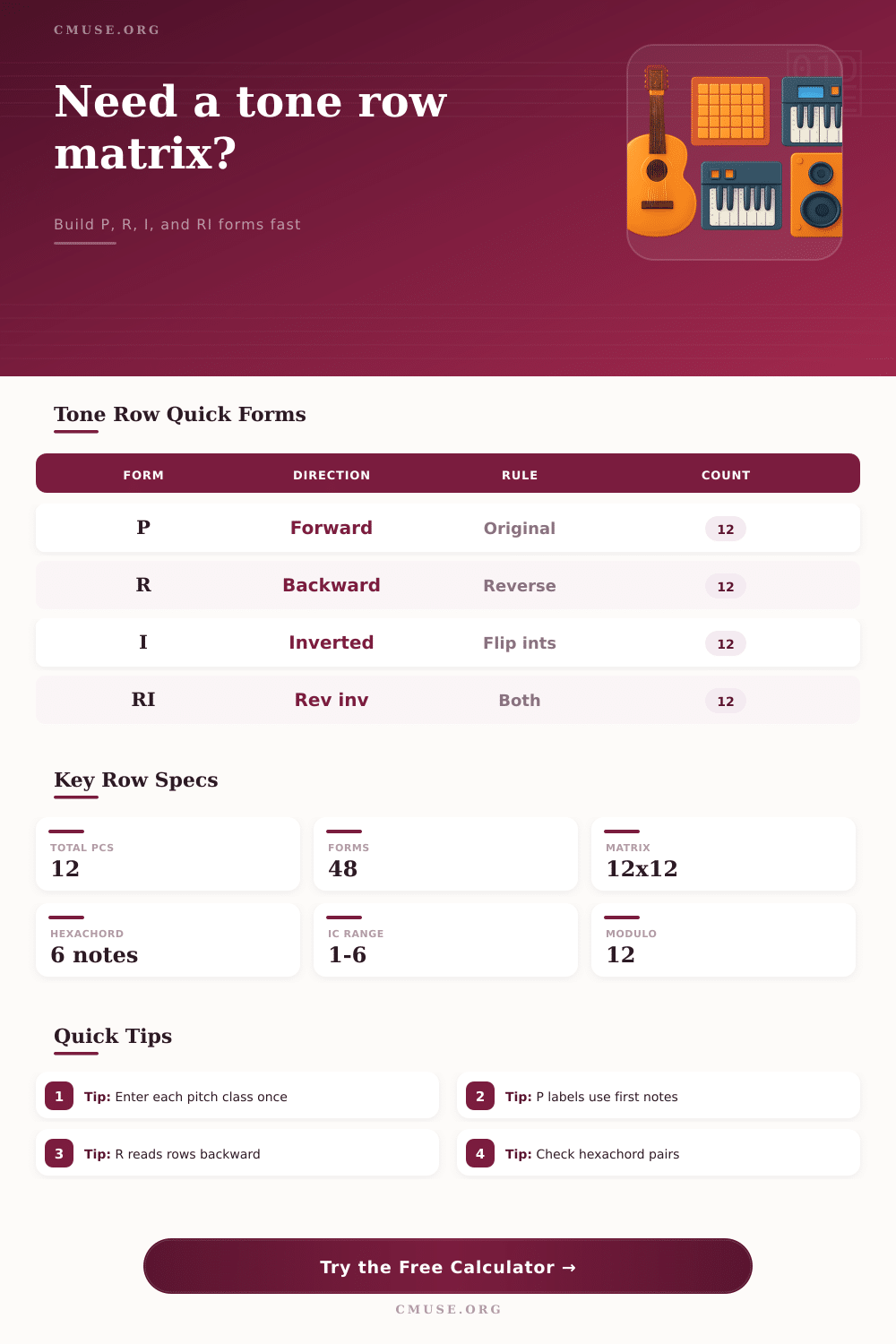
Tone rows is central to twelve-tone music due to the fact that tone rows provides composers with an ordered set of twelve pitch class. These twelve pitch classes can be changed through four basic transformation. The first transformation are the prime form, which is the original form of the row and which progresses forward from the starting pitch of the tone row.
The second transformation is the retrograde form, which reads the same line of notes backward. The third transformation is the inversion, which flip the direction of every interval in the tone row. The fourth transformation is the retrograde inversion, which combine the retrograde and inversion transformations.
How to Use a Tone Row Matrix
Each of these four form can be transposed twelve times creating a grid of forty-eight possibilities. The entire grid of rows are important in twelve-tone music because every note in a twelve-tone composition can be traced back to these tone rows. Furthermore, ensuring that every note in a composition map to one of these tone rows ensures that the texture of that composition is derived from the same material.
When you enter a tone row into the matrix calculator, the calculator first check to ensure that each of the twelve pitch classes appears once in the tone row. Because the tone row must contain each of the twelve pitch classes without duplicate or missing pitch classes, any row with duplicate or missing pitch classes will break the logic of the matrix calculations; it will be flagged for you. Following this initial check, the matrix is construct.
The matrix is constructed by placing the prime form of the row into the first row of the matrix. Each of the remaining rows of the matrix is constructed based off the inversion of the row as it appear in the first column. Each cell within the matrix represents a different form of the tone row.
Each row of the matrix indicates which form of the tone row is being read, while each column of the matrix indicates the name of the transposition of that row. The notes within each row can be represented as there absolute pitch-class numbers, or they can be represented as a zero starting point for that tone row. The intervals within the tone row determine the character of the tone row.
If the tone row use only small intervals between its notes, the tone row will result in smooth, stepwise melodies. If the tone row contains many long, leaps between its pitch classes, that tone row will create angular melodies. Furthermore, if a tone row contains long leaps between its pitch classes, those leaps can be inverted to create another line of the same row.
The interval-class count will reveal to the composers whether the tone row contains all possible distance between the pitch classes from one to six semitones. Furthermore, the interval-class analysis will reveal if some distance between the pitch classes occur more than others within the tone row. This information is important to the composers to determine how varied the row will be when it is transformed into other forms.
Another aspect of tone rows is the concept of the hexachord structure. Most tone rows have a first six notes and a last six notes to the tone row. These two groups of six notes is referred to as complementary sets; they contain no pitches in common.
However, some tone rows contain at least one pitch class in common between the first six notes and the last six notes. The calculator will tell you whether the tone row has complementary sets or overlapping sets of pitch classes. Furthermore, the segment-size selector allow the composer to examine whether a tone row contains trichords (three-note groups) or tetrachords (four-note groups).
The segments of tone rows are important to analyze because most twelve-tone compositions treat each segment as if it was a separate region within the composition. There are also reference tables that explain each of the four operation that can be performed on tone rows, as well as descriptions of the six interval classes within a tone row. Each row contains tables that explain that the prime rows are read from left to right, but retrograde rows are read from right to left.
Furthermore, inversions are read from top to bottom, but retrograde inversions are read from bottom to top. There is also a table describing the different sonic meaning of intervals like semitones or tritones as opposed to perfect fifths. These references are included to help you focus on the musical meaning of tone rows rather than the arithmetic behind them.
There are preset tone rows within the matrix. For example, Schoenberg’s tone row from his Suite, Op. 25 contain many small intervals and a few long leaps while never using the same interval distance twice.
Webern’s tone row from his Symphony, Op. 21 contain mirror symmetry; its second half is the inversion of its first half. Finally, the Klein Mother tone row contains every interval from one to eleven semitones within the tone row.
These tone rows can be loaded into the matrix. Furthermore, the display can be changed from musical notes to numbers. The frequency reference at the bottom of the results panel will display the frequency of the first pitch class of the row in relation to the pitch near middle C. This frequency is calculate using A4 as the standard tuning row.
This reference is important in understanding how the tone row will sound within a composition; it is important to relate this row to sound. Finally, you can choose the accidental preference for the tone row. The accidental preference is used to ensure that the tone row maintain the spellings of the accidentals that the composer prefers.
Whether sharps, flats, or mixed accidentals are selected, the preference will be respected. Working with the matrix is valuable in that it remove guesswork from the composing process. Once the tone row is entered into the matrix, all possible form of that tone row are visible in the matrix.
Furthermore, the composer does not have to perform any calculations regarding transpositions or inversions of the tone row; they are visible in the matrix. The matrix makes it clear which form of the tone row begin on which pitch class in the row, and which intervals relate to which other intervals in the tone row. Thus, the composer can focus on his or her composition rather than calculating the tones of the tone row.
The matrix not only organizes the tone row for the composer, but it also act as a map of that row that may be consulted while composing or analyzing the work.