Roman Numeral To Chord Calculator
Convert roman numeral analysis into spelled chord names, chord tones, harmonic function, inversion bass, and figured-bass shorthand for major and minor keys.
Preset use: Load common classical, jazz, pop, modal, and minor-key roman numerals, then adjust the key, scale form, extension, and inversion.
Calculation Breakdown
| Roman Numeral | Triad Quality | Seventh Quality | Common Function |
|---|---|---|---|
| I | Major | Major seventh when diatonic | Tonic area and point of rest |
| ii | Minor | Minor seventh | Predominant, often moves to V |
| iii | Minor | Minor seventh | Tonic prolongation or passing color |
| IV | Major | Major seventh | Predominant or plagal color |
| V | Major | Dominant seventh | Dominant pull toward I |
| vi | Minor | Minor seventh | Tonic substitute and deceptive goal |
| viio | Diminished | Half-diminished seventh | Leading-tone dominant function |
| Degree | Natural Minor | Harmonic Minor | Melodic Minor Ascending |
|---|---|---|---|
| i | Minor tonic | Minor tonic with major seventh available | Minor tonic with raised sixth and seventh context |
| ii | Diminished predominant | Diminished predominant | Minor predominant color |
| III | Major mediant | Augmented mediant color | Augmented mediant color |
| iv or IV | Minor subdominant | Minor subdominant | Major subdominant from raised sixth |
| v or V | Minor dominant | Major dominant | Major dominant |
| VII or viio | Major subtonic | Diminished leading-tone chord | Diminished leading-tone chord |
| Symbol Type | Example In C | Chord Result | Interpretation |
|---|---|---|---|
| Flat scale degree | bVII | Bb major | Borrowed or modal subtonic color |
| Sharp scale degree | #iv | F# minor or altered quality | Chromatic predominant or passing harmony |
| Secondary dominant | V/V | D major | Dominant of the dominant chord |
| Secondary seventh | V7/ii | A7 | Dominant seventh targeting ii |
| Secondary leading tone | viio/V | F# diminished | Leading-tone chord targeting V |
| Chord Type | Root Position | First Inversion | Second / Third Inversion |
|---|---|---|---|
| Triad | 5/3, root in bass | 6/3, third in bass | 6/4, fifth in bass |
| Seventh chord | 7, root in bass | 6/5, third in bass | 4/3 fifth in bass; 4/2 seventh in bass |
| Add9 chord | Add9 above triad | Use chord-tone bass | Figure depends on voicing |
| Suspended chord | 4 replaces third | Bass can obscure resolution | Resolve suspension before analysis if needed |
| Progression Slot | Roman Numeral | Example In C Major | Typical Role |
|---|---|---|---|
| Opening tonic | I | C major | Establishes the key center |
| Predominant setup | ii7 or IV | Dm7 or F major | Prepares dominant motion |
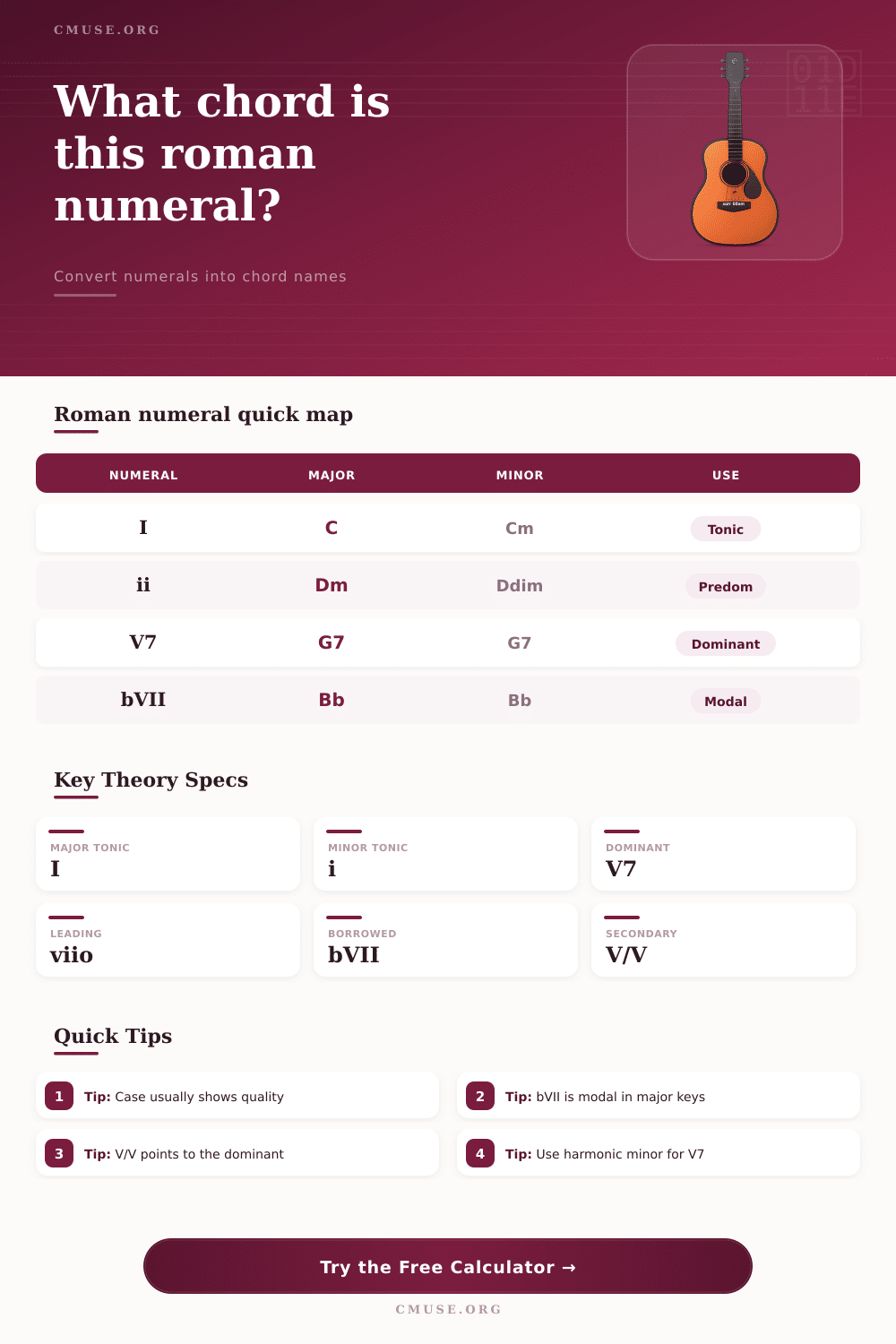
| Cadential dominant | V7 | G7 | Creates strong pull to tonic |
| Deceptive arrival | vi | A minor | Delays the expected I chord |
| Modal color | bVII | Bb major | Adds mixolydian or borrowed sound |
Roman numerals in music are symbols that represent the function of a chord within a musical key. Roman numerals dont just label a chord, but Roman numerals tells you how a chord functions and where a chord sits in relation to the tonic. For instance, if you see the Roman numeral I within a major key, the Roman numeral I indicates that the chord is the tonic chord.
The tonic chord provides a sense of arrival within a piece of music because it is the home note for a musical key. Furthermore, if you see the Roman numeral V within a major key, the Roman numeral V indicates that the chord is a dominant chord. A dominant chord create tension within the music because it wants to resolve to the tonic chord.
What Roman Numerals Mean in Music
The system of Roman numerals in music is useful because it separates the function of the chord from the spelling of the chord’s notes. Because the Roman numerals separate the function of a chord from its spelling, musicians can shift the chord progression to any musical key without having to change the notes of the chords. Roman numerals are also flexible in their application to music, specifically within the context of musical keys that employ minor scales.
Within natural minor scales, Roman numerals indicates the quality of the chords that are present within the key. However, if musicians use harmonic and melodic minor scales, the raised leading tone creates a major tonic chord and alters the colors of the predominant chords within a musical key. The decision of which minor scale form to use within a musical key decides the dramatic qualities of the music.
Another way to use Roman numerals in a chord progression is to use secondary dominants to indicate that a chord is dominant to another scale degree aside from the tonic of the key. For instance, if a chord has a Roman numeral of V/V, it indicates that the chord is the dominant of the dominant chord. This chord treats the fifth note scale degree as if it were the tonic note of the chord.
Because the music does not alter the chord’s function, even though it has a different key signature, the ear of a listener can still perceive a shift in the gravity of the music. Roman numerals can indicate the presence of a secondary dominant chord, but the musician must decide whether or not it is useful to the music that is to be produced. Another use of Roman numerals is to indicate borrowed chords.
Borrowed chords are chords that come from another scale but are used within the current musical key. For instance, a flat seven chord within a major key is a borrowed chord because the chord is not one of the diatonic chords of that key. Borrowed chords are used within rock and folk music.
The use of borrowed chords provides a darker color to the music while the music remains within its original key. Roman numerals indicate borrowed chords so musicians are aware of the presence of these chords in the chord progression. Although calculators can recognize and highlight the tones within a borrowed chord, musicians must use their musical judgment to decide if that borrowed chord enhances the lyrics of the song or the moment in which it is performed.
Roman numerals can also be used to create inversions of chords. Inversions change the order in which the notes of a chord are played, but they do not change the function that the chord fulfills within a musical piece. For example, a first inversion of a tonic chord will still be a tonic chord but will sound differently because the third of the chord will be in the bass of the chord.
Another example is using a second inversion of a dominant chord. Using a second inversion of the dominant chord will signal to listeners that a cadence is upcoming in the song because the bass note of a second inversion of a dominant chord will create stepwise motion with the rest of the chord progression. Additionally, figured bass numbers indicate which tone of a chord will be in the bass of the chord.
These numbers are used to provide instructions for musicians regarding how to play a chord progression. By creating inversions of chords, musicians have more control over the contour of the chords bass line. However, the inversions do not alter the harmony of the chord.
Many musicians make mistakes when they use Roman numerals to describe chords. One of the most common is treating every Roman numeral as having a fixed quality within a chord progression. Instead, the Roman numeral provide a clue as to the quality of the chord.
However, the scale within which the chord is used can override that clue provided by the Roman numerals. Another mistake that many musicians make is ignoring the context of the chords. For example, if a musician plays a vi chord in a song, it could act as a deceptive resolution or it could be playing passing harmony between two predominant chords.
The other chords in the song and the melody played dont indicate the function of the vi chord in this example but rather indicate it. A calculator can perform the arithmetic of music by being given the key of a song, the Roman numeral of each chord in the song, the scale form of the chords, and the extension of each chord. However, the calculator cannot provide musical judgment as to whether or not a chord belongs in a certain musical phrase.
Musicians must use their ears to recognize when a chord belongs in a certain part of a song and to test each chord progression on a musical instrument. While Roman numerals and music theory provide a map for musicians to explore, their ears provide the musical judgment that decides the route that the song will take.