Chord Tone Calculator
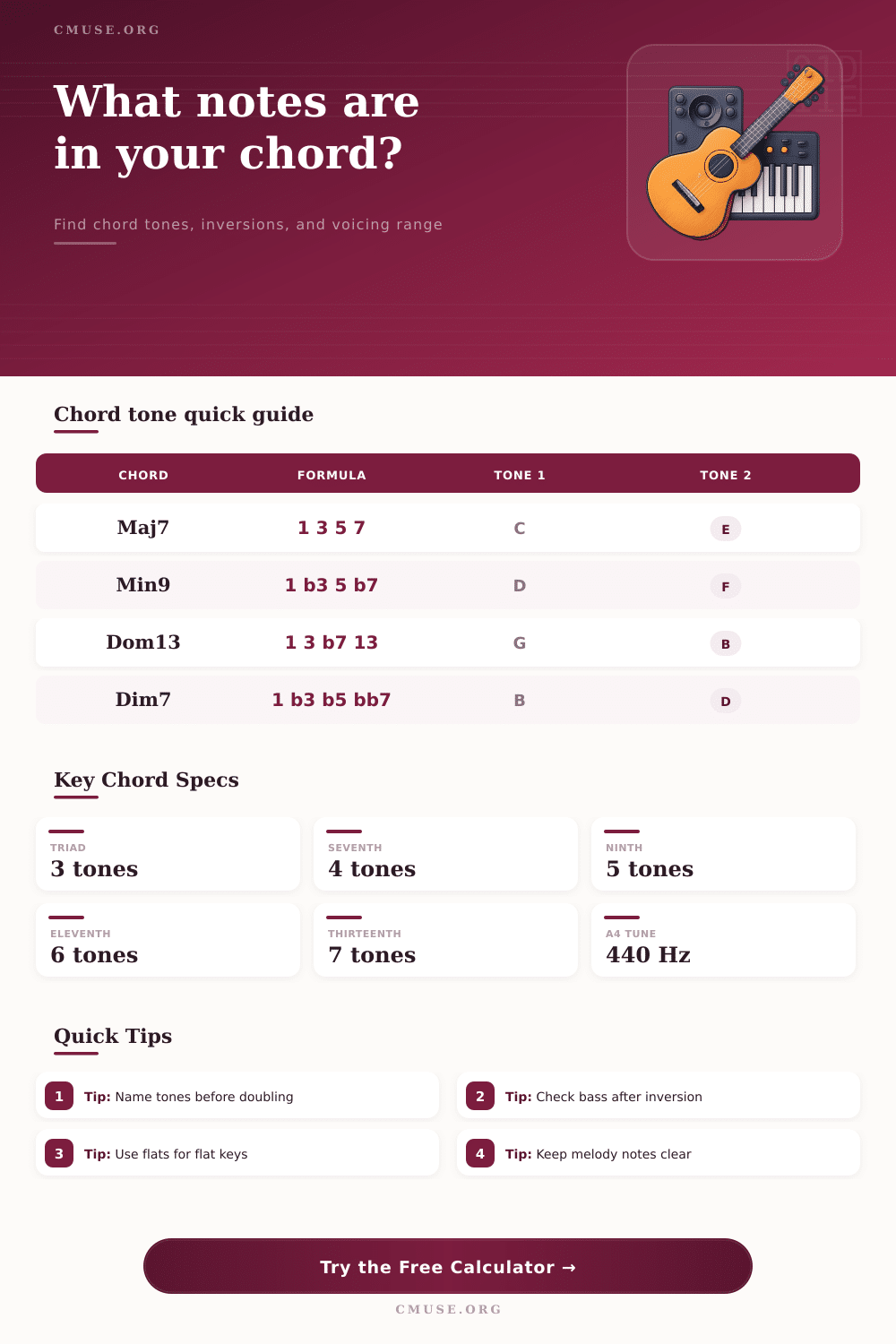
Find the notes, interval formula, inversion bass, voicing span, MIDI numbers, and frequency range for common chords used in piano, guitar, arranging, and theory work.
Preset use: Load a real musical chord shape, then change the root, quality, extension, inversion, notation, or concert pitch to match your part.
Calculation Breakdown
| Quality | Formula | Semitones | Typical Use |
|---|---|---|---|
| Major | 1 3 5 | 0, 4, 7 | Stable tonic, bright triad, major key harmony |
| Minor | 1 b3 5 | 0, 3, 7 | Minor tonic, ii chord, vi chord, darker color |
| Diminished | 1 b3 b5 | 0, 3, 6 | Leading-tone function and symmetrical tension |
| Augmented | 1 3 #5 | 0, 4, 8 | Chromatic dominant color and raised fifth movement |
| Sus2 | 1 2 5 | 0, 2, 7 | Open pop, folk, guitar, and modal voicings |
| Sus4 | 1 4 5 | 0, 5, 7 | Suspension before resolving to a major third |
| Extension | Added Formula | Added Semitones | Common Chord Sound |
|---|---|---|---|
| 6 | 6 | 9 | Warm major or minor color without a seventh |
| 7 | b7 | 10 | Dominant pull or minor seventh chord color |
| maj7 | 7 | 11 | Major seventh color for jazz and cinematic harmony |
| 9 | b7 9 | 10, 14 | Dominant or minor ninth color with wider upper tone |
| 11 | b7 9 11 | 10, 14, 17 | Suspended, modal, or extended dominant sound |
| 13 | b7 9 11 13 | 10, 14, 17, 21 | Large dominant color for horns, keys, and arranging |
| Semitone | Chord Name | Simple Interval | Example Above C |
|---|---|---|---|
| 0 | 1 | Perfect unison | C |
| 1 | b2 or b9 | Minor second | Db |
| 2 | 2 or 9 | Major second | D |
| 3 | b3 or #9 | Minor third | Eb |
| 4 | 3 | Major third | E |
| 5 | 4 or 11 | Perfect fourth | F |
| 6 | b5 or #11 | Tritone | Gb or F# |
| 7 | 5 | Perfect fifth | G |
| 8 | #5 or b13 | Augmented fifth | Ab or G# |
| 9 | 6 or 13 | Major sixth | A |
| 10 | b7 | Minor seventh | Bb |
| 11 | 7 | Major seventh | B |
| Voicing Style | What Changes | Best For | Range Behavior |
|---|---|---|---|
| Close position | Stack tones within one octave when possible | Theory spelling, compact piano, quick analysis | Narrowest span |
| Drop 2 | Second-highest tone drops one octave | Guitar sets, section writing, cleaner inner voices | Moderate span |
| Open spread | Upper tones move into wider octaves | Ballads, pads, lower-register chords | Wide span |
| Keyboard stack | Upper extensions are placed above the chord shell | Piano voicings and synth comping | Balanced span |
| Guitar friendly | Middle voices are opened to reduce close clusters | Fretboard checking and rhythm guitar parts | Playable span |
Chord tones is the specific notes that make up a chord. Chord tones are the fundamental building blocks that is used to create chords. By selecting different chord tones when building a chord, you change the sound that the chord make.
For instance, using a minor third instead of a major third will make the chord sound minor instead of major. Other chord tones includes extensions to the chord, such as the seventh, the ninth, the eleventh, and the thirteenth note of the chord. Using these chord extensions will also change the sound of the chord due to the addition of these additional musical note to the chord.
Chord Tones, Inversions and Voicing
The root of the chord is the note that is use to determine the quality and name of the chord. The root is the foundation of the chord. The type of third and fifth that are use in that chord determines the quality of a chord.
By changing the third in the chord, the quality of the chord will change. In addition to selecting the root notes in a chord and the quality of the chord, using inversions for that chord can change chords. An inversion of a chord occur when the third or fifth note of that chord is move to the lowest note in the chord, also known as the bass note in the chord.
By moving the third or fifth of a chord to the bass of that chord, the lowest frequency that is heard from that chord will change. However, the chord that is create will remain the same. The calculator on this page allow users to select the inversion of a chord to hear how that may affect the chord.
Voicing refer to the arrangement of chord tones within a chord. Voicing can be used to determine the spacing between each chord tone in a chord. For instance, close position voicing select chord tones that is within one octave of each other.
Open position voicing move chord tones down an octave or more to create more space between each chord tone. Because voicing determines the spacing of chord tones, different voicing style make the same chord sound different. The calculator allows users to select different voicing styles for a chord to compare the sound of each voicing style.
The frequency of each note in a chord and the pitch of each note are important to consider for individual instrument. The way in which a chord is played on one instrument may sound different than another instrument due to the frequency of the chord notes on that instrument. For example, the same chord will sound more different on a piano than on a guitar.
The frequency display on this calculator will allow users to see the frequency of each chord tone in the chord. Additionally, the concert pitch of a chord may change depending on the instrument use. For instance, if an instrument changes from 440 Hz to 442 Hz, the frequency of each note in the chord will change.
The reference tables and the interval map is two tables that can aid in understanding the different elements of a chord. The reference tables allow users to see the extensions of each chord, such as the 13-note chord having the seventh, ninth, eleventh, and thirteenth notes add to the triad of the chord. By understanding how users add each extension to a chord, users will understand why the span of the chord increase with each extension.
The interval map allows for the translation of each distance between the chord tones in semitones to the name of that interval. Thus, the interval map allow users to translate the mathematics behind the chord to the musical names for each interval. Chord symbol can be played in different ways on different musical instruments.
For instance, a chord symbol may sound different on a piano than it does on a guitar. The calculator will show these different sound for the same chord symbol. Additionally, some chords has an enharmonic spelling to their chord symbols.
For example, the chord symbol for two flats is the same as the chord symbol for one sharp but with a different name. This notational preference will allow for the chord symbol to match the notations that a specific player for that chord. The goal in understanding chords is to understand the role of each component of a chord.
The calculator will help users to understand these component without having to use arithmetic to do so.