Chord Substitution Calculator
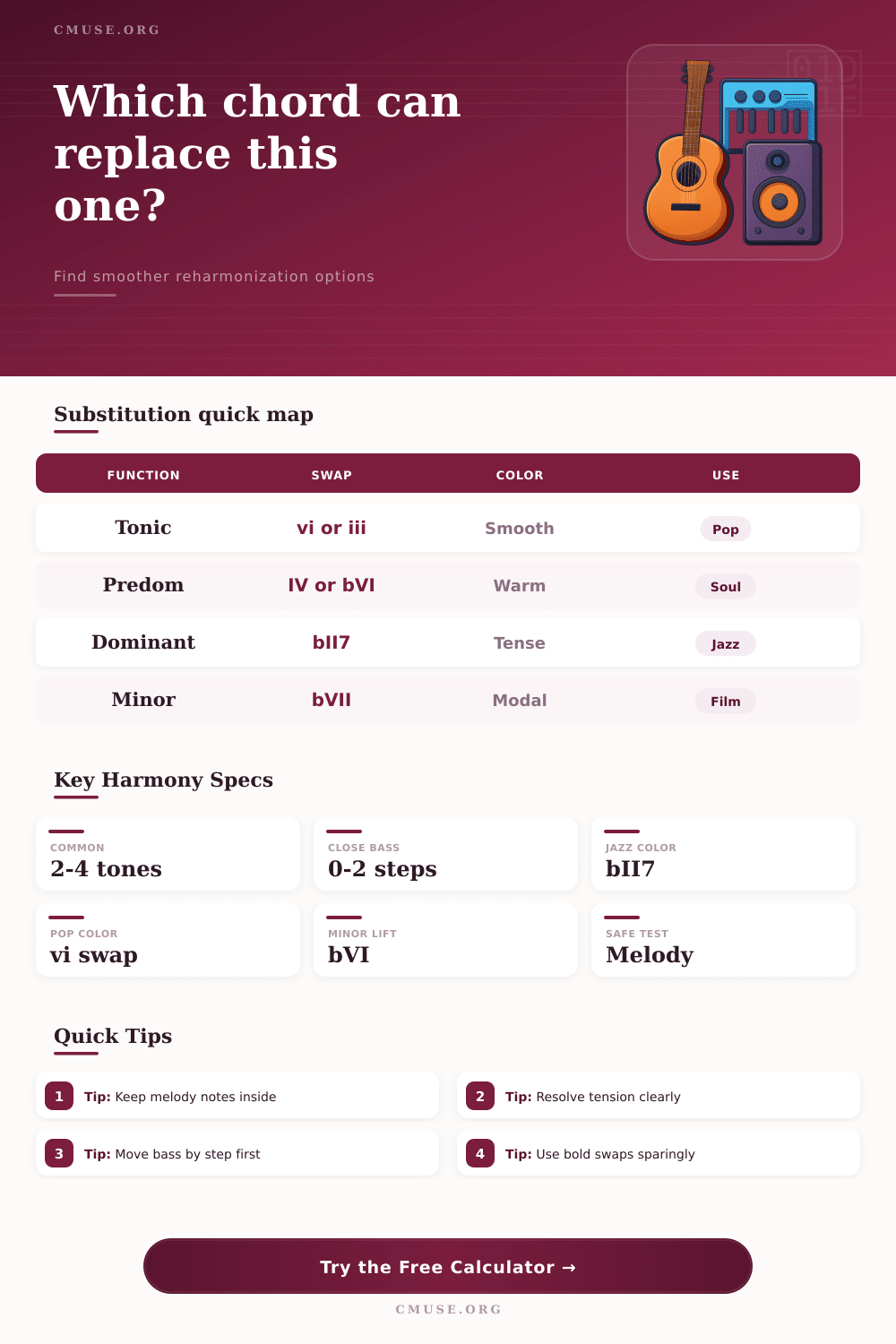
Choose a key, chord function, melody note, and style target to generate functional reharmonization options with shared-tone, bass-motion, and tension checks.
Preset use: Load a real writing context, then change the melody note or color target to compare diatonic, secondary dominant, tritone, borrowed, and modal substitutions.
Calculation Breakdown
| Original Function | Conservative Swap | Color Swap | Why It Works |
|---|---|---|---|
| I tonic | vi or iii | Imaj9 or bIIImaj7 | Shares tonic notes while changing bass color |
| ii predominant | IVmaj7 | bVImaj7 or #iv°7 | Prepares dominant with shared scale tones |
| V dominant | vii°7 | bII7 tritone sub | Preserves leading-tone pull to the tonic |
| vi relative minor | I6 or iii7 | IVmaj7 or bVImaj7 | Keeps tonic-family stability with a softer root |
| iv borrowed minor | iiø7 | bVII7 backdoor | Uses modal mixture before resolving home |
| Style Target | Preferred Substitution | Typical Tension | Best Harmonic Moment |
|---|---|---|---|
| Diatonic pop | Relative minor, mediant, IV for ii | Low | Verse loops and singable choruses |
| Jazz standard | Tritone sub, secondary dominant, diminished passing | Medium to high | Cadences, turnarounds, bridge approaches |
| Soul or gospel | Backdoor bVII7, borrowed iv, bVImaj7 | Medium | Final phrases and plagal moves |
| Film harmony | Chromatic mediant, planed major chords | High | Scene changes and emotional lifts |
| Modal writing | bVII, sus chords, quartal color | Low to medium | Vamps without strong V-I gravity |
| Progression Moment | Plain Chord | Substitution Option | Resulting Sound |
|---|---|---|---|
| ii-V-I in C | Dm7 - G7 - Cmaj7 | Dm7 - Db7 - Cmaj7 | Smooth chromatic dominant descent |
| Pop tonic in G | G - D - Em - C | Em - D/F# - G - C | Same center with softer opening color |
| Blues close in E | B7 - A7 - E7 | F7 - A7 - E7 | Bright tritone dominant before home |
| Minor cadence in A | Bm7b5 - E7 - Am | Fmaj7 - E7b9 - Am | Borrowed predominant with darker pull |
| Gospel close in B♭ | F7 - B♭ | A♭7 - B♭ | Backdoor dominant with warm release |
| Melody Degree | Usually Fits | Watch Out For | Good Substitution Use |
|---|---|---|---|
| 1 | I, vi, IVmaj7, bVImaj7 | Sharp altered dominants | Tonic replacement and modal mixture |
| 2 | ii7, V9, bVII13, sus chords | Plain major triads without added 9 | Suspended and dominant extensions |
| 3 | Imaj7, iii7, vi7, secondary dominants | Minor borrowed iv | Smooth pop and R&B reharmonization |
| 4 | ii7, IV, V7sus, bVII7 | Major tonic triads | Predominant and backdoor motion |
| 5 | I, iii, V, vi7, bIIImaj7 | Tritone roots without extensions | Mediant color and tonic-family swaps |
| 6 | ii7, IVmaj7, vi, bVImaj7 | Dominants with flat 13 conflict | Warm borrowed and relative-minor color |
| 7 | V7, vii°7, Imaj7, iii7 | Flat-seven modal chords | Dominant pull and major seventh color |
Chord substitution are the process of replacing one chord within a musical progression with a different chord. Chord substitution allow for musicians to change the color of a musical progression, the bass lines of a musical progression, or the placement of the melody within a musical progression, all without having to rewrite the musical progression altogether. Chord substitution can be used as an means of maintaining the function of the chord that is being replaced but changing the specific chord that is contained within that chord.
In order to use chord substitution effective, a musician must understand the musical functions of each of the chords within a musical progression. Each chord within a musical progression may have a specific function within the song; for example, a tonic chord provide stability to the song, a predominant chord create movement within the song, and dominant chords provides resolution to elements of the song. Each of these functions remain the same for each chord within the musical progression regardless of the specific note that comprise that chord.
How to Replace Chords in a Song
Chord substitution is used to find a new chord that provides the same musical function as the original chord. Another consideration for musicians is the melody of the song. The melody note of the song must be compatible with the new chord that is substituted for the original chord in that musical progression.
If the melody note of the song becomes an avoid note for the substituted chord, then that chord substitution will fail. While a single tone that is shared between the chord and the melody can make a chord substitution seem inevitable, two tones that is shared between the chord and the melody can make a chord substitution seem more dull. Another consideration for musicians is the movement of the bass lines of the song.
Stepwise bass line movement can help hide the fact that a chord substitution is occurring, but a circle of fifths movement creates a sense of that chord movement. Additionally, chromatic slides into the new chords will create tension within the song, and the consideration of bass movement will alter the chord substitution that is created. If a musician does not consider bass movement in a song, then the chord substitutions will sound as if they belong to another song altogether.
Another consideration for musicians is the style in which each chord substitution will be targeted. Diatonic chord substitutions is limited to the scale from which the song is created. Jazz chord substitutions introduce tension within the chords through tritone substitution.
Soul and gospel music may use borrowed chords to provide a lift to elements of the song such as it’s ending. In film music, chromatic mediants may be used to indicate a change in scene within the film. Modal substitutions allow chords to be substituted in a direction sideway rather than forward in the song.
Each of these options for chord substitutions contain a different level of tension within the song; therefore, they will sound differently when they are applied to the same musical progression. Common mistakes in chord substitution may occur if the musician chooses to ignore certain element necessary to perform chord substitution. For instance, if a musician chooses jazz chord substitutions for a pop vocal song, that is a common mistake that will result in overly complex chord substitutions.
Additionally, if a musician uses the same bass movement for each musical section of a song, that is another common mistake that will create a lack of contrast between each section of a song. Chord substitution can be treated as a short experiment. Each musician should try the first suggestion for chord substitution, then try the second suggestion for chord substitution, then return to the original chord.
The ear of the musician is the best judge of whether or not each chord substitution is successful. Each chord substitution should be attempted only if it creates some improvement to the musical line of the song. If a chord substitution seems to fight against the melody of the song, then that musician should select a different chord substitution.