Chord Extension Calculator
Build 7th, 9th, 11th, 13th, altered, added-tone, and rootless chord voicings from a root note, chord family, extension choice, and playable register.
Preset use: Load a common jazz, pop, gospel, funk, film, or guitar voicing, then adjust the root, upper extension, alteration, register, and spread.
Calculation Breakdown
| Extension | Simple Interval | Semitones Above Root | Common Function |
|---|---|---|---|
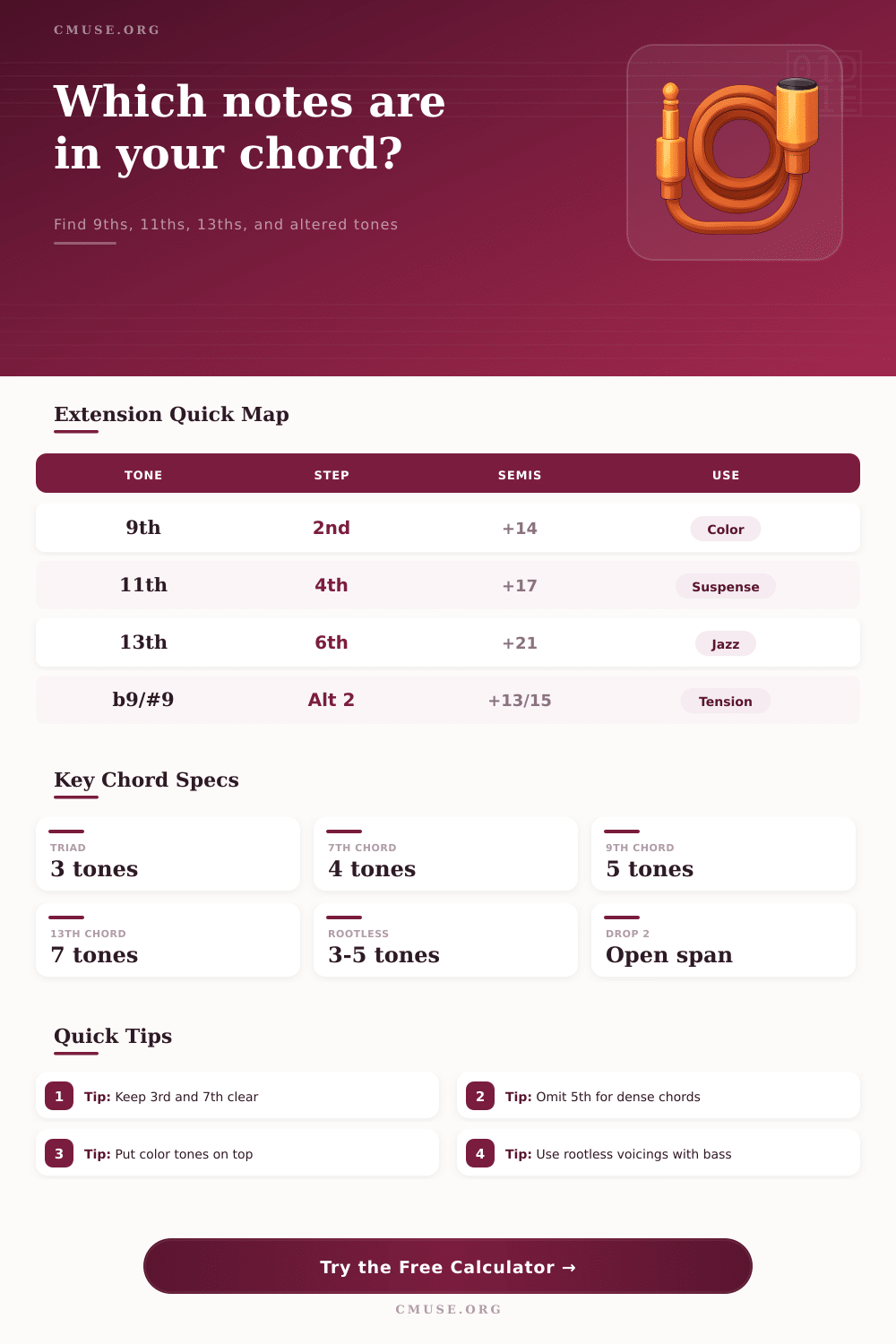
| 9th | Compound 2nd | 14 semitones | Smooth color above triads and seventh chords |
| Flat 9 | Lowered compound 2nd | 13 semitones | Strong dominant pull, especially into minor keys |
| Sharp 9 | Raised compound 2nd | 15 semitones | Blues and altered dominant bite with major 3rd |
| 11th | Compound 4th | 17 semitones | Suspended or modal color; can clash with major 3rd |
| Sharp 11 | Raised compound 4th | 18 semitones | Lydian major or dominant color without the natural 11 clash |
| 13th | Compound 6th | 21 semitones | Open jazz color, often voiced above 3rd and 7th |
| Flat 13 | Lowered compound 6th | 20 semitones | Altered dominant color with darker resolution pressure |
| Family | Core Formula | Typical Extensions | Best Omission |
|---|---|---|---|
| Major 7 | 1, 3, 5, 7 | 9, sharp 11, 13 | Omit 5th when adding sharp 11 and 13 |
| Minor 7 | 1, b3, 5, b7 | 9, 11, 13 | Keep 11 for modal color; 5th can go |
| Dominant 7 | 1, 3, 5, b7 | b9, #9, #11, 13, b13 | Omit 5th before omitting 3rd or b7 |
| Minor major 7 | 1, b3, 5, 7 | 9, 11, 13 | Keep 7th audible for the signature color |
| Half-diminished | 1, b3, b5, b7 | 9, 11, b13 | Do not omit b5; it defines the family |
| Diminished 7 | 1, b3, b5, bb7 | 9, 11, b13 | Keep symmetry clear before adding colors |
| Voicing | Main Treatment | Strong For | Span Tendency |
|---|---|---|---|
| Closed position | Stacks tones as close as possible | Choir pads, compact piano blocks, horn section checks | Smallest span |
| Open position | Raises alternating upper tones | Ballads, film harmony, spacious keyboard parts | Wide span |
| Drop 2 | Drops the second-highest voice one octave | Guitar sets, horn soli, jazz keyboard color | Medium-wide span |
| Rootless keyboard | Removes root, keeps 3rd and 7th | Jazz comping with bass, left-hand voicings | Medium span |
| Shell plus color | Prioritizes root, 3rd, 7th, top color | Arranging sketches and quick lead-sheet choices | Controlled span |
| Guitar friendly | Limits note count and spread | Playable grips and chord-melody reductions | Targeted span |
| Recipe | Formula | Typical Notes In C | Practical Use |
|---|---|---|---|
| Cmaj9 | 1, 3, 5, 7, 9 | C E G B D | Clean major color for pop, jazz, and film cues |
| Cm11 | 1, b3, 5, b7, 9, 11 | C Eb G Bb D F | Minor modal sound with a soft suspended top |
| C13 | 1, 3, 5, b7, 9, 11, 13 | C E G Bb D F A | Dense dominant color; often omit 5th or 11th |
| C7b9 | 1, 3, 5, b7, b9 | C E G Bb Db | Classic V7 tension resolving down a fifth |
| C7#11 | 1, 3, 5, b7, #11 | C E G Bb F# | Lydian dominant color for jazz and fusion |
| C6/9 | 1, 3, 5, 6, 9 | C E G A D | Stable major color without a leading-tone 7th |
Chord extensions involve adding additional note to a basic chord triad to create chords with additional color to the basic triad chord. A basic chord consists of a root, third, and fifth note. However, chord extensions go beyond the fifth note to add notes such as the ninth, eleventh, or thirteenth note to a chord.
Adding these notes make the chord more complex. However, too many chord extension can make a chord sound muddy. Therefore, before adding chord extensions, a musician must decide how to add these extensions to keep the chord clear to the listener.
How to Use Chord Extensions
Several decisions must be made before playing chord extensions. The musician must decide on the chord family that they will use. Additionally, they must decide the number of chord extensions that they want to use.
Furthermore, the musician must decide if they will alter the chord extensions and how they will voice those chord extensions. The third and seventh notes is known as the guide tone for a chord. These are the most important note for a chord because they determine where the chord is going.
The chord extensions simply provide color to the chord; however, the extensions provide color only if the guide tones remains clear and strong in the chord. A chord extension calculator is a helpful tool for musicians to manage the chord extensions in a chord. A chord extension calculator takes the variables that a musician use, such as the root of the chord, the quality of the chord, the chord extensions to be used, the alterations to the chord, the voicing of the chord, and the treatment of the fifth note in the chord.
Based off these variables, the chord extension calculator will show the musician the resulting chord notes. Using a chord extension calculator, a musician can see if the chord notes will work for their instrument. They can see the span of the chord and the density of the chord notes.
The reference tables will allow a musician to understand the intervals of the chord extensions, such as why a sharp eleventh note is a semitone above the natural fourth note. Many musicians will find that omitting the fifth note in a chord will allow for additional chord extensions to be played in the chord. Because the fifth note is less distinctive than the other notes in a chord, it can be omitted to allow for more room for chord extensions such as the ninth, eleventh, and thirteenth notes.
Additionally, another way to manage chord extensions is to use rootless voicing. In a rootless voicing, the musician omits the root of the chord so that a bass player can play that root note. This allows for chord extensions to be played while having enough space in the chord for each note to ring clearly.
Depending on the type of music that is to be played, there will be different density of chord extensions that will work best. Gospel and soul music will use many chord extensions to create the thick sound that is required for these music genre. Jazz music will use chord extensions with more air space between each extension so that the chords has breathing room for the instrumentation to stand out from each other.
Guitar players may use fewer chord extensions because it is difficult for them to play six or more notes at once. The chord extension calculator will allow musicians to accommodate for these differences with the chord extension variables and the chord span that will result. A common mistake that many musicians make when playing chord extensions is that they treat all chord extensions as being of the same importance.
However, the top note of a chord is the most important for a chord’s identity. Therefore, the musician should place the most interesting of the chord extensions on the top note of a chord to give it a sense of identity. Placing the chord extension in the middle of a chord can make the identity of that chord not as clear to the listener.
The chord extension calculator can be used to calculate and test a few different chord extensions to determine which should be the highest note of the chord. Additionally, the chord extensions that are used will also dictate the chord’s timing. Using many chord extensions in a chord can work for long time span of music.
However, it can look clumsily for music that requires chords to change quickly. For fast timings, shell voicings can work better. Shell voicings contain only the root, third, seventh, and one chord extension.
These voicings work better for faster musical rhythms than chords with many extensions. The chord extension calculator can help a musician by demonstrating the difference in the number of notes that will be played in a chord. However, the musician must make the decision on which chord will work best for the specific musical phrase that is to be played.
The purpose of using chord extensions is not simply to play more notes in a chord. No, the purpose is to ensure that the correct notes are played in the correct register for the chord. The goal is to create a chord that contains the chord extensions to provide color to the chord while ensuring that the third and the seventh notes are still audible.
If the third and seventh notes are still audible, the chord extensions can be used to provide color to the chord without fighting for the listener’s attention. The chord extension calculator will calculate and demonstrate the chord extensions that will be played. However, a musician must use their ears to fine-tune the chord and ensure that it is correctly balance.