
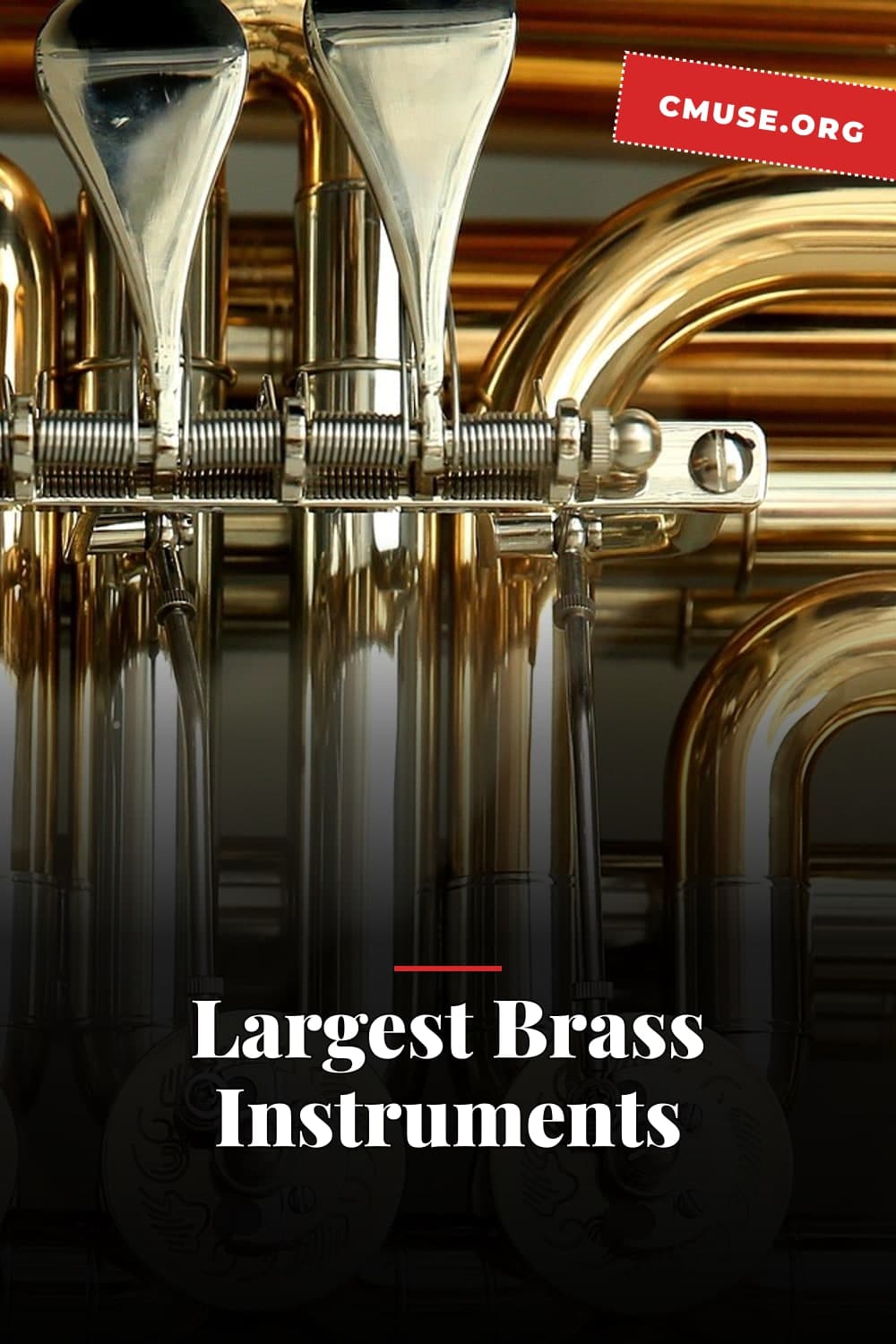
Brass instruments have a way of commanding attention. Their bold, resonant tones cut through orchestras, brass bands, and jazz ensembles with an authority that few other families can match. Yet while trumpets and trombones get most of the spotlight, the true giants of the brass world lurk in the back row where their sheer size and sonic power can overwhelm everything around them.
These instruments are not just bigger versions of familiar horns. They represent engineering marvels built to produce frequencies so low they can rattle your ribcage. Exploring the largest brass instruments reveals how musicians and makers have pushed the limits of physics, metallurgy, and human lung capacity in the pursuit of deeper, richer sound.
What makes an instrument qualify as one of the largest goes beyond simple length or weight. The real measure is its tubing length, bell diameter, and the fundamental pitch it can reach. These monsters often require multiple players, custom stands, or even mechanical assists just to produce a single note.
Their history stretches from 19th century experiments in Wagner’s operas to modern marching band spectacles and avant-garde performances. Each one on this list earns its place by redefining what a brass instrument can be, both in scale and in the unique musical role it fills. You’ll see how size creates tradeoffs in agility, portability, and sheer playability, yet the payoff in sonic depth makes it all worthwhile.
The Most Impressive Large Brass Instruments
1. Serpent
The serpent stands as one of the earliest attempts to build a truly deep brass voice. Developed in France during the late 16th century, this instrument consists of a long wooden tube covered in leather and bent into a sinuous shape that gives it its name. Players blow through a brass mouthpiece into a narrow bore that flares out to a small bell, producing a tone that sits comfortably in the bass register.
Its winding design, often stretching over eight feet when uncoiled, allowed musicians to reach low notes that were impossible on straight trumpets of the era. That practical solution to an acoustic problem is exactly why the serpent earned a lasting spot in church music and early orchestras. It bridged the gap between vocal bass lines and the brighter brass section, adding a woody, vocal quality that still surprises listeners today.
The instrument’s awkward shape made it notoriously difficult to play in tune, which is the part most people miss when romanticizing its history. Finger holes cut into the wood provided limited pitch control, forcing players to rely on embouchure and breath support to coax accurate notes. Despite those challenges, the serpent remained popular for over two centuries because nothing else could deliver that particular dark, reedy bass timbre.
Composers like Handel and Mendelssohn wrote parts specifically for it. When you hear a modern reproduction in a period ensemble, you understand why musicians tolerated its quirks. The serpent’s size was not about spectacle but about solving a real musical need in a time before valves and modern keywork existed.
2. Ophicleide
Next comes the ophicleide, essentially a keyed brass version of the serpent that arrived in the early 19th century. Its name means “keyed serpent” in Greek, and the design replaced the serpent’s leather-covered wood with a wide conical brass tube that unfolds to roughly nine feet. Seven to nine keys operated by the left hand allowed for much better intonation than the older instrument could achieve.
The ophicleide quickly found its way into military bands, orchestras, and even early jazz experiments because it offered power and projection that the serpent never quite managed. Its bell, often measuring ten inches across, helped it cut through louder ensembles without losing its characteristic warmth.
What makes the ophicleide special is how it balanced size with playability. Unlike later contrabass instruments that demand heroic effort, a skilled player could navigate scales and arpeggios with surprising agility. That versatility earned it temporary stardom in works by Berlioz and Verdi.
Yet the ophicleide’s reign was short-lived once the tuba family matured. Its keys proved finicky in extreme temperatures, and the rise of valved brass instruments offered easier alternatives. Still, if you attend a brass band concert featuring one of the few remaining master players, you hear exactly why it mattered.
The ophicleide proved that a large brass instrument could be both powerful and musically nimble, setting the stage for everything that followed.
3. Contrabass Trombone
The contrabass trombone takes the familiar slide mechanism and scales it up dramatically. Modern versions often feature a double slide with tubing that stretches nearly fifteen feet when fully extended. The bore can reach one inch in diameter, and the bell flares out to twelve inches or more.
These instruments produce a sound so low and rich that it feels less like a brass note and more like moving air itself. Composers call for them when they want the orchestra’s foundation to shake the floorboards. Wagner used them extensively in his operas, understanding that their dark power could convey both menace and majesty.
Playing one requires serious physical commitment. The slide positions are wider, the mouthpiece is larger, and sustaining notes in the true pedal register demands enormous breath support. That’s the tradeoff that keeps the contrabass trombone from being more common.
Yet when a section of three plays in unison, the effect is unmatched. You feel the sound as much as you hear it. Orchestral musicians often switch between standard and contrabass models during a single concert, showing how the larger instrument fills a specific low end role that no other brass voice can replicate with the same clarity and punch.
4. Euphonium
The euphonium, sometimes called the tenor tuba, brings a more lyrical personality to the low brass conversation. While not the absolute largest, its wide conical bore and generous bell diameter of around fifteen inches allow it to produce a warm, singing bass that blends beautifully with other instruments. The instrument measures about nine feet of tubing in its standard form, though compensating systems add extra loops that increase both complexity and capability.
Its four or five valves give players access to a chromatic range that reaches deep into the bass clef while maintaining the smooth, vocal quality that has made it a favorite in British brass bands for over a century.
The euphonium earns its place on this list because it proves size does not always equal brute force. Its tone can be astonishingly delicate, capable of nuanced phrasing that larger tubas struggle to match. Solo repertoire for the instrument has grown dramatically in recent decades, with players like Steven Mead demonstrating its expressive range.
When you listen to a euphonium performing a lyrical melody over a brass ensemble, you realize how its proportions create the perfect balance of power and finesse. It is large enough to anchor the harmony yet agile enough to carry the tune, which is exactly why it remains essential in so many ensembles.
5. Helicon
The helicon represents a clever solution to the problem of playing massive brass instruments while marching. Developed in the mid-19th century, this contrabass instrument wraps its thirteen feet of tubing in a circular shape that rests on the player’s shoulder. The bell points forward, projecting sound directly over the band rather than into the sky.
Its large bore and impressive bell diameter allow it to deliver the same low fundamentals as a standard tuba but in a configuration that distributes weight more evenly. Sousa’s bands popularized the helicon before the sousaphone improved upon the design, yet the helicon retains a loyal following in European folk and military traditions.
The instrument’s ergonomic approach to size is what makes it fascinating. By reshaping the tubing into a wearable form, makers turned an otherwise stationary giant into a mobile powerhouse. Players still need strong lungs and sturdy backs, but the helicon allows bass voices to participate in parades and outdoor performances that would otherwise exclude them.
Its continued use in specific cultural contexts shows how thoughtful design can overcome the natural limitations of extreme size. When you see a line of helicons in a traditional Bavarian band, you understand that sometimes the largest instruments need to adapt their shape to remain practical.
6. Tuba
The tuba itself, particularly the contrabass models, sits at the pinnacle of conventional brass instrument size. A full-sized BB-flat contrabass tuba can stretch eighteen feet when uncoiled, with a bell that reaches two feet in diameter. These instruments serve as the foundation of orchestras, wind ensembles, and brass bands, providing the deep bedrock upon which everything else is built.
Their rotary or piston valves, combined with an enormous bore, allow them to produce clear, focused tones even in the lowest registers where smaller instruments simply fade away.
What separates the best contrabass tubas from lesser models is not just size but the precision of their design. Makers like Meinl-Weston and Miraphone have refined these instruments over generations to minimize the intonation problems that naturally arise with such long tubing. The result is an instrument that can both rumble with thunderous power and deliver surprisingly agile passages when required.
Orchestral tubists often speak of their instrument as having a personality that rewards patience and punishes haste. That combination of immensity and musical sensitivity is why the tuba remains the gold standard against which all other large brass instruments are measured.
7. Subcontrabass Tuba
Finally, the subcontrabass tuba, sometimes called the hyperbass or simply “the monster,” pushes the concept to its logical extreme. These rare instruments feature tubing lengths exceeding thirty feet and bells large enough to fit a child’s head inside. Only a handful exist in the world, often custom-built for specific ensembles or experimental projects.
They can produce fundamental pitches so low they border on the infrasonic, notes that you feel more than hear. Some models incorporate extra valves or even electronic assistance to manage the immense air column.
Their rarity and difficulty make them more curiosity than practical tool, yet they serve an important role in expanding our understanding of what brass instruments can achieve. When a subcontrabass tuba joins a performance, it redefines the sonic landscape entirely. The air movement alone creates a physical presence that changes how listeners experience the music.
These instruments remind us that the quest for deeper sound has no theoretical endpoint, only practical boundaries of human capability and engineering. Their existence proves that even after centuries of development, brass instrument makers continue to dream bigger.
In the end, these largest brass instruments show us that size in music is never just about volume or spectacle. Each one solves a particular sonic puzzle while introducing new challenges of its own. Whether you are listening to a serpent in a Renaissance ensemble or feeling the floor shake under a modern contrabass tuba, you are experiencing the same fundamental human impulse: the desire to push instruments to their physical limits in search of sounds that resonate somewhere deeper than ears alone can register.
The next time you encounter one of these giants in a concert hall or marching field, take a moment to appreciate the engineering, history, and sheer determination required to bring such massive voices to life. They may be impractical, demanding, and occasionally ridiculous, but they expand what music can be in ways that smaller instruments never could.