Phantom Power Load Calculator
Estimate total condenser microphone current, supply headroom, phantom power draw, and cable voltage drop for P12, P24, and P48 audio systems.
🎙 Session Presets
⚡ Phantom Power Inputs
📊 Phantom Power Spec Grid
🔌 Typical Microphone Current Ranges
| Device Type | Typical Current | Planning Value | Load Note |
|---|---|---|---|
| Small diaphragm condenser | 2 to 5 mA | 4 mA | Often efficient for stereo work |
| Large diaphragm condenser | 3 to 7 mA | 5 mA | Some tube-style FET models draw more |
| Shotgun condenser | 2 to 6 mA | 5 mA | Long cables can matter on location |
| Active DI box | 3 to 8 mA | 6 mA | Check pad and active circuit specs |
| Boundary microphone | 2 to 5 mA | 3.5 mA | Useful for conference or stage arrays |
⚙ Phantom Standards and Feed Resistors
| Standard | Nominal Voltage | Feed Resistors | Common Use |
|---|---|---|---|
| P48 | 48 V | 6.81k each leg | Modern studio microphones and interfaces |
| P24 | 24 V | 1.2k each leg | Some legacy or compact systems |
| P12 | 12 V | 680 ohm each leg | Older portable and broadcast gear |
| Custom | User set | Device dependent | Use only with verified equipment data |
📏 Cable Resistance Reference
| Cable Type | Approx Ohm per 1000 ft | Best Use | Voltage Drop Behavior |
|---|---|---|---|
| 22 AWG low loss | 16.1 ohm | Long studio or stage runs | Lowest drop in this calculator |
| 24 AWG standard | 25.7 ohm | General XLR microphone cable | Good for most live and studio work |
| 26 AWG thin | 40.8 ohm | Short stage patches | Watch long runs with high current mics |
| 28 AWG mini | 64.9 ohm | Mini multicore or compact snakes | Highest drop, keep runs shorter |
🎧 Common Session Planning Examples
| Session | Devices | Current Estimate | Suggested Supply |
|---|---|---|---|
| Solo vocal overdub | 1 condenser | 4 to 6 mA | Any healthy P48 channel |
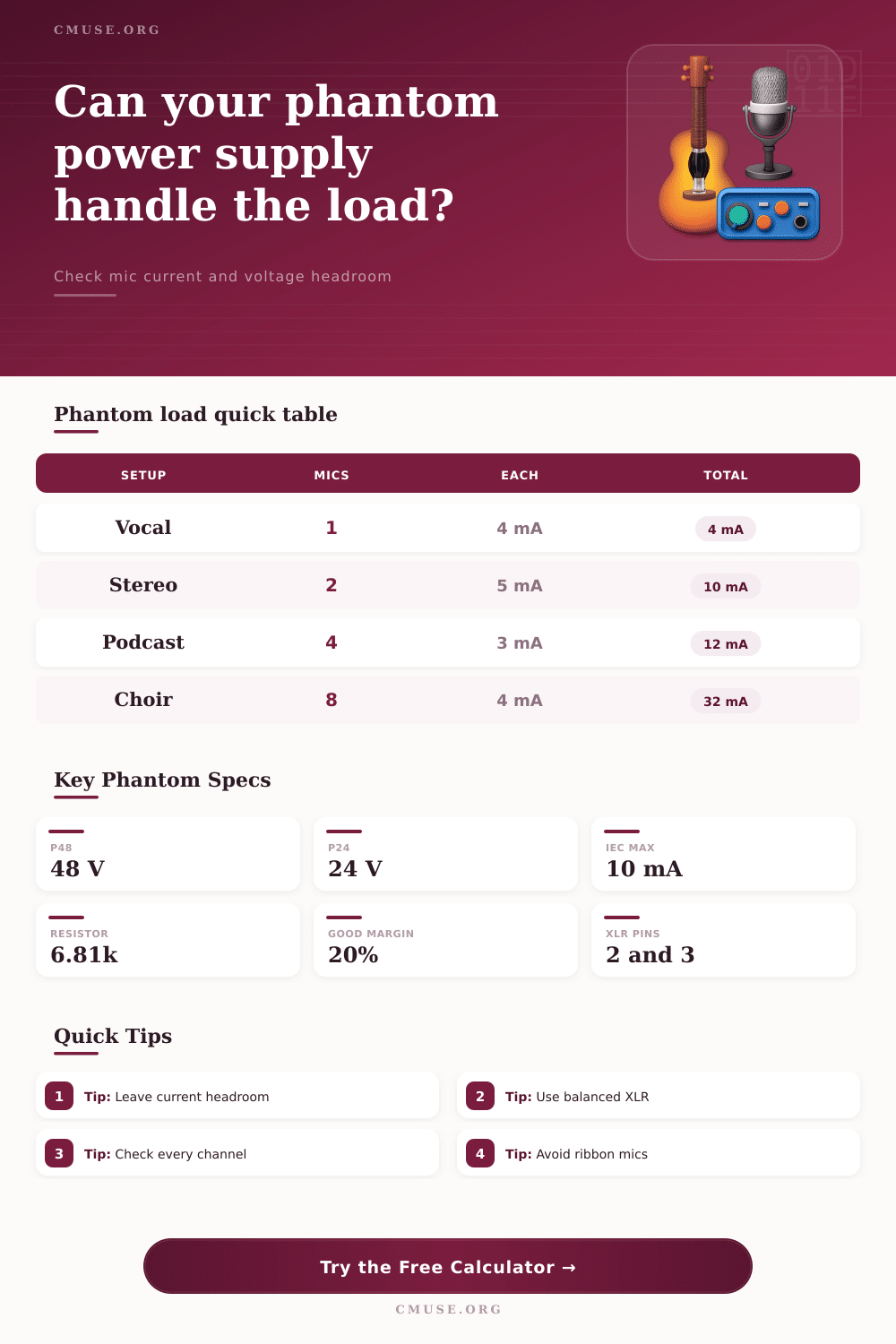
| Stereo acoustic guitar | 2 condensers | 8 to 12 mA total | 20 mA supply with margin |
| Four-person podcast | 4 condensers | 12 to 24 mA total | 32 mA or more preferred |
| Choir or ensemble array | 6 to 10 mics | 24 to 50 mA total | Dedicated mixer phantom rail |
| Location film kit | Shotgun plus spots | 15 to 35 mA total | Extra headroom for long cables |
When the session to record takes place, it is possible that the condenser microphones will not be able to function. However, the condenser microphone is rarely the source of the failure of the recording devices. More often, the condenser microphone will fail to function because the phantom power supply cannot provide the currents necessary to the various microphones that may be turned on at once.
Thus, phantom power can become a problem in relation to the recording devices if the total current draws of the microphones are to great for the phantom power supply to handle. To determine whether the phantom power supply can handle the current draw of the various microphones that will be used during the recording session, a calculator can be used. To calculate the current draw of the phantom power supply, several different piece of information are required to be entered into the calculator.
How to Use a Phantom Power Calculator for Microphones
For instance, the user must enter the number of active device that will be used during the recording session, as well as the current draw of each of those devices. The user can enter the capacity of the phantom power supply into the calculator, as well as the length and gauge of the longest cable that will be used during the recording session. Most moddern audio interfaces will provide a limit of approximately ten milliamps of current per channel.
However, many large-diaphragm condenser microphones will only require between three and seven milliamps of current each. While the current requirement of a single condenser microphone may be small, the current requirements of many condenser microphones may be too greatly for some recorders. For instance, if a shotgun microphone and several plant microphones is connected to a single recording device, it is possible that the current draw of those various condenser microphones will exceed the capacity of that recorder.
The length and gauge of the cables that connect the various devices will also have an impact on the amount of voltage that reaches the condenser microphone. Every foot of cable will add to the resistance of the circuit to the condenser microphone. The longer the cable, and the thinner the gauge of the cable, the greater voltage drop that will occur due to this resistance.
Thus, the calculator can provide an estimate of the voltage drop of the various lengths and gauges of the cables prior to the recording session taking place. Headroom can be provided for the phantom power supply in addition to the current requirements of the microphones. The user can enter headroom into the calculator as a percentage that represents the headroom that will be provided to the phantom power supply.
Maintaining headroom for the power supply will prevent the phantom power supply from failing due to the possibility that the microphone may draw more current than specify by the manufacturer of the microphone, or due to changes in the temperature of the microphone and it’s circuit. An exception to phantom power supply usage are ribbon microphones. Phantom power sent to a ribbon microphone can destroy the ribbon element within the microphone.
Thus, the user must take care with phantom power supplies to ensure that they views the type of microphone that is connected to each channel prior to turning on phantom power. Additionally, active direct boxes will also draw current from the phantom power supply, and the amount of current that the direct box draws can change if the pad is turned on. Recording sessions may use many different types of microphones, and the different types of microphones may have different current draws.
For instance, a choir array may include both small-diaphragm condenser microphones and boundary microphones, each of which may have different current requirements. Thus, the user can adjust the current draw of each type of microphone within the calculator. Manufacturers of phantom power supplies can list either the total current draw of the power supply, or the per-channel current draw.
Thus, if the total current draw is not known, it is best to use the per-channel specification of the phantom power supply as the maximum amount of current that can be drawn, and to apply headroom to that specification. The use of the phantom power supply calculator will provide certainty prior to the beginning of the recording session. While small vocal overdubs or other small groups of microphones is within the capacity of the power supply, the capacity of the power supply may become to be of concern if many microphones are to be used, or if the recording session will involve the use of long cables.
By knowing the total current draw of the microphones that are to be used during the recording session, it is possible to prevent any failure of the phantom power supply during that recording session. Thus, the phantom power supply calculator ensures that the power supply will remain stable during the recording session, that each microphone will have an adequate amount of voltage, and that there will be no power supply problems during that recording session.