Earplug NRR Calculator
Estimate field-adjusted earplug attenuation, protected dBA, daily dose, and allowed exposure time for rehearsals, venues, studios, and loud equipment.
🎧 Quick Presets
📈 Protection Inputs
📌 NRR Spec Grid
| Adjustment Method | Formula Used | Best Use | Conservative Level |
|---|---|---|---|
| NRR minus 7 only | Reduction = NRR - 7 | Basic A-weighted estimate | Least conservative |
| 50% safety factor | Reduction = (NRR - 7) / 2 | Workplace planning screen | More conservative |
| NIOSH type derating | Reduction = derated NRR - 7 | Compare protector styles | Varies by type |
| Custom fit percent | Reduction = (NRR - 7) x fit percent | Known fit-test or field estimate | User controlled |
| Earplug Type | Typical Label NRR | Real-World Variable | Calculator Note |
|---|---|---|---|
| Foam roll-down plug | 29-33 dB | Deep insertion and seal | Use foam derate or 50% factor |
| Filtered musician plug | 12-25 dB | Filter curve and fit | Good for flatter music balance |
| Premolded reusable plug | 20-27 dB | Canal shape match | Often modeled as non-formable |
| Custom molded plug | 15-30 dB | Impression quality and filter | Use custom percent when known |
| Banded canal cap | 14-25 dB | Positioning consistency | Best for intermittent use |
| Music Scenario | Typical dBA | Common Plug NRR | Why Calculate |
|---|---|---|---|
| Acoustic rehearsal | 82-90 dBA | 12-18 dB | Avoid over-muffling detail |
| Band rehearsal | 94-102 dBA | 20-29 dB | Check protected level |
| Drum room | 98-108 dBA | 29-33 dB | Duration matters quickly |
| Club or stage | 100-110 dBA | 25-33 dB | Consider dual protection |
| Pyro or tools | 110-120 dBA | 30-33 dB | Impulse checks need caution |
| Unprotected Level | NRR 22 at 50% | NRR 29 at 50% | NRR 33 at 50% |
|---|---|---|---|
| 90 dBA | 82.5 dBA | 79.0 dBA | 77.0 dBA |
| 95 dBA | 87.5 dBA | 84.0 dBA | 82.0 dBA |
| 100 dBA | 92.5 dBA | 89.0 dBA | 87.0 dBA |
| 105 dBA | 97.5 dBA | 94.0 dBA | 92.0 dBA |
| 110 dBA | 102.5 dBA | 99.0 dBA | 97.0 dBA |
Earplugs have a Noise Reduction Rating. The Noise Reduction Rating is the number that is printed on the package of the earplugs. The Noise Reduction Rating is derive from laboratory tests on the earplugs.
However, the Noise Reduction Rating does not always correspond to earplugs’ effectiveness when used in real-world settings. There are a variety of reasons why earplugs may not reflect the Noise Reduction Rating in real-world settings. For one, people do not always insert earplugs to the correct depth into they ears.
How Well Earplugs Protect Your Hearing
Additionally, people have different shape ear canals, which means that some people may have better fits for earplugs than others. Furthermore, earplugs may become loose when people are moving, which means that the earplugs may not work as efficient as the Noise Reduction Rating suggests. For these reasons, people should always assume that earplugs will not provide the Noise Reduction Rating amount of noise reduction in a real world settings.
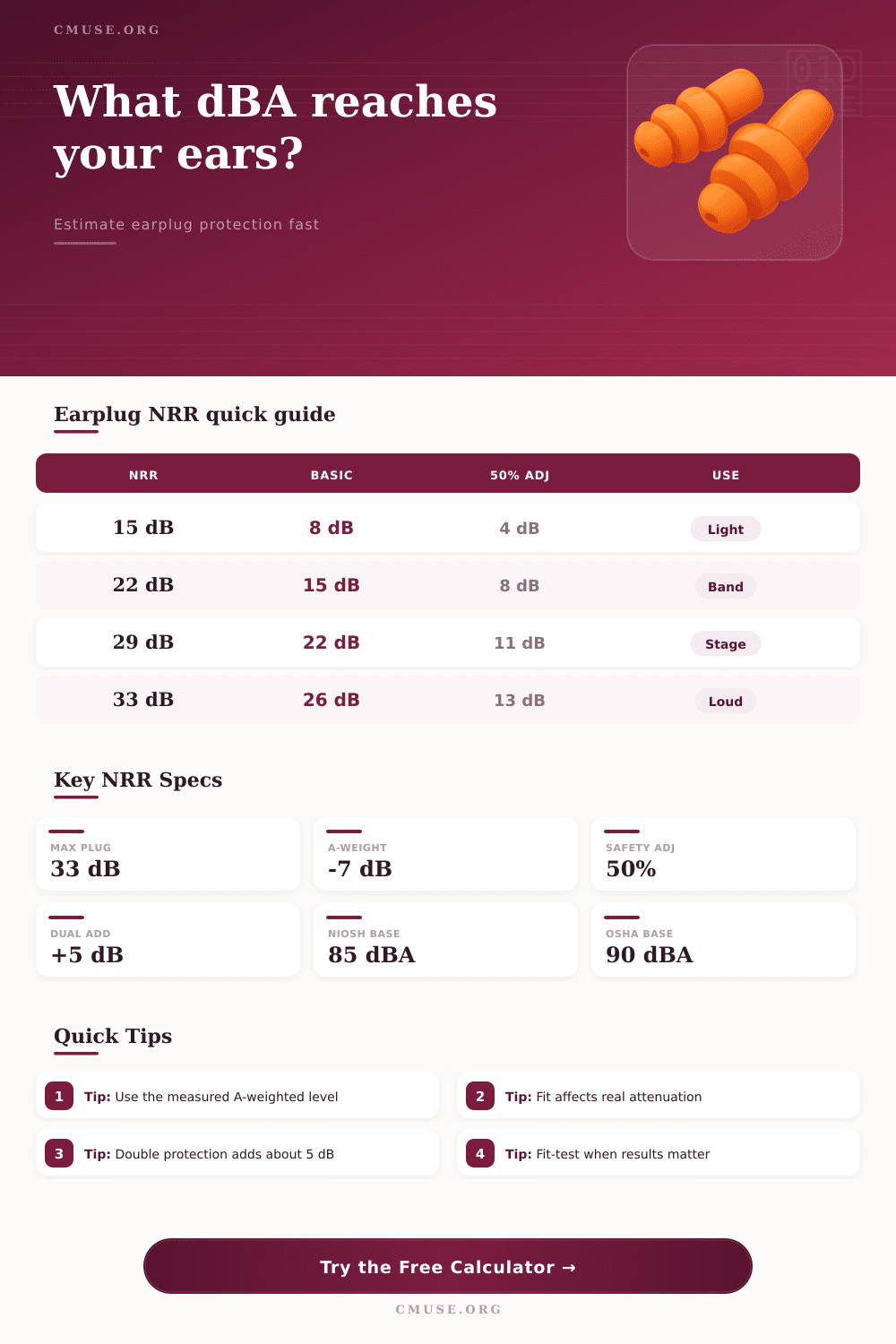
To calculate how much noise reduction earplugs will actualy provide, there are a couple of mathematical methods. One method is to subtract seven decibel from the Noise Reduction Rating of the earplugs. This is because laboratory tests use C-weighted sound measurements while the sounds that people are exposed to in everyday life use A-weighted sound measurements.
Secondly, take the resulting number and divide by two. This is because earplugs may not provide a perfect fit to peoples ears. For instance, a high Noise Reduction Rating earplug may lose much of its effectiveness if it is not inserted deep into the ear canal.
Additionally, earplug effectiveness may vary based off the types of earplug that is used, whether it is foam earplugs or silicone earplugs. Once you know the expected noise reduction, you can calculate how long you should remain in that loud environment. Regulatory bodies has established that humans should not be exposed to noise levels above eighty-five decibels for more than eight hours.
However, the higher the decibel levels are, the more dangerous it is for the ears of the individuals exposed to such loud noise for extended periods of time. Using a calculator, it is possible to determine whether your earplugs provide enough noise protection. The calculator will ask for the decibel measurement of the sound that you are exposed to, your earplugs noise rating, how well you fit into the earplugs, and for how long you are exposed to the loud noise.
Using this calculator will help you determine whether you need more earplugs, or if you need to reduce the amount of time that you are exposed to loud noises. Another option is to use dual protection. Dual protection mean wearing both earplugs and earmuffs at the same time.
You should not just assume that the two will add up to the two noise reduction ratings of the earplugs and earmuffs. An alternative method to calculate dual protection is to use the higher noise reduction rating of the two, and then add five decibels to that amount. This method of calculating dual protection can be helpful if the environment in which you are is louder than one hundred and five decibels.
However, you should also know that adding earmuffs to earplugs provides a small amount of additional noise protection. One of the most important factors to consider when using earplugs is the quality of the fit of the earplugs into the ear canal. The quality of the fit of the earplugs will determine the amount of noise that the earplugs will block.
You can test the fit of the earplugs by speaking into your own ear with the earplug inserted. Your voice should sound muffled through your ear canal when the earplug is inserted correct. Another alternative method to measuring the fit of your earplugs is to use professional fit testing system.
These systems will tell you the exact amount of noise that your earplugs will block. You should input this factor into all of your planning tool to ensure that you are calculating the amount of noise reduction that you will actualy experience when you wear the earplugs. Musicians have specific needs with earplugs.
Musicians must be able to hear the music that is being played when they are wearing their earplugs. For this reason, musicians use filtered earplugs instead of foam earplugs. Although foam earplugs may have high noise reduction rating, musicians must be able to hear the music.
Therefore, musicians prefer filtered earplugs because they even out the noise levels for each frequency of sound that is played. Depending upon the musician and the type of music that is to be listened to while wearing the earplugs, there may be a preference for a specific type of earplug. Earplugs should be purchased according to the tasks that you will be performing with them.
Impulse sounds, such as drum or cymbal sounds, can be very loud. These types of sound are very brief in length but reach high volumes. These high volumes of impulse sounds can damage the ears of those who is exposed to them.
Earplugs will reduce impulse sounds, but they will not eliminate the peaks of those impulses with the earplugs. When calculating the noise exposure for musicians, it is important to use only the average sound level of the noises, and to add a margin of safety to account for the peak impulses of those loud sounds. In addition to the noise that you may encounter in your performances, there may also be noise in your daily life.
The total exposure to noise is the total amount of noise that you will hear during your daily life. If you are a musician, you may need to rehearsal, teach music, or even record music. All of these activities will expose your ears to noise.
If you only calculate the noise that you may encounter during a music concert, you will not account for all of the noise that your ears may be exposed to. You should keep track of the total amount of noise exposure during your daily life in order to avoid the slow accumulation of noise that can lead to permanent hearing loss. Use a noise calculator to calculate the amount of noise exposure that you may be getting during your daily life.
However, you must be honest about how well the earplugs are seat into your ears. Using earplugs each day and accurately calculating the amount of noise in your environment will allow you to protect your hearing for a lifetime.