Exchange Rate Noise Calculator
Compare the booked exchange rate for a royalty, licensing, tour, or distribution payout against the actual conversion rate, processor spread, and likely low-high rate band.
Preset use: Load a real-world music business scenario, then adjust the source amount, booked rate, actual rate, rate band, spread, and payout split.
Calculation Breakdown
Booked rate
Rate move
Spread drag
Noise per split
| Rate Case | Rate Used | Gross Home Value | Spread Drag | Net Home Value |
|---|
| Split Plan | Source Per Split | Net Per Split | Noise Per Split | Use Case |
|---|
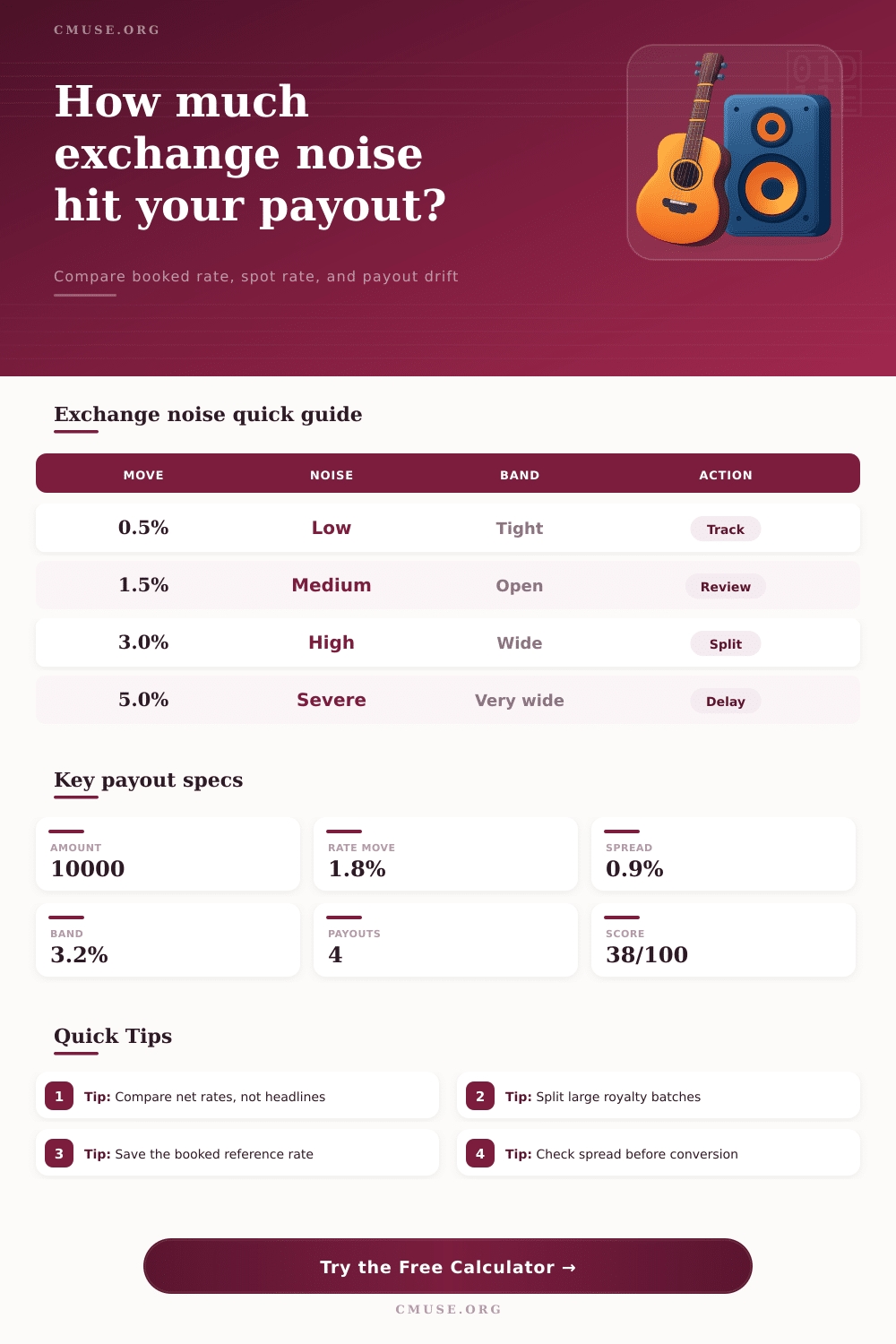
| Rate Move | Noise Level | Typical Music Payout | Practical Check |
|---|---|---|---|
| 0 to 0.75% | Low | Routine streaming, small catalog, or rehearsal reimbursement | Keep the conversion receipt with the statement. |
| 0.75 to 2% | Moderate | Quarterly royalties, mid-size licensing, club tour settlement | Compare booked and net rates before closing the report. |
| 2 to 4% | High | Publisher advance, festival settlement, international merch run | Split or time the conversion when the payout is not urgent. |
| 4%+ | Severe | Large sync, label recoupment, multi-territory distribution batch | Document the rate source and approve the conversion intentionally. |
| Scenario | Common Source | Noise Driver | Best Input To Verify |
|---|---|---|---|
| Streaming royalties | Distributor statement | Statement date versus transfer date | Booked reference rate |
| Publishing royalties | PRO or publisher report | Territory pooling and late settlement windows | Actual conversion rate |
| Tour settlement | Promoter or venue sheet | Weekend rate movement and transfer spread | Spread or fee percent |
| Sync licensing | License invoice | Large single conversion and invoice timing | Low-high rate band |
| Merch receipts | Card processor batch | Multiple small conversions across sale days | Payout split count |
When you recieve a royalty statement from a territory that uses a different currency than the currency you hold, the number on the royalty statement will likely be different then the number that arrives in your bank account. The difference between the two numbers are known as exchange noise. Exchange noise is created every time a royalty payment move across a border or a payment processor processes it.
Teams often dont notice the presence of exchange noise until they receive the royalty payment into their bank account, and until they realize that there expected royalty was not reflected in the book. While the difference between the two numbers on a single royalty statement may be small, exchange noise can reach significant levels when evaluating the royalty payments that arrives in a catalog or quarter. The booked rate for a royalty statement is the reference point that was recorded on a specific date for that royalty statement.
How Exchange Noise Affects Royalty Payments
However, the booked rate is not the rate at which royalties will be paid; the actual exchange rate may differ from the booked rate, and the payment processor may take a fee referred to as a spread for processing the payment. Additionally, the payment may be split into several payments, each of which could introduce additional exchange noise and distort the totalroyalty that is paid. It is important for teams to have an understanding of the potential for distortion of that royalty payment prior to finalizing royalty and accounting books for the period.
The various field of the calculator are important in that they allow teams to understand the impact that exchange noise have upon their royalty payments. The source amount is the total of the exchange noise that is present in the calculated royalty payments. The booked rate and actual rate fields allow for observations of the drift of the currency.
The low and high band field allow teams to enter the range of potential royalty payments for that period, the spread field allows for the inclusion of the fees of the payment processor, and the payout count field allows for teams to understand if the royalty payments are distributed in such a way that each royalty statement includes an even distribution of exchange noise or whether the exchange noise is concentrated within a few of the royalty statement for the period. It is common for many of these field to be underestimated by royalty teams. For instance, it is common for many teams to not consider the potential impact of a spread if the rate for the currency is drifting, as the two factors impact one another.
Consider that a spread of 0.8% may have a small impact upon a stable rate. However, the same 0.8% spread applied to a drifting currency rate of 2% will have a different impact upon the royalty payments. The calculator allows for teams to understand these impacts, such that teams dont have to manually calculate these rates every time that they are considering an exchange of royalty payments.
By understanding the net home payout figure that appears beside the booked reference rate on the royalty statement, teams can determine whether they would like to accept the royalty statement as is, or request the licensee to make changes to the royalty statement. The same logic that apply to individual royalty payments can be applied to split payouts. Split payouts occur when a license distributes a large royalty amount into several batches or royalty statements during a year.
By entering a split count figure into the calculator, teams can determine if the booked and actual rates for the license are even within the batches of royalty statements, or if they are instead concentrated within a few of the royalty payments. This information can be used to schedule follow-up royalty payments, or even to negotiate with the licensee a different language within the master license agreement. Royalty currencies may drift in value due to the difference in the time between when the distributor books the royalty for the period, and when the bank processes the royalty payments.
For instance, the books may be closed on the 15th of each month, but the bank may not process royalty payments until the 28th of the month. During this 13-day period, the exchange rate may change due to central bank meetings, news events, or even holidays within the country from which the royalty is source. Each of these fields within the calculator allow for teams to account for the potential impact of these currency movements.
While the impact of exchange noise may seem to have a minimal impact upon each royalty statement individually, the impact of exchange noise has the potential to become significant if those calculations are made over the entire catalog of royalties that each licensee manages. Thus, the royalty calculator makes that impact visible and adjustable while the royalty is still in the system and being processed. It is important for each licensee to develop a habit of using the royalty calculator in place of accepting the settlement figure that is provided with each royalty statement.
By comparing the booked rate to the current spot rate and the declared spread, teams can determine if there would of benefit in speaking to the licensee to adjust their royalty statement or splitting the batch of royalty payments to which they are entitled. While the royalty calculator does not remove the potential for royalty licensees to suffer a loss of value of their royalty payments due to exchange noise errors, it does make the size of that risk legible to each licensee.