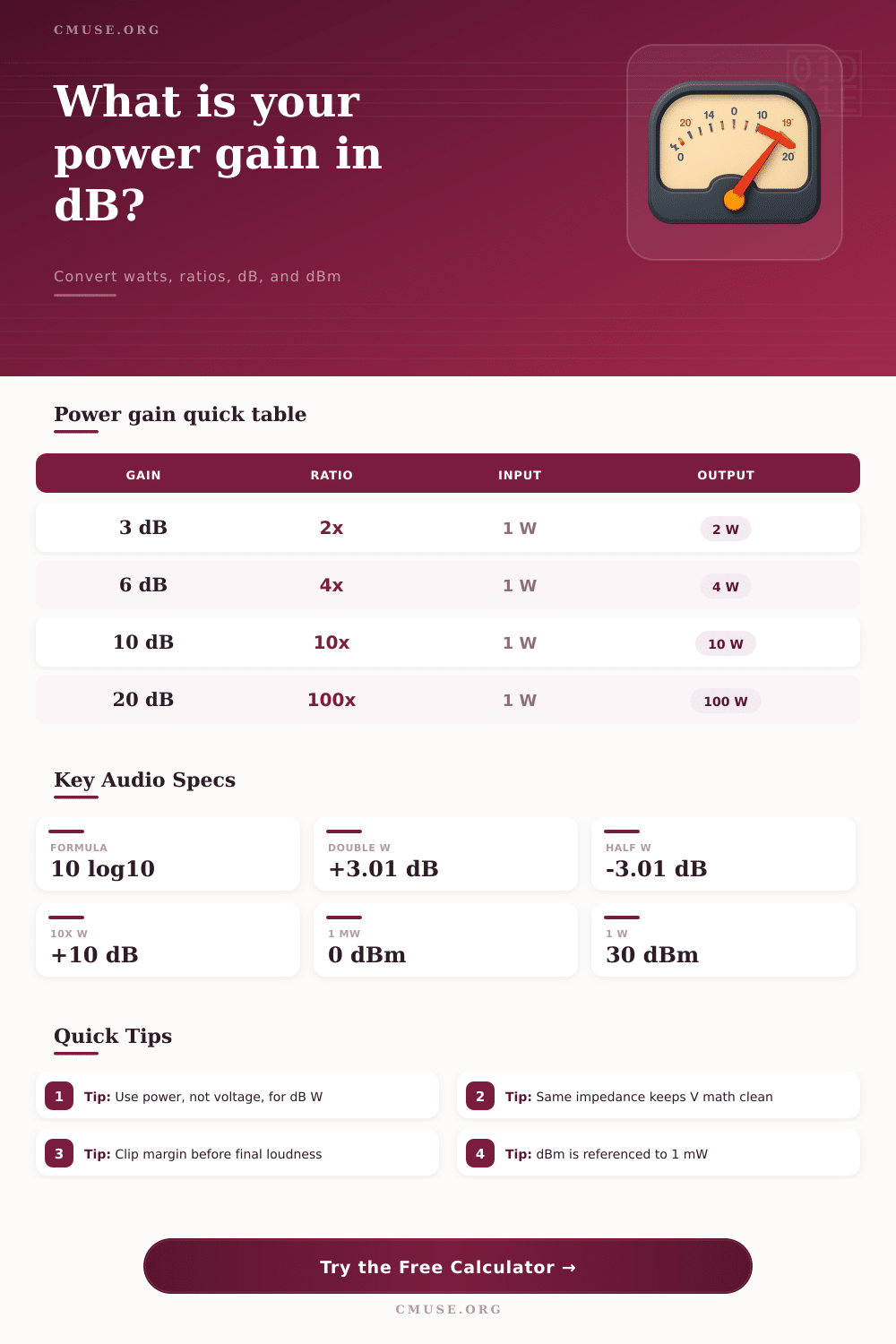
Power Gain dB Calculator
Convert amplifier power gain between input watts, output watts, power ratio, dB, dBm, RMS voltage, and speaker or load impedance.
Start point: Load a common studio, hi-fi, PA, or headphone amplifier case, then adjust the power and impedance numbers to match the actual circuit or speaker load.
Calculation Breakdown
| Gain or loss | Power ratio | 1 W input gives | Common audio meaning |
|---|---|---|---|
| -10 dB | 0.100x | 0.10 W | Large pad or heavy attenuation |
| -3.01 dB | 0.500x | 0.50 W | Half-power point |
| 0 dB | 1.000x | 1.00 W | Unity power gain |
| +3.01 dB | 2.000x | 2.00 W | Double power |
| +6.02 dB | 4.000x | 4.00 W | Double voltage into same load |
| +10 dB | 10.000x | 10.00 W | One decade of power gain |
| Scenario | Input power | Output power | Power gain |
|---|---|---|---|
| Headphone amplifier stage | 1 mW | 100 mW | 20.00 dB |
| Studio monitor amplifier | 1 W | 50 W | 16.99 dB |
| Guitar combo power section | 0.5 W | 15 W | 14.77 dB |
| Touring amp channel | 10 W | 800 W | 19.03 dB |
| Speaker attenuation pad | 100 W | 25 W | -6.02 dB |
| RMS voltage | Load | Output power | dBm level |
|---|---|---|---|
| 2.00 V | 32 ohms | 0.125 W | 20.97 dBm |
| 8.94 V | 8 ohms | 10.0 W | 40.00 dBm |
| 20.00 V | 8 ohms | 50.0 W | 46.99 dBm |
| 40.00 V | 4 ohms | 400 W | 56.02 dBm |
| 56.57 V | 8 ohms | 400 W | 56.02 dBm |
| Conversion | Formula | Use when | Note |
|---|---|---|---|
| Power to dB | dB = 10 log10(P2 / P1) | You know both powers | Powers must use the same unit |
| dB to ratio | Ratio = 10^(dB / 10) | You know gain or loss in dB | Negative dB gives a ratio below 1 |
| Voltage to power | P = V rms squared / R | You know output voltage and load | Use RMS voltage, not peak voltage |
| Power to dBm | dBm = 10 log10(P / 0.001 W) | You need milliwatt reference | 1 W equals 30 dBm |
Power gains is a measurement that is used within audio systems to describe how much an amplifier will increase the strength of an audio signal. Many people may believe that if the amplifier contain twice the amount of watts, that the audio will seem twice as loud to the listener. However, increasing the watt of an amplifier only provides a small increase in the loudness of the audio system.
This is due to the fact that human hearing is based upon a ratio of loudness rather than the absolute value of loudness. A calculator can be used to calculate the power gain of an audio system to determine how many decibel the audio signal will increase without having to memorize the logarithmic rule for calculating power gains. Different specifications for audio equipment utilize different references for there measurement of power gain.
How Power Gain Affects Loudness
For example, some specifications utilize the reference of dBm (which is referenced to one milliwatt of power), while other specifications may utilize dBW (which is referenced to an one watt of power). Using these different references provide for some potential of confusion between the different manufacturers and their specifications for power gain. In order to properly understand the audio system that is being created, it is important for those understanding the specifications of that audio equipment to understand these references.
Otherwise, they may not properly understand how much headroom the amplifier will have before it begins to clip the audio signal. Impedance can also impact the power gain within an audio system. For instance, if an amplifier can deliver a specific voltage to an eight-ohm speaker, it will deliver less power to that same speaker if the impedance of the speaker are four ohms.
Because power gain relate to the amount of power that is delivered to the speakers, it is also important to consider the impact that impedance may have upon power gain. Calculators can be used to provide watts of power that are delivered to speakers based off their voltage and impedance, which can help to compare that power gain to the power gain of the audio amplifier. The audio system in which the amplifier is contained may also impact the amount of sound that reach the listener.
For example, speakers with high sensitivity will allow for more sound to reach the listener than speakers with low sensitivity, the placement of the speakers can also impact the amount of sound that reaches the listener, as can the furniture within the listening area that may absorb some of that sound. Thus, although an amplifier may be rated to produce thirty watts of power at the amplifier terminals, that sound may be less at the listener due to these other factors. While the power gain is constant within an audio system, the loudness of that audio system may vary based upon these other factor.
People may make mistakes in relating voltage gain to power gain. For instance, voltage gains utilize a factor of twenty in the logarithm calculation, but power gains utilize a factor of ten. Using the wrong factor in these calculations will lead to the development of incorrect calculation of power gain.
Thus, individuals must utilize the proper factor in these equations in order to correctly calculate the power gain of an audio system, especially as it relate to the amount of headroom that that audio amplifier will have. Decibels are always a ratio, and understanding that decibels are a ratio is half the battle of correctly calculating the power gain of audio systems. A ten decibel increase in power always means that the power will increase ten-fold, whether that power level is one watt or one hundred watts.
Thus, these two values is separate concept, and the decibel gains should not be confused with the absolute values of watts. Headroom refers to the difference between the level at which audio signals are typically listened to and the maximum level of gain that the amplifier will produce without clipping the audio signal. If the average audio signal is ten decibels below the maximum gain, then the audio system will have a comfortable amount of headroom for any peak in the audio signal.
If the system does not have sufficient headroom, however, any transient in the audio signal will be compressed. Individuals can use calculators to determine the precise power gain of an audio system that is to be created, allowing individuals to determine if the amplifier has the headroom to handle any audio material that is to be play. Attenuators and audio signal pads can be used to reduce the power gain of an audio system.
For instance, a six decibel pad will reduce the power that is delivered to speakers by half. Thus, using pads will reduce the headroom of the audio system create. The knowledge of power losses can help individuals to determine if the protection that the pad will provide to the audio system is worth the reduction in the maximum output of the system.
Finally, it is also important to measure the gains of power at several point within the audio system. For instance, the power gain at the amplifier may differ from the power gain at the speakers. Thus, if power gain is to be correctly calculated for the audio system, it should be calculated at several point to provide an accurate overall understanding of the audio system created.