Point Source SPL Calculator
Estimate sound pressure level at a listener, microphone, or measurement point using inverse-square distance loss, source summation, directivity, boundary gain, and air attenuation.
| Distance Change | Pressure Ratio | SPL Change | Use |
|---|---|---|---|
| Same distance | 1.00x | 0 dB | Reference point stays unchanged. |
| Double distance | 0.50x | -6.0 dB | Classic point-source field rule. |
| Triple distance | 0.33x | -9.5 dB | Useful for small room throw estimates. |
| Ten times distance | 0.10x | -20.0 dB | Outdoor or large venue planning check. |
| Sources | Incoherent | Partial Coupling | Coherent Stack |
|---|---|---|---|
| 2 identical sources | +3.0 dB | +4.5 dB | +6.0 dB |
| 4 identical sources | +6.0 dB | +9.0 dB | +12.0 dB |
| 8 identical sources | +9.0 dB | +13.5 dB | +18.1 dB |
| 16 identical sources | +12.0 dB | +18.1 dB | +24.1 dB |
| Condition | Q Or Gain | dB Effect | Calculator Reading |
|---|---|---|---|
| Omnidirectional source | Q 1 | 0 dB DI | Use for broad radiation or unknown pattern. |
| Cardioid or half-space aim | Q 2 | +3.0 dB DI | Good starting point for vocal or small cabinet aim. |
| Forward speaker estimate | Q 4 | +6.0 dB DI | Useful when the main lobe points at the listener. |
| Corner loading | 3 boundaries | +9.0 dB | Most meaningful at low frequencies near large surfaces. |
| Scenario | Reference | Listener Point | Approx Result |
|---|---|---|---|
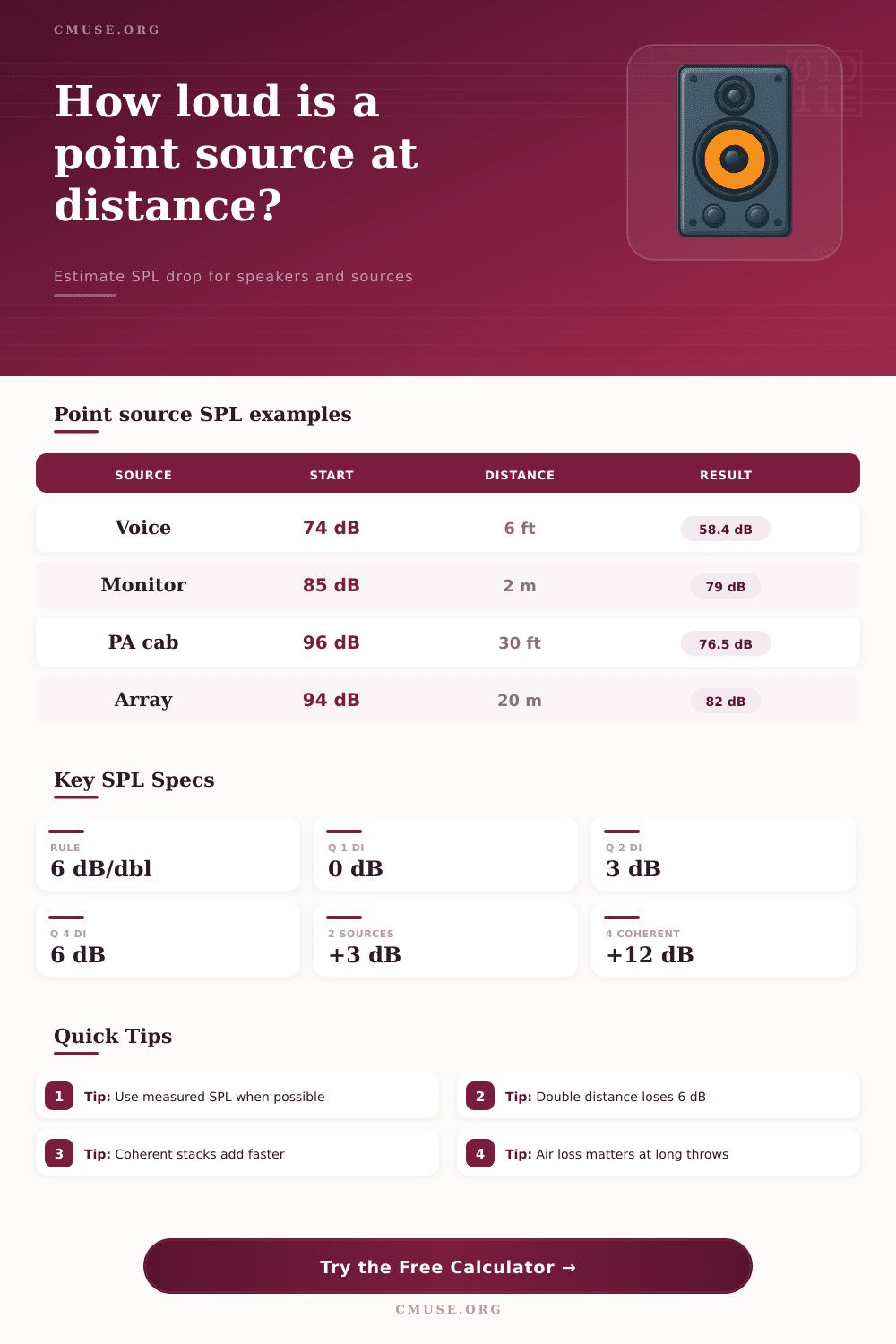
| Spoken voice | 74 dB at 1 ft | 6 ft free field | About 58 dB SPL before room effects. |
| Nearfield monitor | 85 dB at 1 m | 2 m, one speaker | About 79 dB SPL before room gain. |
| Small PA cabinet | 96 dB at 1 m | 30 ft, Q 4 | About 76 to 83 dB SPL depending on aim. |
| Four-box cluster | 94 dB at 1 m | 20 m, partial sum | About low 80s dB SPL in free field. |
Sound behaves in a certain way when it leave a loudspeaker or a voice; the energy of that sound becomes thinner the more farther that the sound travels from the loudspeaker or the vocal source. Consequently, the sound pressure level of that sound will drop as the energy of that sound becomes thinner with distance. This drop in sound pressure level with distance is the question that is ask of many in the field of sound engineering: will one loudspeaker provide enough sound for the back of the room, or will two speaker cabinets provide enough sound for a small stage?
The drop in sound pressure level with distance follow a specific rule. If the distance between the sound source and the listener is doubled, the sound pressure level will drop six decibel. This rule is accurate only in open air, as open air contains no surface that will reflect the sound from the loudspeaker.
How Sound Gets Quieter and How to Use a Speaker Level Calculator
A calculator that measures sound pressure level allows a user to input a reference level, and two distances from the loudspeaker to calculate the drop in sound pressure level. Such a calculator makes it easy for a sound engineer to avoid remembering the six decibel rule with distance. In the real world, multiple sound sources are encountered.
When multiple identical sound sources are introduced, the sound levels will add, but the amount that the sound levels add together depend upon how the sound sources are coupled to each other. If two speakers are placed next to each other and emit their sound waves in phase with each other, the two speakers will provide six decibels of increase in sound pressure level. If, however, the two speakers are far from each other or if their sound waves are out of phase with each other, the two speakers will only add three decibels of increase in sound pressure level to the sound that emanate from the speakers.
A calculator can incorporate the summation mode to input the placement of the speakers to determine the correct increase in sound pressure level. The factor of directivity may also impact the calculation of sound pressure level. If the loudspeakers are arranged in the form of a horn or wedge, the sound energy will be focused forward.
Consequently, a listener that is positioned along the axis of the horn or wedge will experience a higher sound pressure level than that which would be calculated by the inverse square law alone for sound propagation. A calculator that determines sound pressure level allows a user to select a value for directivity, which introduces an index into the calculation of sound pressure level. Boundary gain is another factor that works in opposition to directivity.
If a speaker cabinet is placed on the floor or against a wall, the sound energy will reflect off of that floor or wall, increasing the sound pressure level at low and mid frequency. The correct setting for boundary can be selected in the sound pressure level calculator. Air absorption is yet another factor that engineers often overlook.
Air absorption becomes important in calculating sound pressure level at distances between the loudspeaker and the listener that exceeds thirty feet. High frequencies in the sound that is radiated from the loudspeaker interacts with the air molecules; the higher the frequency of that sound, the more energy it will lose to the air. As a result of this interaction with the air, high frequencies will lose energy as they travel towards the listener.
Air absorption of high frequencies can be ignored for distances under thirty feet. However, at distances beyond thirty feet, air absorption can lead to a loss in sound pressure level that need to be accounted for in the determination of the loudspeaker system. The air-loss field in the calculator allow for the gradual roll-off of high frequencies so that you dont assume that the sound spectrum that reaches the back row of the audience is the same as that which leaves the loudspeaker.
While these calculations are not a replacement for physical measurement in the room, they will provide you with a starting point for your sound pressure level calculations, especially in small rooms where the reflections tend to elevate the sound level of the loudspeakers; small rooms do not often follow the mathematics of point sources due to the reflected sound in those small spaces. Instead, you can use the baseline reading provided to you by the calculator to determine how much additional sound pressure level the room will contribute to the sound based off the size of the room and the materials that are utilized for the rooms surfaces. Many people make a variety of mistakes when employing these calculations.
For example, many people will use the sensitivity rating provided in the speaker’s data sheet but fail to notice the reference distance for that sensitivity rating. Using both a one-meter and a three-foot sensitivity rating will lead to a shift in the curve that represents the loudspeaker’s sound pressure. In addition, people often incorrectly assume that each loudspeaker cluster in an array should be treated as if it is coherent.
Unless the speaker boxes are close to one another and driven from the same signal, it is better to use the partial-coupling option provided rather than the coherent option. The tables provided on this page display many of the same calculations in a different format. The distance loss tables display the reduction in sound pressure level that occurs in response to tripling the distance between the loudspeaker and the audience, while the source summation tables indicate the impact of increasing the number of loudspeakers that are arranged in a coherent array.
While it is not necessary to memorize the decibel levels in these tables, it is important for you to recognize the scenarios associated with each loudspeaker array so that the calculator can provide you with the appropriate coefficient for that scenario. In outdoor loudspeaker arrangements, there are additional variables to consider such as the effect of the wind and the effect of the temperature gradients on the sound waves. Additionally, the ground can absorb sound waves, reducing the sound pressure level that reaches the audience by several decibel.
While the calculator cannot provide you with the effect of the wind and the temperature gradients, it can help to calculate the baseline sound pressure level that would occur in still air. Once you know the baseline level of sound pressure that will reach the audience, you can decide if the use of delay towers or additional loudspeaker cabinets would be advantageous. There are a few steps in the calculation of the sound pressure level that will reach the audience.
First, you must physically measure the loudspeaker or find the sound pressure level that is published for that loudspeaker at a specified distance. Second, you must decide how many loudspeakers will be contributing to the sound pressure level at the listening position. Finally, you must decide what impact the surfaces and the air path between the loudspeakers and the audience will have on the sound.
While the calculator will make these calculations for you after you select these variables, you will still have to listen to the room where the sound is playing; the variables of the room and the weather will always have the final effect on the sound that reaches the audience.