Doppler Shift Calculator
Estimate observed pitch, cents change, wavelength, and radial velocity for moving sound sources and listeners.
🎯 Real Sound Presets
🎚 Doppler Inputs
📌 Core Doppler Spec Grid
📊 Speed of Sound Reference
| Medium | Condition | Speed | Use Case |
|---|---|---|---|
| Air | 0°C | 331.3 m/s | Cold outdoor sound |
| Air | 20°C | 343.4 m/s | Room temperature audio |
| Helium | 20°C | 1007 m/s | Gas demo reference |
| Water | 20°C | 1482 m/s | Underwater acoustics |
🎼 Musical Pitch Shift Reference
| Cents | Musical Size | Frequency Ratio | Listening Meaning |
|---|---|---|---|
| 10 cents | Fine detune | 1.0058x | Small but audible |
| 50 cents | Quarter tone | 1.0293x | Clearly bent pitch |
| 100 cents | Semitone | 1.0595x | One piano key |
| 1200 cents | Octave | 2.0000x | Double frequency |
🚦 Scenario Comparison Table
| Scenario | Source Pitch | Motion | Expected Shift |
|---|---|---|---|
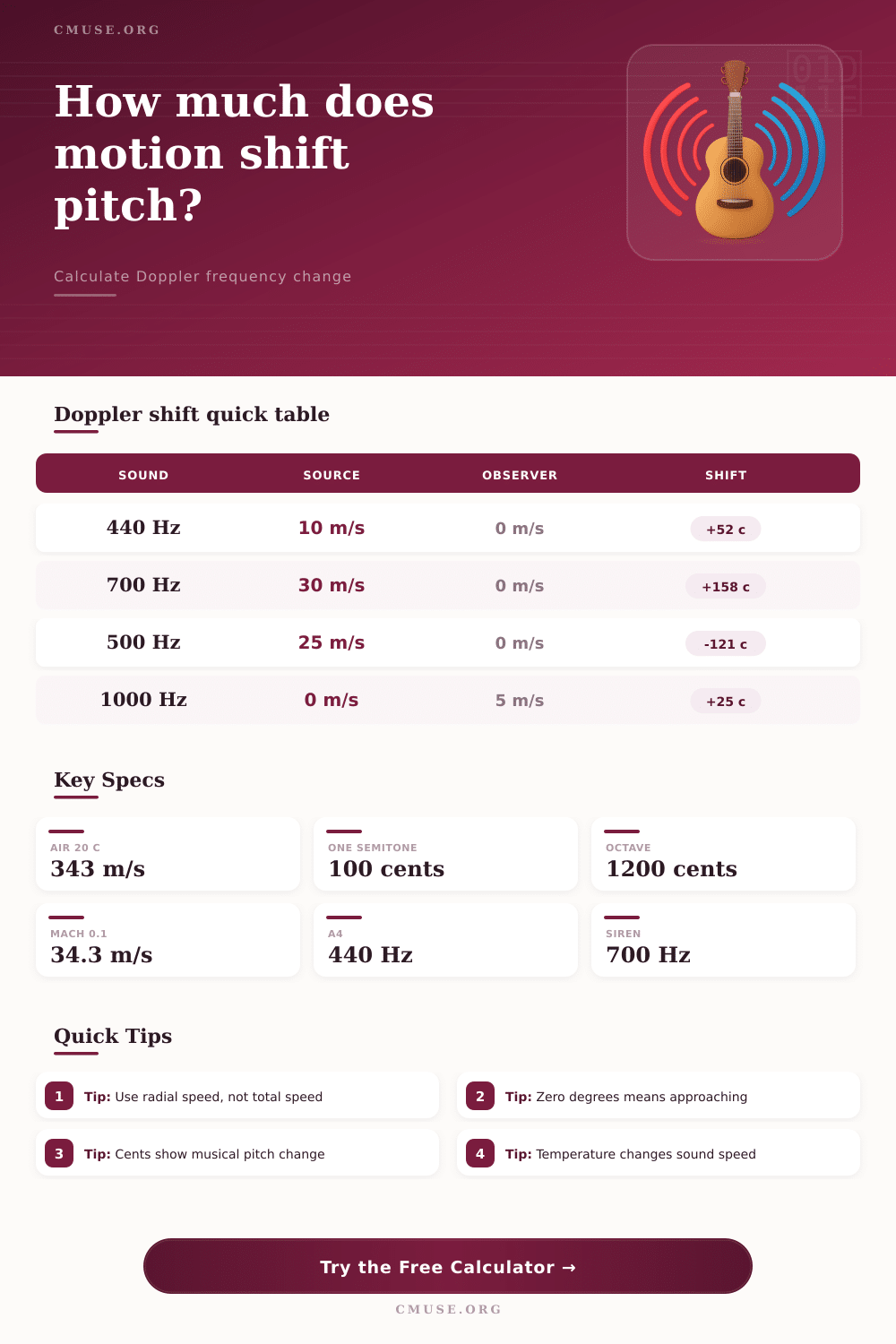
| Ambulance approaching | 700 Hz | 29 m/s source | About +150 cents |
| Train horn receding | 500 Hz | 22 m/s source | About -108 cents |
| Walking listener | 440 Hz | 1.4 m/s observer | About +7 cents |
| Race car approaching | 1000 Hz | 83 m/s source | Large upward bend |
🧮 Formula Comparison Grid
📝 Doppler Formula Reference
| Case | Equation | Positive Direction | Best For |
|---|---|---|---|
| Source only | f' = f v / (v - vs) | vs toward listener | Siren, car, train |
| Observer only | f' = f (v + vo) / v | vo toward source | Moving mic, listener |
| Both moving | f' = f (v + vo) / (v - vs) | Radial components | Field recording |
| Pitch cents | 1200 log2(f' / f) | Positive is sharper | Music tuning |
The calculator uses classical sound Doppler math and radial velocity components. It is intended for sound in a medium, not light-speed relativistic Doppler calculations.
The Doppler effect is the change in the pitch of the sound that is caused by the movement of the sound source or the listener. The effect doesnt change the sound that is created by the source altogether, but it does change the way in which the sound wave reach the listener due to the movement of either the sound source or the listener. These effects are experienced when the ambulance siren sounds highly pitch as the ambulance approaches the listener, but lowers in pitch as the ambulance move away from the listener.
As such, knowing about the Doppler effect is helpful for individuals who is recording music, or for those that are listening to the passing of vehicle. The Doppler effect is correlated with the radial motion of the moving object. Radial motion is the component of the object’s movement that is directly towards or away from the listener.
How to Use a Doppler Effect Calculator
If the vehicle is not moving directly towards or away from the listener, then there is a more smaller Doppler effect. For instance, if the vehicle is moving in a path that is perpendicular to the listener, the radial motion component will be zero, leading to a zero Doppler effect. Additionally, because the total speed of the object and its radial speed are not the same variable, the Doppler effect can change if the angle of the movement of the object change.
In addition to the movement of the object, other environmental factor play a role in the Doppler effect, as well. For example, air temperature will impact the speed at which sound move through the air. If it is warmer outside, sound can travel at a faster rate through the air; the higher the speed of sound, the smaller the change in frequency that results from movement of the object.
Additionally, the medium through which sound travels can impact the Doppler effect; sound travels at different speed through water and helium than through air. These various factors will impact the outcome of the Doppler effect; thus, the use of a calculator will help to determine the exact frequency of the sound that will be heard. A Doppler effect calculator allow for the individual to input various factor related to the Doppler effect in order to calculate the exact frequency of the sound that will be heard.
For example, the individual can enter the speed of the source of the sound, the speed of the person who is listening to the sound, the angle of the movement of the sound source, the air temperature, and the medium through which the sound travels into the calculator. According to these factor, the calculator will output the frequency of the sound that will be heard, the shift in pitch in musical cents, and the new wavelength of the sound. An important variable that can be entered into the calculator is the angle of the movement of the sound source.
For instance, if the angle is zero degree (the object moving directly towards the listener), the frequency will rise. If the angle is 180 degrees (the object moving directly away from the listener), the frequency will drop. If the angle is 90 degrees (the object moving perpendicular to the listener), there will be no Doppler effect.
Thus, a variety of angle can be tested in the calculator to determine how angle impact the Doppler effect. The speed of the source of sound and the speed of the listener will impact the strength of the Doppler effect. For instance, if the individual that is moving is a person on foot that is moving next to the sound source, the Doppler effect will be much smaller than if the individual is on a bicycle.
Additionally, the Doppler effect will be smaller than expected for individuals unless either the object is moving at very high speed, or the frequency of the sound is very high. Thus, individuals should of consider the context of the movement of the object prior to calculating the Doppler effect. There are some common mistake that can be made when calculating the Doppler effect.
For instance, one of the most common is to use the total speed of the moving object rather than the radial speed of that object. The radial speed is the speed at which the object move directly towards or away from the listener; it is this speed that create the Doppler effect. Another of the common mistake is to forget to include the air temperature when calculating the Doppler effect.
The air temperature impact the speed of sound; a change in the speed of sound will impact the result in cents; thus, the temperature must be included in the calculation. These error can be avoided by the use of the calculator. Wavelength is also related to the Doppler effect.
A shorter wavelength of sound lead to a higher pitch. A longer wavelength of sound lead to a lower pitch. Because the frequency and wavelength of sound are related, the wavelength and the frequency of the sound will always move together.
Thus, by displaying the wavelength on the calculator alongside the frequency, the individual know that there calculations are correct. The Doppler effect has many different application in the world. From the approaching ambulance sirens to the monitors that play for performers on stage, and from sound system on aircraft to those in various location around the world, the Doppler effect has many application.
The variables that should always be considered prior to calculating the Doppler effect are the motion of the sound source, the motion of the listener, the angle of the sound source movement, the air temperature, and the medium through which the sound move. By defining these variable, the frequency of the sound that is created can be easily calculated. These factor are made visible to the individual through the use of the Doppler effect calculator.
There are various reason that the Doppler effect calculator can be of benefit to the individual. For instance, the motion of object is rarely constant in the real world. For instance, the horn of a vehicle that is on a platform that is rotating will change angle every few second.
Additionally, performers on stage may walk across the stage. Thus, the calculator can be of benefit in adjusting each variable to determine the impact of that variable on the resulting Doppler effect. The calculator is, therefore, of benefit to those who wish to understand the Doppler effect and to verify its presence prior to beginning to record music or to perform.