
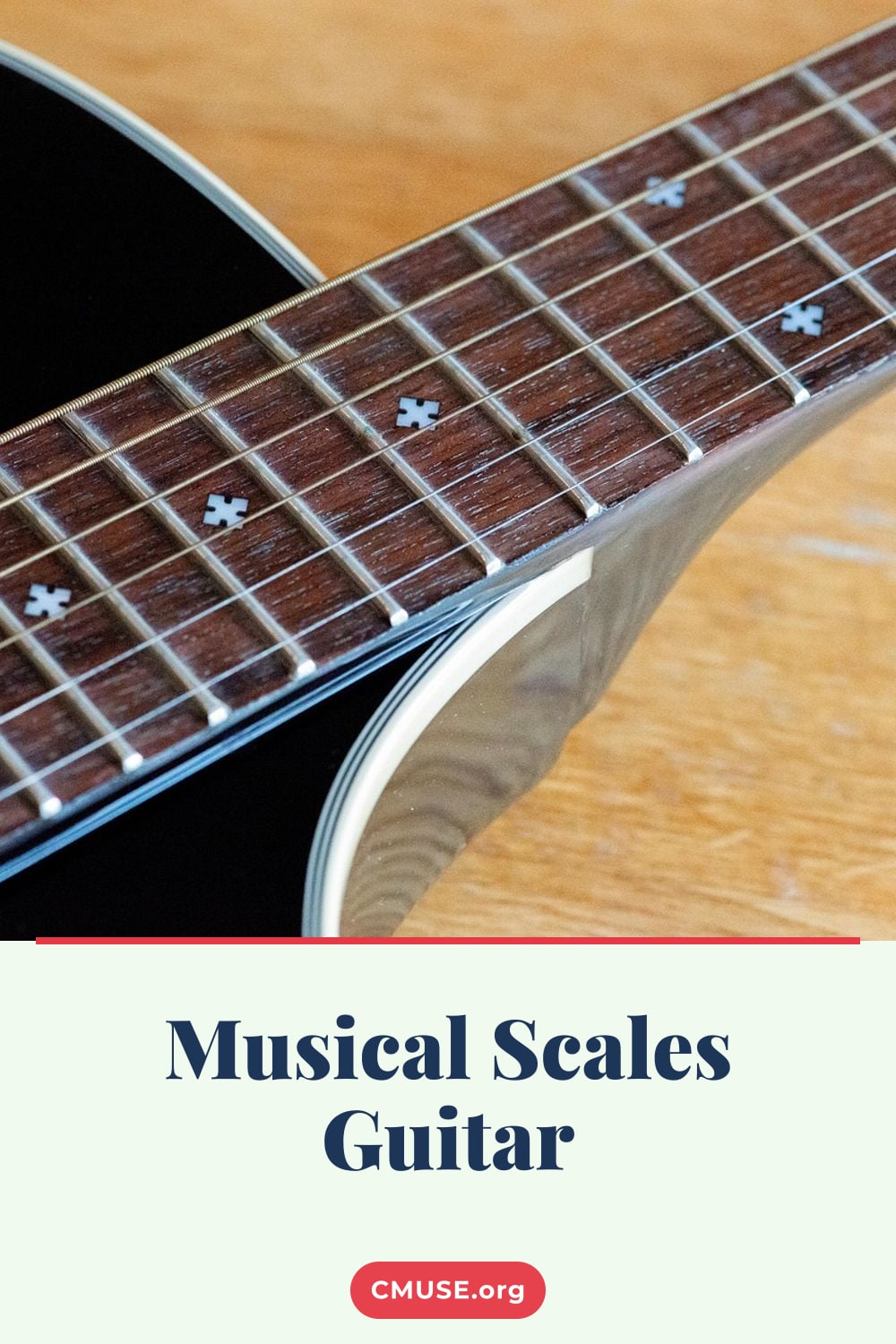
Guitar scales sit at the heart of everything you play. They are the map that turns random notes into melodies, riffs, and solos that actually make sense. Once you understand how scales work on the fretboard, you stop hunting for the right sound and start creating it on purpose.
That shift changes your playing forever.
Most guitarists spend years patching together bits of theory while their fingers chase patterns they half remember. The good news is you do not need to memorize every possible scale before you sound good. You need a handful of the right ones, practiced with intention.
The list below walks through the scales every guitarist should know, in an order that builds real musical vocabulary instead of just collecting exotic names. Each one unlocks something specific, and each carries its own personality on the instrument.
Essential Guitar Scales Every Player Should Know
1. Major Scale
The major scale is where everything begins. Play it in the key of C and you get the familiar do-re-mi pattern that Western ears grew up on. On guitar it lays out across the fretboard in five main positions that connect like puzzle pieces.
Once you can move that shape anywhere, you suddenly own every major key without learning new fingerings. That is why teachers start here. It is not the most exciting scale to solo with, but it is the parent that gives birth to everything else.
Learn it clean and even, then start varying the rhythm. You will hear how every pop song you love borrows from its DNA.
2. Natural Minor Scale
Right after the major scale comes its moody sibling, the natural minor scale. Drop the third, sixth, and seventh degrees by a half step and the whole mood changes. The same notes as the major scale exist here, just starting on a different degree.
That overlap is the first big revelation for most players. You are not learning six new notes, you are simply looking at the same set from a different doorway. On guitar the minor scale sits nicely under the fingers in the pentatonic boxes you already know.
It gives rock ballads their melancholy and metal its darkness. Play it over a minor chord and the fit feels like coming home.
3. Pentatonic Scale
The pentatonic scale might be the single most useful tool on the guitar. Take away the fourth and seventh degrees from the major scale and you get five notes that almost never sound wrong. That is why every guitarist from blues legends to modern shredders returns to it daily.
The minor pentatonic box at the fifth fret is usually the first shape new players learn, and for good reason. It works over both major and minor progressions when you know how to emphasize certain notes. The trick is bending the flat third and flat seventh just enough to add vocal-like expression.
Those bends turn a simple scale into something that sings.
4. Blues Scale
Once you have the pentatonic under control, the blues scale adds one crucial blue note, the flat fifth. That single addition changes the entire flavor. Suddenly you have the gritty, slightly dangerous sound that defines electric blues and early rock and roll.
On guitar the flat fifth lives right next to familiar pentatonic shapes, so the fingerings stay comfortable while the emotional range expands. Use it sparingly at first. Too much flat-five can make your playing sound like an exercise instead of a statement.
The scale rewards restraint and well-timed repetition.
5. Harmonic Minor Scale
The harmonic minor scale raises the seventh degree of the natural minor and creates a leading tone that pulls strongly toward the root. That raised seventh gives classical music, flamenco, and neoclassical metal their exotic tension. On the guitar the gap between the sixth and seventh frets creates an augmented second interval that sounds Middle-Eastern to Western ears.
Many players discover this scale while learning the intro to a certain Yngwie Malmsteen tune. The fingering feels slightly awkward at first because it breaks the usual two-notes-per-string habit, but the payoff is worth the extra practice. It lets you outline dominant chords with real authority.
6. Melodic Minor Scale
Melodic minor is the shape-shifter of the scale world. When you climb the scale you raise both the sixth and seventh degrees, then lower them again on the way down. That dual behavior gives jazz and fusion players a Swiss-army-knife scale that adapts to almost any chord.
On guitar the ascending version feels like a major scale with a flat third, while the descending version returns to natural minor. The real skill lies in knowing which chords inside a progression call for which version. Most guitarists start by applying the ascending form over minor chords with a major seventh on top.
The sound is instantly brighter and more sophisticated than plain minor pentatonic.
7. Dorian Mode
The modes of the major scale open an entire universe once you are ready for them. Start with the Dorian mode, which is simply the major scale starting on its second degree. It gives you a minor sound with a natural sixth that feels brighter than regular minor.
Countless classic rock solos live inside Dorian without the player ever naming it. On guitar the shape overlaps heavily with pentatonic boxes, so you can slide between them without losing your place.
8. Mixolydian Mode
The next essential mode is Mixolydian, the dominant scale that lives on the fifth degree. It turns a plain major scale into something bluesier by flattening the seventh. Use it over dominant seventh chords and your solos gain that loose, roadhouse swagger.
9. Phrygian Mode
Phrygian mode deserves its own paragraph because it carries such a distinct personality. Starting on the third degree of the major scale, it features a flat second that creates an instantly Spanish or metal flavor. The half-step between the root and second degree makes it perfect for heavy rhythm parts and neoclassical runs.
Guitarists often discover Phrygian while learning certain Metallica riffs or trying to cop Paco de Lucia licks. The scale feels exotic at first, yet the fingering is surprisingly logical once you see how it sits on the low E and A strings. It is the scale that makes your playing sound like it is from somewhere else even when you are using exactly the same notes as everyone else.
10. Whole Tone Scale
The whole tone scale is built entirely from whole steps, giving it a floating, dreamlike quality with no perfect fourth or fifth to anchor it. Only two whole tone scales exist, and once you learn one the other is just a half step away. On guitar the even spacing means you can move the same shape up or down by two frets and stay inside the scale.
That symmetry makes it easy to create patterns that sound complex but are mechanically simple. Jazz players use it to float over augmented chords, while rock guitarists reach for it when they want a solo to sound unhinged. It is not an everyday scale, but when the moment calls for it nothing else will do.
11. Diminished Scale
The diminished scale alternates whole and half steps in a repeating pattern, creating eight notes instead of seven. That extra note gives it a symmetrical structure that works beautifully over diminished chords and dominant chords with altered tensions. Guitarists often learn the diminished scale in fingerings that climb three frets at a time, which feels different from every other scale on the instrument.
The symmetry means you only need to learn a few starting points to cover the whole neck. It is the secret weapon behind many bebop lines and certain fusion runs that sound impossible until you realize the built-in repetition is doing half the work.
12. Chromatic Scales
Chromatic scales deserve a place on this list even though they use every single note. They are not something you usually solo with for long stretches, but they teach your fingers precision and evenness like nothing else. Practicing chromatic exercises across all strings improves your alternate picking, your hammer-ons, and your sense of time.
On guitar the chromatic scale turns the fretboard into a pure physical exercise before it becomes music. The best players treat it as daily technique maintenance rather than a musical destination. When you do use chromatic passing tones inside a real line, they add sophistication without calling attention to themselves.
These scales are not isolated facts to collect. They are overlapping languages that start to borrow from one another the moment you begin improvising. The guitarist who knows only pentatonic will sound limited next to the one who hears the pentatonic inside the Dorian or the blues note hiding in a Mixolydian phrase.
The real practice is not running scales up and down forever. It is using them to create short musical sentences, then linking those sentences into something that tells a story.
Start with the major and minor, make the pentatonic your native tongue, then let the more colorful scales arrive when your ears demand them. The fretboard stops feeling like a grid of mysterious dots and starts feeling like a neighborhood where you know every street. That is when the guitar finally begins to speak in your own voice.