Reverb Radius Calculator
Estimate a room's critical distance from volume, reverberation time, source directivity, and working mic or listener position.
🎙 Real Room Presets
🎚 Room And Source Inputs
📊 Directivity And Formula Spec Grid
Calculation Basis
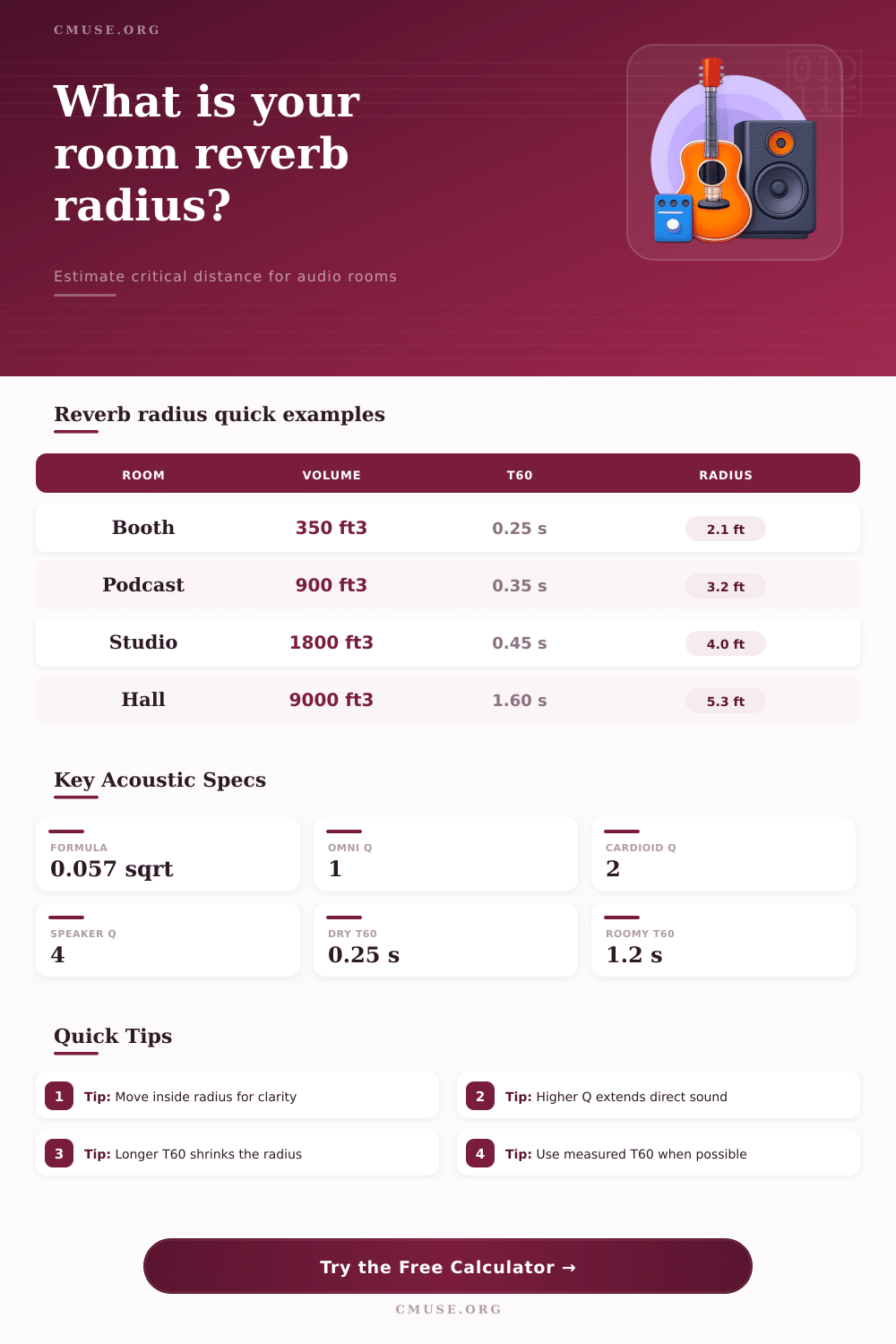
The calculator uses the common diffuse-field approximation: critical distance in meters equals 0.057 times the square root of source Q multiplied by room volume in cubic meters, divided by T60.
How To Read The Result
Inside the reverb radius, direct sound is stronger than reverberant sound. At the radius, they are approximately equal; beyond it, room sound dominates.
🔊 Source Directivity Reference
| Source Type | Typical Q | Directivity Index | Use In Calculator |
|---|---|---|---|
| Omnidirectional instrument or talker estimate | 1 | 0 dB | Use for very broad radiation or unknown aim. |
| Cardioid vocal, small monitor, seated talker | 2 | 3 dB | Good starting point for podcast and vocal rooms. |
| Forward-facing studio monitor or stage source | 4 | 6 dB | Use when the source is clearly aimed at the listener. |
| Horn, wedge, or tightly aimed loudspeaker | 8 | 9 dB | Use for stronger pattern control and focused projection. |
⏱ T60 Room Reference
| Room Use | Typical T60 | Acoustic Meaning | Radius Effect |
|---|---|---|---|
| Vocal booth or voiceover space | 0.15-0.30 s | Very dry, close, controlled speech capture. | Longer usable direct zone. |
| Podcast room or treated bedroom studio | 0.25-0.45 s | Dry enough for speech and overdubs. | Moderate close-mic radius. |
| Small control room or project studio | 0.30-0.60 s | Controlled but not fully dead. | Balanced listening radius. |
| Practice room, rehearsal room, small hall | 0.70-1.80 s | Audibly live room character. | Shorter direct zone. |
🎶 Common Room Size Examples
| Scenario | Dimensions | T60 / Q | Approx Radius |
|---|---|---|---|
| Recording booth | 5 x 5 x 8 ft | 0.22 s / Q 2 | 1.7 ft / 0.52 m |
| Home studio | 10 x 12 x 8 ft | 0.45 s / Q 2 | 2.1 ft / 0.64 m |
| Control room | 12 x 16 x 9 ft | 0.40 s / Q 4 | 3.7 ft / 1.13 m |
| Small hall check | 40 x 30 x 16 ft | 1.60 s / Q 4 | 6.9 ft / 2.10 m |
⚖ Direct Sound Comparison Grid
| Position | Distance Rule | Direct/Reverb Balance | Practical Reading |
|---|---|---|---|
| Close zone | 0.5 x radius | About +6 dB direct | Clear voice or instrument pickup with less room tone. |
| Working zone | 0.7 x radius | About +3 dB direct | Natural but still controlled for many recordings. |
| Critical point | 1.0 x radius | 0 dB balance | Direct and reverberant energy are roughly equal. |
| Room zone | 2.0 x radius | About -6 dB direct | Room sound dominates the signal or listening position. |
When you place a microphone in a room, it will pick up both the direct sound and the reflected sound in that room. The direct sound is the sound that comes from the sound source, and the reflected sound is the sound that comes from the sound bouncing off the walls in the room. The balance between these two different types of sound change with the distance between the microphone and the sound source.
The reverb radius is the distance at which the direct sound and the reflected sound have the same amount of energy. If you place the microphone within the reverb radius, the direct sound will be strong relative to the reflected sound. If you place the microphone beyond the reverb radius, the reflected sound will be the dominant sound relative to the direct sound.
Reverb Radius and Microphone Placement
Most people encounter problems with there microphone placement because they place their microphone too far from the sound source. For instance, one person may place a vocal microphone three feet from the speaker who the microphone is to be recorded by. In this example, the microphone may pick up the vocal sounds but they may sound distance.
This is due to the fact that the microphone is outside of the reverb radius at which the direct and reflected sound have the same amount of energy. The distance between the microphone and the sound source is referred to as the working distance for that microphone and sound source arrangement. The reverb radius is an important measurement for microphone placement decisions regarding whether you want the direct sound or the reflected sound to be dominant in the recording.
One of the primary factors that affects the size of the reverb radius is the volume of the room in which the microphone is to be placed. Smaller rooms contain less air than larger rooms. Therefore, the reverb radius will be smaller in a small room relative to a larger room.
The height of the room ceilings also affects the rooms volume and, thus, the reverb radius. Engineers can use calculators to calculate the reverb radius of a given room by entering the dimensions of that room. This method allows engineers to calculate the reverb radius without performing the math calculations manual.
Another factor that affects the reverb radius is the T60 value for the room. T60 is the amount of time that it takes for a sound to drop 60 decibels within a specific room. Rooms with long T60 values will have sound that remains in the room for longer periods of time.
Rooms with long T60 values will have smaller reverb radii than rooms with short T60 values. To illustrate, if a room has a long T60 value, engineers will have to place the microphone closer to the sound source in order to ensure that the direct sound is stronger then the reflected sound. Conversely, if the T60 value for a room is short, such as a vocal booth, the reverb radius will be larger allowing for the microphone to be placed further from the sound source.
The engineer can measure T60 at mid frequencies with accuracy relative to visually estimating the T60 value of the room. The directivity of the sound source also change the reverb radius for a given room. If the sound source radiates sound in all directions (omnidirectional) the sound will excite the room more than if the source was directional.
Sources that are directional will allow engineers to stretch the reverb radius to include more sound sources. Engineers can adjust the Q factor for the sound source that is to be used to select the directivity pattern of that source. By adjusting the Q factor to match the directivity of the sound source, engineers avoid the mistake of treating all sound sources as if they all have the same directivity.
Once engineers calculate the reverb radius for a room, they must decide on the working distance for the microphone relative to the sound source. One method of establishing the working distance is to establish a safety margin for the direct sound relative to the reflected sound. For instance, engineers can establish that the working distance should of seventy percent of the calculated reverb radius.
This will ensure that the direct sound is stronger than the reflected sound. Other engineers may prefer to position the microphone at the reverb radius to ensure that both the direct and reflected sound have equal strength. The sound mixing and mastering engineer will use the decibel measurements that are calculated at the chosen working distance to determine if that working distance produces the sound that is to be created.
Often, the variables of a real room will differ from what is calculated. For instance, furnitures in the room will reflect the sound differently than a smooth surface. Other variables in the room, such as people and uneven surfaces will also change the sound that is reflected within the room.
The type of absorption of the sound on one wall will change the decay of the reflected sound within the room. Additionally, the temperature and humidity within the room may change the T60 for that room. Each of these variables mean that while the reverb radius is an important measurement and starting point for engineers, the reverb radius will not remain a fixed value within a given room.
Often the most practical use of the reverb radius is to estimate the T60 value for the room. By calculating the reverb radius and moving the microphone while listening to the sound that it creates engineers can adjust the settings of the room. There are three options for changing the sound within the room.
First, the engineers can treat the room to reduce the amount of time that sound remains within the room (shorten the T60), which will increase the reverb radius. Second, the engineers can change the source of the sound to a directional source to increase the reverb radius. Third, the engineers can move the microphone closer to the sound source to increase the amount of direct sound that the microphone picks up.
Each of these options has its tradeoffs. For example, treating the room may make it feel less life-like to the listener. Using a directional sound source may lead to coverage hole within the recorded sound.
Finally, moving the microphone closer to the sound source may pick up unwanted breath noise and string noise from the sound source. Often engineers will use reference tables to help them determine the T60 value that they should use for their room when calculating the reverb radius. For instance, the T60 value of a vocal booth is less than one third of a second.
Small control rooms typically have a T60 value between four and six tenths of a second. These reference tables allow engineers to avoid entering incorrect number into the reverb radius calculator. The reverb radius is an important concept to engineers and sound mixing and mastering technician.
By using the reverb radius engineers can start with a clean foundation for their recording of the sound source. Actually, the reverb radius is very useful. If you dont use it your results will be bad.
Youll find it much easier to get the right sound. It isnt a hard concept to master. Just use the right tools and you will recieve better results.
The moddern studio needs this knowledge. It is alot more important than people think. Just follow the steps and it will work fine.
Its a naturaly part of the process. Make sure you check your settings. You should of checked them before.
If you dont, you might have problem. It is just a matter of practice. It can be a luxurius experience if you do it right.
Don’t forget to check the distance. It is vital. You must be carefull.