Sabine Reverb Calculator
Estimate RT60, room absorption, volume, and added treatment needed for studios, booths, rehearsal spaces, and small halls.
🎶 Room Presets
📐 Room And Absorption Inputs
🎚 Absorber Spec Grid
📊 Surface Absorption Reference
| Surface | 125 Hz | 500 Hz | 1000 Hz |
|---|---|---|---|
| Concrete or tile | 0.01 | 0.02 | 0.02 |
| Wood stage floor | 0.15 | 0.10 | 0.07 |
| Carpet on pad | 0.08 | 0.35 | 0.60 |
| Painted drywall | 0.29 | 0.10 | 0.05 |
| Acoustic mineral tile | 0.25 | 0.70 | 0.80 |
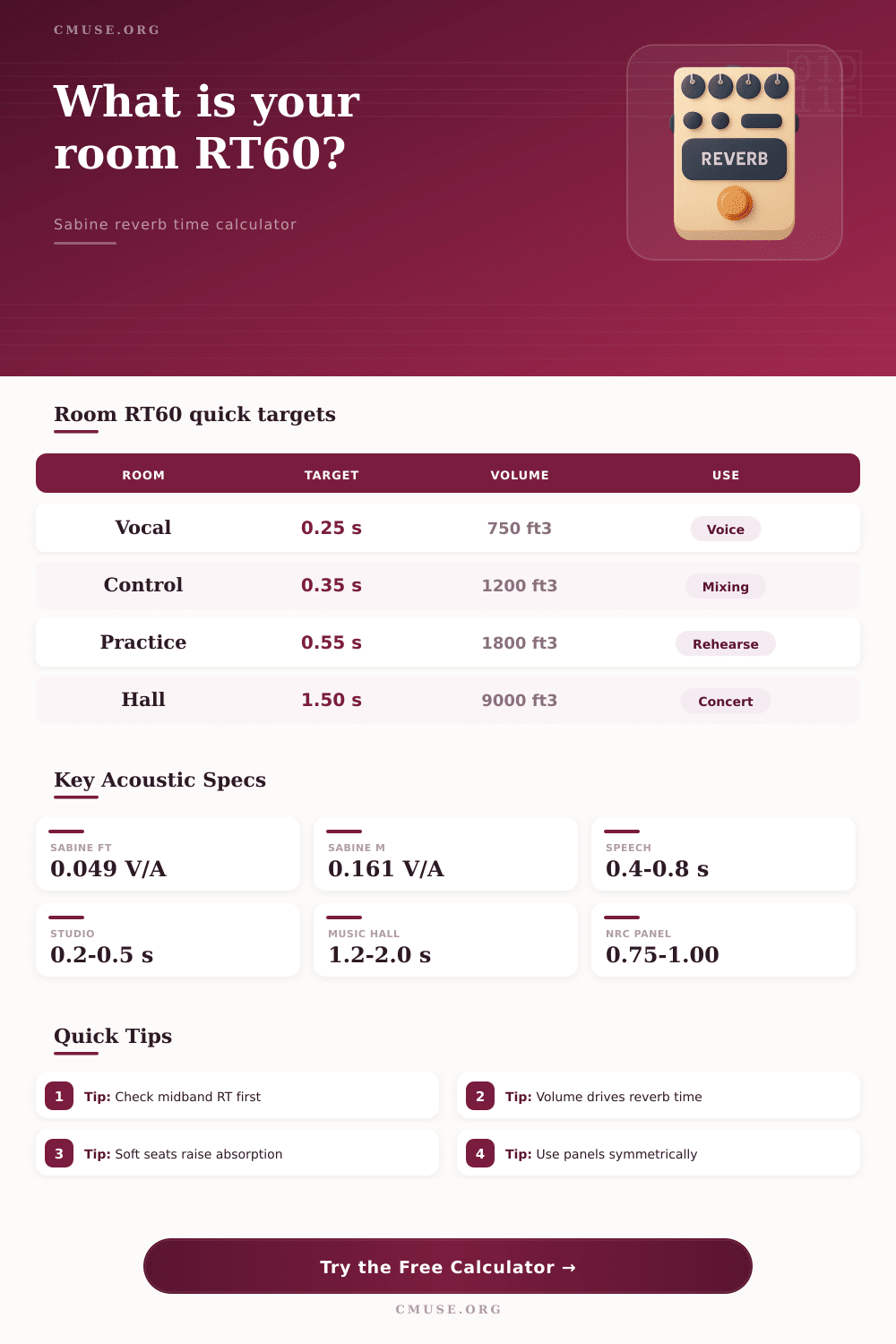
⏱ RT60 Target Ranges
| Room Type | Speech Target | Music Target | Notes |
|---|---|---|---|
| Vocal booth | 0.15-0.30 s | 0.20-0.35 s | Very controlled |
| Control room | 0.25-0.45 s | 0.30-0.50 s | Mix decisions |
| Practice room | 0.40-0.70 s | 0.50-0.90 s | Natural feel |
| Lecture room | 0.45-0.80 s | 0.70-1.00 s | Clarity first |
| Recital hall | 0.80-1.20 s | 1.20-1.80 s | Warm sustain |
🧱 Treatment Comparison
| Treatment | Best Band | Typical NRC | Use Case |
|---|---|---|---|
| 2 in wedge foam | 1-4 kHz | 0.60-0.80 | Flutter control |
| 2 in fiberglass panel | 500 Hz+ | 0.80-0.95 | Voice rooms |
| 4 in broadband panel | 250 Hz+ | 0.90-1.00 | Studios |
| 4 in mineral wool panel | 250 Hz+ | 0.95-1.05 | Live rooms |
| Heavy curtain | 1 kHz+ | 0.45-0.70 | Variable rooms |
🎹 Common Room Size Checks
| Scenario | Dimensions | Volume | Target RT60 |
|---|---|---|---|
| Recording Booth | 5×5×8 ft | 200 ft³ | 0.20-0.30 s |
| Home Studio | 10×12×8 ft | 960 ft³ | 0.30-0.45 s |
| Control Room | 14×18×9 ft | 2268 ft³ | 0.30-0.50 s |
| Teaching Room | 18×24×10 ft | 4320 ft³ | 0.50-0.75 s |
| Recital Hall | 40×60×22 ft | 52800 ft³ | 1.20-1.80 s |
The Sabine formula are used to calculate the reverberation time of a given room. Reverberation time, or RT60, is the time it takes for sound to decreases by 60 decibels after the sound stop. The reverberation time can help to determine whether voices will remain clearly in a room or if instrument will ring too long.
Furthermore, the Sabine formula allows an individual to determine if a given room is appropriate for certain task by providing a numerical value to the reverberation time within that room. The structure of the Sabine formula is simple. To incorporate the Sabine formula into calculations of the reverberation time of a given room, an individual must multiply the volume of the room by a constant, and divide that result by the total amount of absorption that exist within that room.
How to Calculate Room Reverberation Time
The constant that is used in the equation may change based off whether the units metric or imperial units is to be used in the calculation; however, the mathematical relationship of the Sabine formula is the same in any instance. The total amount of absorption that will be reflected in the calculation is determined by measuring the amount of absorption provide by the materials that are present on each of the surfaces within the room (the floor, walls, and ceiling). For instance, a carpet will provide more absorption of sound than drywall.
Thus, if more absorption is provide by the materials within a room, the calculated reverberation time will be lower. Using a calculator allows an individual to test different material within a room without having to move any of the furnitures. All that is required is for the individual to input the dimensions of the room, to select the surfaces that is within the room, and to add any acoustic treatment that is to be installed within that room.
Based upon these variable, the calculator can output the reverberation time of the room for a specific frequency band. Furthermore, that calculated reverberation time can indicate both if the room is within the target reverberation time range already, as well as how much additional absorbing material must be purchase to reach the target reverberation time for that area. Thus, the calculator can assist the individual in determining whether purchasing additional acoustic panels for the room is worth the cost of those panels.
While the Sabine formula makes assumptions about how sound reflect within a room, such as that the sound reflect evenly from each direction in the room, the assumptions may not always be met in actual rooms. For instance, in small booth, low frequencies often reflect into the corners of the booth, and only calculating the reverberation time of the entire space may not reveal any problems created by that reflection of low frequencies into those corners. Thus, although the reverberation time calculator may provide a good estimate of the reverberation time of a room before treatment, the calculated reverberation time is only an estimate; engineers often use the calculation as a point of beginning for treatment of the space, then use measurement tools to ensure that the treatments to the spaces are accurate.
Each of the surfaces that are selected within the reverberation time calculator have different coefficients of absorption at different frequencies. For instance, mineral tile may absorb more sound at 500 Hz than smooth plaster. Additionally, adding the number of individuals to a room will increase the total amount of absorption within the room; individuals absorbs more sound than empty chair within the room.
These different values are accounted for within the reverberation time calculation; the reverberation time calculation utilizes reference value for each type of material within the room. The target reverberation times for rooms may differ based upon the types of tasks that is to be performed within those rooms. For instance, if the tasks within the room relate to the use of the voice, the reverberation time should be shorter to allow for the consonants within the voice to remain distinct.
However, if the tasks within the room relate to the playing of musical instrument, the reverberation time may be longer. Concert spaces may even have longer target reverberation times than music rooms, again due to the desire for the sound of the music to expand within those large space. These target reverberation times can be incorporated within the reverberation time calculation to determine how much treatment will be required to the room to reach those targets.
Many individual may make mistakes when calculating the reverberation time of a space. One of the most common mistake is to ignore the floor and ceiling of the space. Both of these areas may have more square footage within a room than the walls alone, meaning that they may have a substantial impact upon the reverberation time of that space.
Furthermore, individuals may also ignore the fact that different frequency are reflected differently within a space. For instance, treatment to a space for 1000 Hz may have a different result than the same treatment for 250 Hz. Such distinction are made visible to the individual using the reverberation time calculation calculator.
Additionally, air absorption may play a role in the reverberation time; for very large room, air absorption is one of the smallest factor in determining the reverberation time. For instance, in very large recital halls, air absorption becomes more important than in recording studio. Thus, including the consideration of air absorption in the reverberation time calculation ensures that the measurement of reverberation time is accurate.
Furthermore, including air absorption as one of the calculation variable does not make the reverberation time calculation too complicated in its requirements for the users of the calculation. Thus, the main value of the reverberation time calculation is that it allows individuals to make better decision regarding the treatment of their spaces. For instance, individuals can use the reverberation time calculation to determine if the volume of the space may be working against the individuals goal for that area, as well as to determine how much treatment is required to reach those goals, thus saving those individuals the money that they could of spent on purchasing unnecessary acoustic panel for their room.