
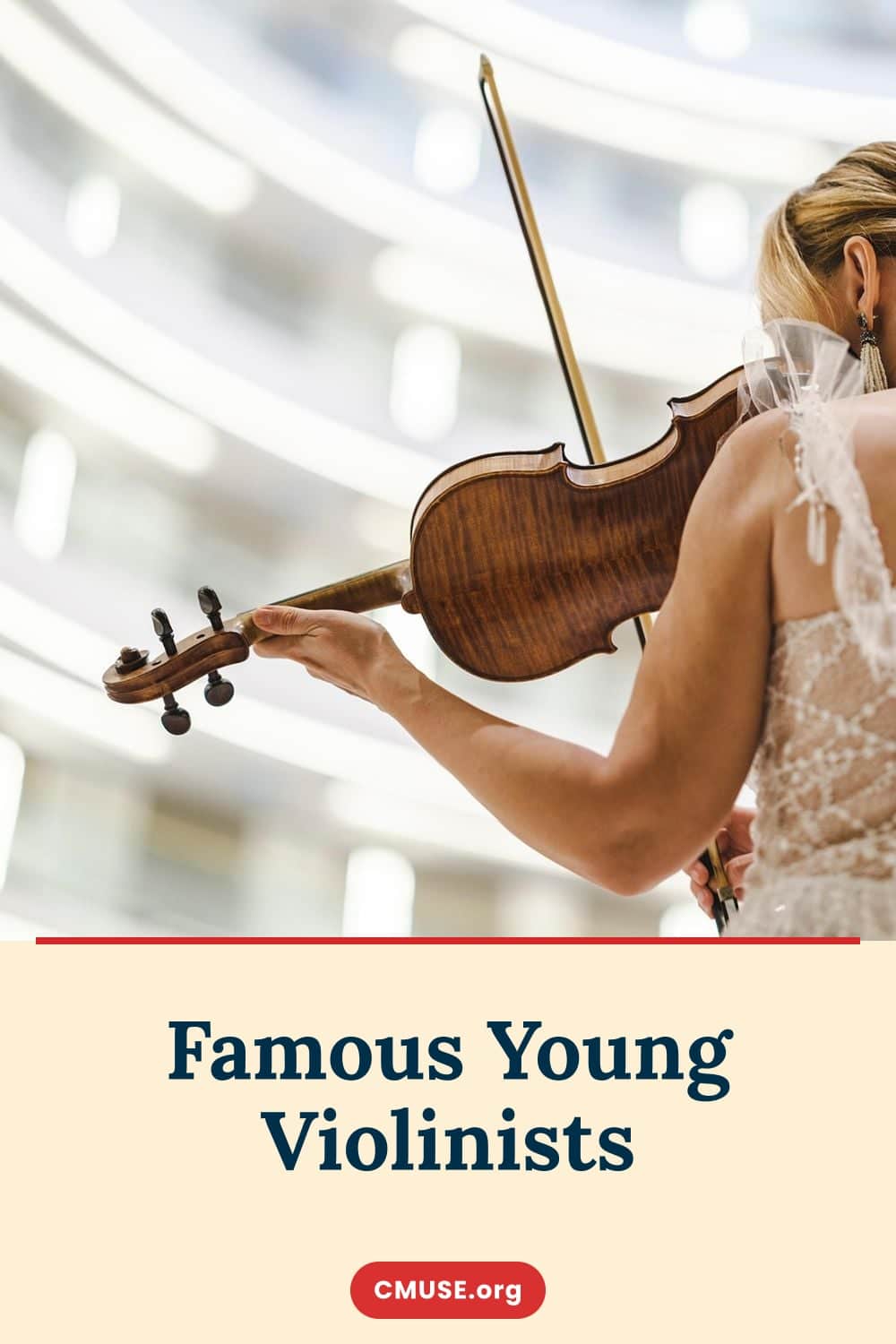
The violin has a way of making time feel elastic. One minute a prodigy is barely tall enough to hold the instrument without a shoulder rest, the next they are standing on international stages trading bow strokes with orchestras twice their age. What separates these young players from every other talented child grinding through scales is not just technical speed but a ferocious blend of musical imagination and sheer nerve.
Their stories remind us that genius at an early age is rarely about perfection. It is about daring to sound like yourself before the world tells you how.
These violinists did exactly that. Each carved out a voice while still navigating adolescence, school exams, and the pressure of adult expectations. Their paths differ wildly in geography, repertoire, and temperament, yet they share one thread: they refused to wait.
The list that follows gathers some of the most compelling cases from the past century. You will meet players who rewrote contest rules, others who built careers outside the competition circuit, and a few who simply let their musical instincts run ahead of their years. Their choices, breakthroughs, and occasional missteps offer a vivid map of what youthful excellence actually looks like in practice.
Most Inspiring Young Violinists To Know
1. Hilary Hahn
Hilary Hahn signed with a major label at age sixteen, but her real arrival had happened years earlier. At ten she performed the Bach Double Concerto with the Baltimore Symphony, already displaying the clean attack and singing tone that would become her trademark. What matters more than the early dates is how she used them.
Hahn treated every youthful appearance as laboratory time, testing fingerings, experimenting with vibrato speed, and learning how different halls reshape sound. By the time she reached her late teens she had developed an interpretive maturity that made critics scramble for new adjectives. Her recordings of the Beethoven and Tchaikovsky concertos, cut while she was still an undergraduate, still serve as benchmarks.
The poise you hear is not borrowed from teachers. It is the sound of a mind that decided early on to trust its own ears.
2. Midori
Midori’s Carnegie Hall debut at fourteen remains one of the most astonishing nights in modern concert history. Bernstein conducted; she was the soloist in the Sibelius concerto. During the performance a string snapped, then another.
Most players would have stopped. Midori walked calmly to the side of the stage, borrowed a spare violin from concertmaster Glenn Dicterow, and finished the piece without dropping a beat. The audience erupted.
That moment crystallized everything about her: technical command so complete it survived equipment failure, coupled with a calm that suggested she had already lived several musical lifetimes. What followed was a career spent balancing superstar status with deep advocacy for music education. She founded an organization that brings instruments and lessons to children in underserved communities, proving that prodigy energy can be turned outward instead of hoarded.
3. Joshua Bell
Joshua Bell was the ultimate American wunderkind of the 1980s. At fourteen he recorded the Mendelssohn concerto with Riccardo Muti and the Philadelphia Orchestra, an album that still crackles with unchecked joy. Bell’s gift was never speed alone. It was his ability to make the violin sound like a slightly mischievous human voice, full of color changes and sly humor.
He balanced that exuberance with serious work on the Bruch and Wieniawski showpieces, building a repertoire that let him move from salon charm to barn-burning virtuosity without seeming to change gears. Later he would test the limits of fame by busking incognito in a Washington subway station, an experiment that revealed how context shapes the way we hear even the greatest players. The kid who once charmed Leonard Bernstein never lost the sense that music should feel like an adventure.
4. Maxim Vengerov
Maxim Vengerov exploded onto the scene in the early nineties as a teenager from the former Soviet Union. His 1990 recording of the Shostakovich First Concerto with Rostropovich conducting captured a ferocity that seemed almost too big for his frame. Vengerov’s tone combined Russian depth with a laser-like focus that cut through any orchestra.
What set him apart was his willingness to treat the violin as a dramatic actor. He would lean into phrases with physical commitment that made audiences lean forward in their seats. By his early twenties he had already collected Gramophone awards and a BBC New Generation Artist designation.
The pressure of that early acclaim could have crushed a less grounded personality. Vengerov channeled it into constant exploration, adding conducting to his portfolio and mentoring younger players who now face the same expectations he once did.
5. Nicola Benedetti
Nicola Benedetti grew up in Scotland with Italian roots and a work ethic that bordered on obsession. She won the BBC Young Musician of the Year at sixteen, performing the Tchaikovsky concerto with a combination of steel and lyricism that made the jury’s decision feel inevitable. Benedetti’s sound is rich and generous, never thin even in the most exposed passages.
She has used her platform to champion British composers and to record imaginative projects that mix classical warhorses with folk music and new commissions. The interesting part is how she speaks about practice. She describes it as problem solving rather than repetition, a mindset that lets her attack difficult passages with curiosity instead of fear.
That attitude, formed in her early teens, continues to shape her artistic decisions today.
6. Janine Jansen
Janine Jansen took a slightly different route. She entered the international spotlight in her late teens with a fresh, chamber-music sensibility that felt like a breeze through a sometimes stuffy tradition. Her early recording of the Vivaldi Four Seasons with friends from the Amsterdam Conservatory emphasized dialogue over display.
Jansen’s tone has a luminous quality that makes even familiar phrases sound newly minted. She refuses to separate solo playing from collaborative work, often performing with the same small group of musicians for years at a time. That loyalty to ensemble values, unusual in a child prodigy culture that prizes individual fireworks, has given her career unusual depth.
When you listen to her Brahms or Beethoven sonatas you hear not just a brilliant violinist but a musician who learned early that conversation matters more than monologue.
7. Augustin Hadelich
Augustin Hadelich survived a horrifying accident at seventeen that burned much of his body and threatened to end his career. Before that he had already won the International Violin Competition of Indianapolis at eighteen, an almost unheard-of age for that particular prize. His recovery became its own master class in resilience.
Hadelich emerged with a sound that combined German precision, Italian warmth, and a poetic freedom that seems to ignore technical barriers. His recordings of the Paganini Caprices show dazzling facility, yet the real revelation comes in quieter works by Schumann or Beethoven where his ability to shape a phrase feels almost conversational. The fact that he reached this level after such trauma makes his story one of the most quietly inspiring in the field.
These violinists prove that starting young is not a guarantee of lasting success, nor is it a curse. What matters is how the years between ten and twenty are used: as fuel for curiosity rather than pressure for perfection. Some competed relentlessly, others avoided contests altogether.
A few treated every stage as a classroom while a couple simply played as if the audience did not exist. All of them, at some point, had to decide whether they would let their early fame define them or whether they would keep evolving once the novelty of youth wore off.
The next time you hear a child prodigy announced with breathless hype, remember these names. Their real gift was not the ability to play fast at twelve. It was the courage to keep listening to their own musical conscience long after the applause for being young had faded.
That is the part worth copying, no matter what age you pick up the instrument.