Build-Up Bar Calculator
Convert BPM, build length in bars, riser subdivisions, snare roll rate, automation step count, pre-drop silence, and grid offset into seconds, beats, hits, and drop timing.
Timing model: Presets load common arrangement values for build sections. Tweak the inputs to line risers, rolls, automation, and drop impact to your DAW grid.
Quarter Beat
Automation Step
Pre-Drop Gap
Riser Grid
| Tempo range | 8-bar build | 16-bar build | Common use |
|---|---|---|---|
| 95-110 BPM | 17.5 to 20.2 seconds | 34.9 to 40.4 seconds | Pop chorus lift, half-time dance pop, K-pop pre-drop tension. |
| 120-130 BPM | 14.8 to 16.0 seconds | 29.5 to 32.0 seconds | House, progressive house, club-ready EDM arrangements. |
| 135-150 BPM | 12.8 to 14.2 seconds | 25.6 to 28.4 seconds | Dubstep, trap, bass music, hard dance, festival drops. |
| 160-180 BPM | 10.7 to 12.0 seconds | 21.3 to 24.0 seconds | Drum and bass, jungle, high-energy breakbeat launches. |
| Subdivision | Events per beat | 128 BPM interval | Best build use |
|---|---|---|---|
| 1/4 notes | 1 | 469 ms | Big impacts, cymbal swells, sparse pop lifts. |
| 1/8 notes | 2 | 234 ms | Steady riser pulses and simple snare acceleration starts. |
| 1/16 notes | 4 | 117 ms | Standard EDM snare rolls and filter-gated movement. |
| 1/32 notes | 8 | 59 ms | Final-bar urgency, fills, and fast white-noise chops. |
| 1/64 notes | 16 | 29 ms | Last-beat stutters; use sparingly to avoid clutter. |
| Automation target | Typical shape | Step count | Mix timing note |
|---|---|---|---|
| Low-pass cutoff | Exponential lift | 16 to 64 | Opens energy while preserving the drop reveal. |
| Pitch riser | Linear or curved | 8 to 32 | Shorter steps feel more mechanical; longer ramps feel smoother. |
| Reverb send | Late swell | 4 to 16 | Pull the send down before impact to keep the drop clear. |
| Snare volume | Rising contour | 8 to 32 | Increase gradually, then mute or reverse before beat one. |
| Preset | BPM | Bars | Arrangement result |
|---|---|---|---|
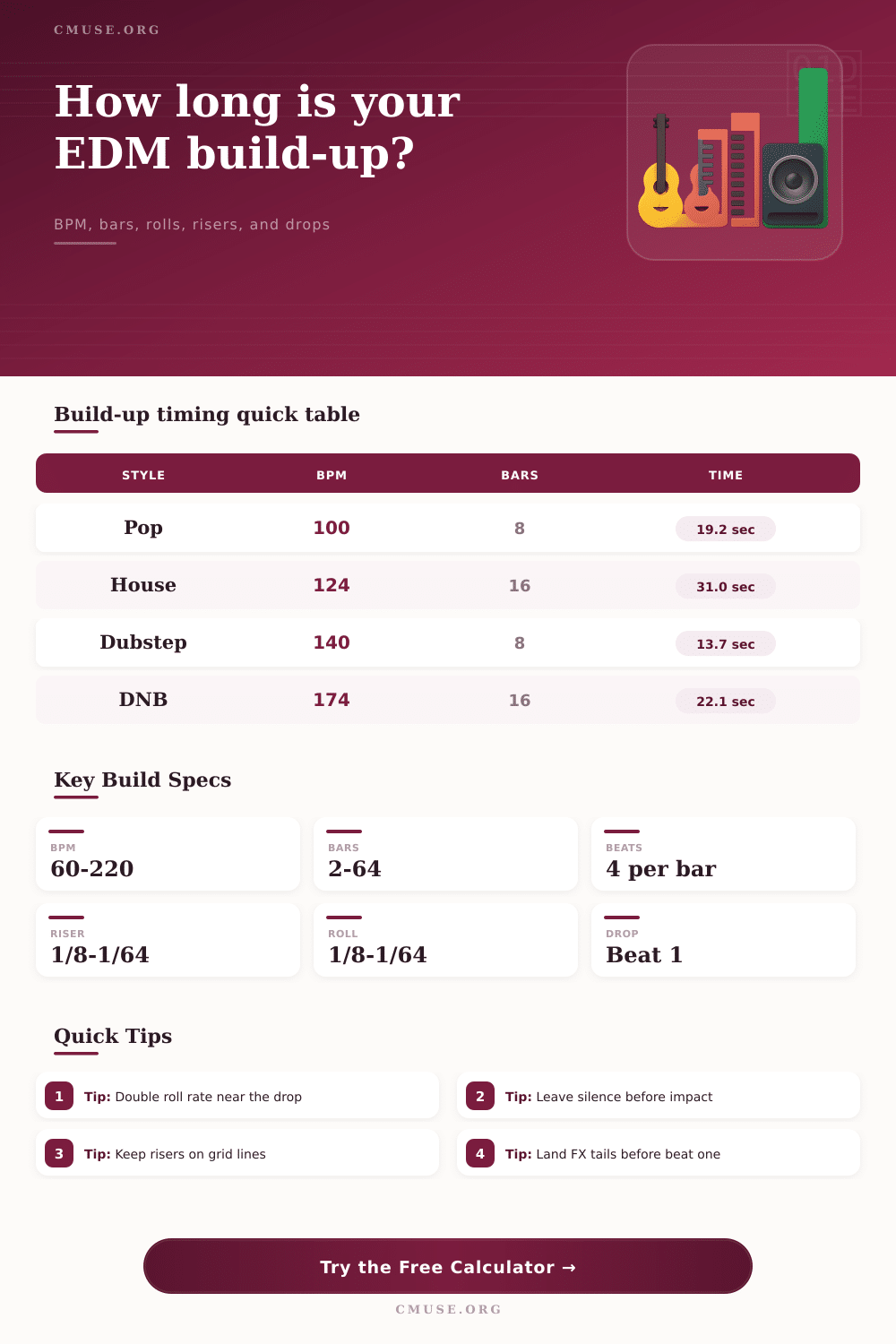
| Pop Chorus Lift | 100 | 8 | 19.2 seconds, 32 beats, gentle 1/8 riser motion. |
| House 16-Bar Rise | 124 | 16 | 31.0 seconds, 64 beats, classic club arrangement spacing. |
| Festival EDM Climb | 128 | 16 | 30.0 seconds, 64 beats, 1/32 final snare density. |
| Trap Snare Ramp | 150 | 8 | 12.8 seconds, 32 beats, fast 1/64 final stutter option. |
| DNB Launch | 174 | 16 | 22.1 seconds, 64 beats, dense rolls without a long wait. |
Tension in electronic dance music (EDM) or pop tracks are created through the process of a build section that gather energy from the listener until a drop occur. The build section gathers energy without revealing the drop too soon, and the producer have to make specific choices about the timing of the build section before the first kick land. The tension within the build section is create through the use of riser sweeps, snare accelerations, and automation movements within the track.
These elements either add pressure to the track or release the pressure from the track. Many producers attempt to create a build section for their tracks but struggle to find ways to measure how the build elements impacts the tension within the track. The beats per minute (BPM) for EDM and pop tracks determines the timing for the entire track.
Timing the Build and Drop in EDM and Pop
Furthermore, the BPM will ultimately determine how much time the producer has within the given number of bars. For EDM and pop tracks with higher BPM values, the same number of bars will pass much more quickly in terms of the real time that passes. A musical idea can feel urgent with high BPM values and feel sluggish with low BPM values.
Producers often use BPM values between 124 and 174 for EDM and pop tracks. A calculator can help producers to determine the number of seconds available for the build section of the song. Using a calculator to determine the number of seconds available in the build section will prevent the producer from guessing at the amount of time available to create the build section.
Another variable that determines the length of the build section of an EDM or pop track is the bar count. The bar count is a flexible variable because the length of the build section can depend on the type of EDM or pop track that is being produce. For instance, eight bars of a half-time pop track may be felt as a long time to build tension but may be short for a drum and bass track.
A common bar count for EDM tracks at festivals is sixteen bars to allow for two riser sections and a snare push but many moddern EDM tracks use twelve or ten bars so that listeners does not lose interest in the song. Furthermore, the bar count will determine the amount of silence within a track before the drop occur. The amount of silence should be appropriate for the density of the elements within the build section.
Within the build section of EDM and pop tracks, there are specific tools that producers can use to sculpt the tension within that section. These tools include riser subdivisions and snare roll rates. Producers can create a snare roll that starts with sixteenth notes and ends with thirty-second notes to create a sense of acceleration within the track.
Furthermore, the producer can determine whether the highest density of snare notes should last for a full bar or only for the final beat within that bar. A calculator can assist producers in sculpting the tension of the track so that they can ensure that the snare roll reaches its final beat at the appropriate time. Many EDM and pop producers will find that the final beat of a bar is the most effective place for the snare rolls highest density because any other placement of the highest snare roll density may flatten the tension within the track.
Another variable that producers can control within a build section is the automation steps for that track. Automation steps is different from the snare roll and other rhythmic elements within the track. For instance, an automation movement that opens a low-pass filter will feel smooth if there are thirty-two steps for the movement but will feel more mechanical if the movement occur over eight steps.
Furthermore, the number of automation steps within a track interact with the riser subdivisions for that track. Producers must ensure that the automation for the track does not occur at a faster rate than the riser subdivisions. Otherwise, the automation and riser subdivisions will compete for the listener’s attention.
Another element within the track is the pre-drop silence before the drop occur within the song. This silence has a large effect on how the listener perceives the drop within the song. Removing a quarter beat of silence before the drop will make the first kick of the drop feel larger in size and impact.
However, too much silence before the drop can make the drop feel like a surprise to the listener. The goal for EDM and pop tracks is for the drop to feel like a release of tension for the listener. An offset control can be used to move the timing of the drop.
Using this control will allow producers to fine tune the drop to occur at the exact time required by another musical element within the track. Another valuable tool within the track is the use of reference tables. These tables can show producers the number of seconds that a given BPM will take within a given bar count.
For instance, at 140 BPM, thirty seconds of a build is very long for a track. A thirty-second build at 140 BPM could be the upper limit of how long producers should take to build up to the drop so every element within the track must justify the length of the build section. By being able to measure the variables within a track, EDM and pop track producers has the ability to make decisions about their songs.
Furthermore, by measuring the variables within a track, EDM and pop track producers will be able to ensure that they can repeat these decisions with intention and purpose. Once producers know how many beats they have within their track and how the density of elements should change within that track, their creative options will become clear. A producer that understands the concept and timing of the build section within a song can transform that build into a designed passage within the song.