Crossfade Length Calculator
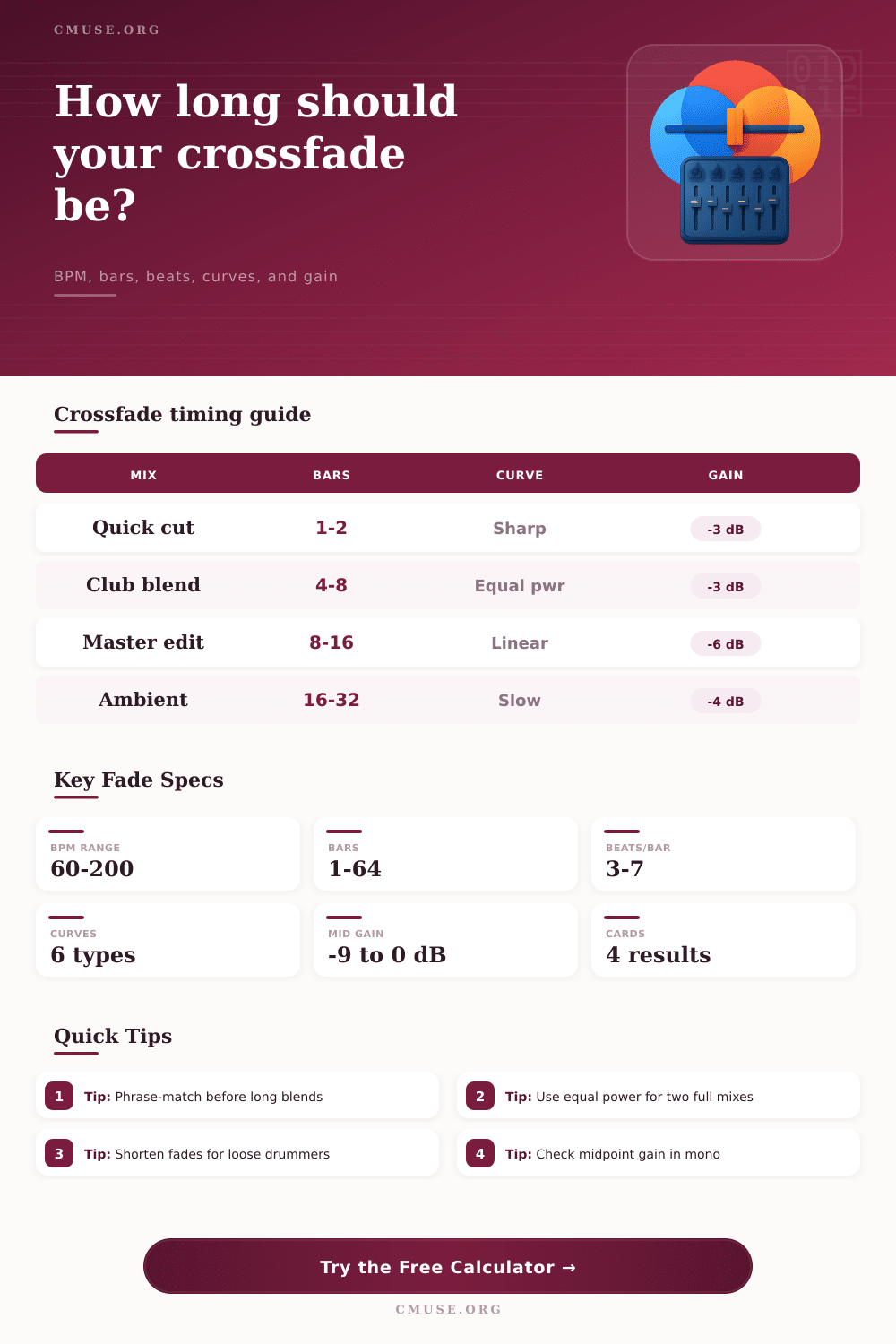
Calculate DJ and mastering crossfade timing from source BPM, target BPM, bars, beats, manual overlap seconds, phrase alignment, crossfader curve, and midpoint gain.
Preset use: Load a realistic DJ, edit, or mastering fade, then adjust BPM and phrase settings to match the two tracks you are joining.
Crossfade Breakdown
Midpoint time
Center power sum
BPM separation
Beat countdown
| Curve | Best use | Typical midpoint | Practical note |
|---|---|---|---|
| Linear amplitude | Playlist edits and mastering crossfades | -6 dB each | Smooth voltage fade, often feels slightly quieter at center. |
| Equal power | Two full-band DJ tracks over the same beat grid | -3 dB each | Usually keeps perceived loudness stable through the middle. |
| Slow-in | Incoming vocal, intro, or pad that should creep in | -4 to -6 dB | Outgoing deck remains dominant until the second half. |
| Slow-out | Outgoing groove needs to clear early for a new drop | -2 to -4 dB | Incoming deck becomes dominant before the center point. |
| Sharp cut | Scratches, drops, radio stings, hard edits | 0 to -3 dB | Keep overlap short to avoid flams and doubled transients. |
| Mastering S | Album sequence, applause tails, ambience, broadcast beds | -4 to -6 dB | Slow ends with a controlled, graceful center transition. |
| DJ or edit use | Bars / beats | At 100 BPM | At 128 BPM |
|---|---|---|---|
| Scratch or drop cut | 0 to 1 bar | 0 to 2.4 s | 0 to 1.9 s |
| Open-format chorus blend | 2 to 4 bars | 4.8 to 9.6 s | 3.8 to 7.5 s |
| Club phrase transition | 8 bars | 19.2 s | 15.0 s |
| House or techno ride | 16 bars | 38.4 s | 30.0 s |
| Ambient, intro, or outro wash | 32 bars | 76.8 s | 60.0 s |
| Mastering playlist fade | Manual seconds | 2 to 12 s | 2 to 12 s |
| Alignment mode | Grid size | Good for | Watch point |
|---|---|---|---|
| Beat matched | 1 beat | Short cuts, edits, cue juggling | Can still feel unphrased if vocals clash. |
| Bar aligned | 1 bar | Most pop, hip-hop, and wedding transitions | Check where the snare and vocal pickup land. |
| 8-bar phrase | 8 bars | Open-format drops and radio edits | Short intros may need a cue offset. |
| 16-bar phrase | 16 bars | Club intro-to-chorus and chorus-to-break mixes | Works best when both tracks keep steady drums. |
| 32-bar phrase | 32 bars | House, trance, techno, and long builds | EQ and gain staging matter across the long overlap. |
| Free timing | No grid | Ambient beds, speeches, podcast music, sound design | Use the waveform and ears instead of beat counts. |
| Preset | Starting length | Curve | Midpoint gain |
|---|---|---|---|
| Radio Sting Cut | 0 bars, 2 beats | Sharp cut | -1.5 dB |
| Open Format Drop | 2 bars | Slow-out | -3 dB |
| Club 8-Bar Blend | 8 bars | Equal power | -3 dB |
| House Phrase Mix | 16 bars | Equal power | -3 dB |
| Ambient Wash | 32 bars | Mastering S | -4.5 dB |
| Mastering Edit Fade | Manual 8 seconds | Mastering S | -6 dB |
A crossfade is the lengths of time that two song play at the same time. The length of a crossfade determine how the audience perceive the transition between the two songs. If the crossfade is too short, the next song will play in the gap before the current song end.
If the crossfade is too long, the two songs will overlap for more then far too long. You must find a balance between the musical structure of the two songs and the actual length of the crossfade in second. The first factor to consider when setting the length of a crossfade is the tempo of the songs.
How to Set Crossfade Length
The tempo of the song that is playing out of the current playing device can be used to calculate the length of the crossfade. However, if the song that is being crossed into have the new tempo for the area, you can also use that songs tempo. Additionally, the average of the two song tempos can be used to create a gradualy crossfade between the two tracks.
The tempo of a song is the number of beat that play in a minute. The tempo of the song will dictate how many second a specific number of beat will play. Musical phrase or bars and beat can be used to determine the length of the crossfade.
For example, four bars of a song at 128 bpm will play for approximately fifteen seconds. Eight bars of the same song will play for approximately thirty second. The number of bars in a crossfade will determine how many musical phrase the two songs will play at the same time.
Additionally, adding extra beat to a crossfade will allow for the proper exit of a song. Adding extra beat is especially useful for when a vocal or a drum fill occur at an inconvenient time. Another factor that can be used to determine a crossfade is known as alignment.
The most common form of alignment are beat matching and bar alignment. Beat matching is used for quick transition between songs. Bar alignment is used for songs based off pop and hip-hop music.
Eight bar and sixteen bar alignment are used for open-format music. Thirty-two bar alignment is used for dance music like house and techno music. Another form of alignment is free timing, used for ambient music or music with spoken introduction.
The shape of the crossfade and the point of the midpoint gain will affect the volume of the music that the listener hear during the crossfade. One of the most common form of crossfade is equal-power curve, used predominantly in clubs around the world. Equal-power curve ensure that there is no change in the volume of the song between the two track.
Linear curve are another form of crossfade, but linear curve will cause a dip in the volume of the song in the middle of the crossfade unless the midpoint gain is lowered. Slow-in and slow-out curve allow the one song to remain the dominant song in the mix for a longer period of time than the other song. Tempo drift is a variable that can occur for songs with different tempo.
A small difference in tempo, such as a two-bpm difference over thirty seconds, the listener may go unnoticed. However, the same bpm difference played over two minute will be felt in the song. Here, the decision must be made as to whether the outgoing song will have the same tempo as the incoming song or both song will have a tempo in the middle of the two tempo.
Safety tail are extra amount of audio that are added to the end of a crossfade. The safety tail provide a buffer of the outgoing song. This buffer allow the incoming song time to settle before the outgoing song end.
This parameter is especially important for songs that use alot of reverb on the outgoing song. A lot of reverb will create a long tail of sound that need time to fade out. Phrase offset allow for the exit of the outgoing song to be moved four or eight beat earlier so that the vocal and other sound will exit at an apropiate time.
This does not alter the length of the crossfade. A close proximity to the nearest clean boundary for the song will determine whether or not this offset is needed. After determining each musical parameter for the crossfade, the result of each parameter should be checked.
The tempo drift and alignment of the two songs should be checked after setting each musical parameter. If the aligned exit of the songs is much longer than the desired crossfade, the cue point for the song should be moved. If the volume of the song’s bass is too high in the middle of the crossfade, the user should lower the gain or change the type of crossfade.
The length of a crossfade is a balance between the structure and the environment of the room where the music will be played. The number listed above represent the starting point for mixing songs in a track or playlist.