Setlist Duration Calculator
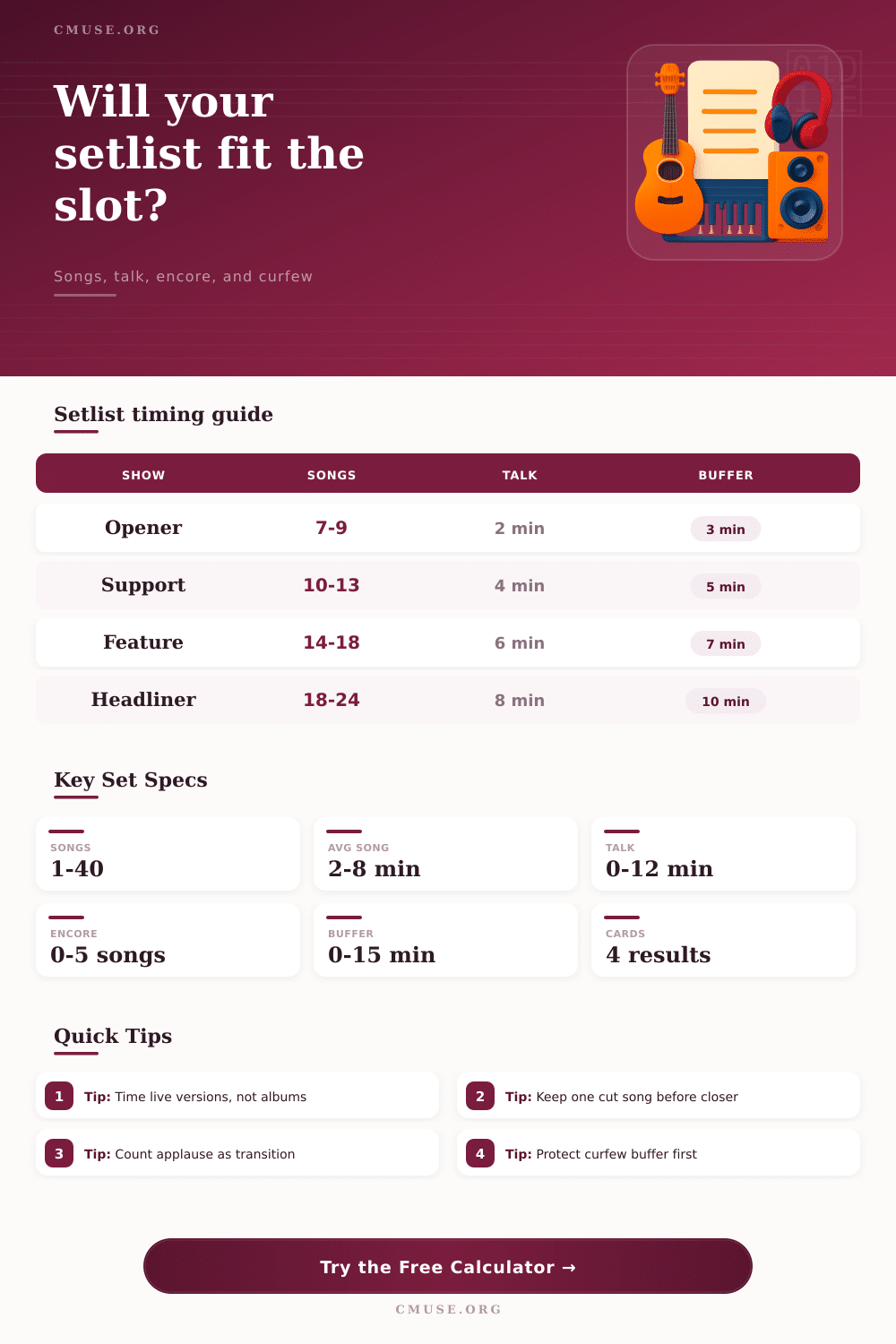
Build a show clock from song count, average song length, fixed song durations, talk breaks, transitions, intro, outro, encore time, curfew buffer, and the booked slot.
Preset use: Load a realistic show profile, then replace the songs and timing assumptions with the actual arrangement lengths from rehearsal.
Timing Breakdown
| # | Song | Parsed Duration | Timing Note |
|---|
| Format | Typical Slot | Song Count | Timing Watchpoint |
|---|---|---|---|
| Broadcast taping | 20 to 35 minutes | 5 to 8 songs | Fixed clock, no stretched applause. |
| Club opener | 25 to 40 minutes | 6 to 10 songs | Short transitions protect the closer. |
| Theater support | 40 to 60 minutes | 10 to 14 songs | Intro, outro, and line-change gaps add up. |
| Album showcase | 60 to 80 minutes | 12 to 18 songs | Deep cuts may run longer live than rehearsal notes. |
| Headliner encore set | 80 to 120 minutes | 18 to 26 songs | Encore songs need curfew clearance. |
| Element | Lean Value | Standard Value | Risk Signal |
|---|---|---|---|
| Transition or applause gap | 10 to 20 sec | 20 to 45 sec | Instrument swaps or long backing-track cues. |
| Talk break | 15 to 30 sec | 30 to 75 sec | Stories before several songs in a short slot. |
| Intro and walk-on | 0.5 to 1.5 min | 1.5 to 3 min | Video roll, host intro, or delayed first downbeat. |
| Encore return | 2 to 4 min | 4 to 8 min | Unplanned encore after stage manager calls time. |
| Curfew buffer | 3 to 5 min | 5 to 12 min | Outdoor curfew, broadcast, or next act handoff. |
| Preset | Slot Plan | Setlist Shape | Best Use |
|---|---|---|---|
| Club Opener | 32 minute slot, 3 minute cushion | Fast songs, few talks | Testing whether one more song can fit. |
| Theater Support | 55 minute slot, 5 minute cushion | Singles plus one ballad | Protecting the support-act hard stop. |
| Acoustic Story Set | 50 minute slot, longer talk breaks | Fewer songs with context | Balancing stories against music time. |
| Jazz Quartet Feature | 70 minute slot, elastic song lengths | Longer improvisational sections | Checking final downbeat and curfew risk. |
| Encore Heavy Headliner | 105 minute slot, 10 minute cushion | Main set plus planned encore | Deciding where to place cut songs. |
A performance involve many different elements that take up time. Songs, transitions, applause, and spoken word all take up time during a performance. Each of these element that take up time during a performance must be accounted for because the length of the performance isnt just the length of each song during the performance.
For instance, elements like applause or stories take up minute during a performance that should also be accounted for in the total time of that performance. If the band dont account for those minutes, the performance may take up too much time during the allotted time for that performance. One of the tool that can assist in managing the total time of a performance is the use of a calculator.
How to Plan the Time for a Show
Each calculator allow for the input of the length of each song that the band is to be performed live, as well as the allowance of time for talk break between songs. The band accounts for the talk breaks separate from each song because the length of the talk breaks will not change based off the length of the song or the speed at which the band performs. Additionally, the calculator also allows for the input of time for encores in which the band must leave and return to stage.
Additionally, each calculator also displays the flex that the performance will have. Flex is the amount of time that will remain before the performance hits it’s hard stop or curfew. If the flex is small, it may be necessary for a song to be removed from the performance.
For instance, if the song to be removed is any song except the final song in the performance, it is possible for that final song to still be the closer to the performance. In addition to the calculator, there are also some variable that cannot be accounted for in the calculator. Some of these variables include technical failure, such as a cable failure, and audience responses, such as the audience singing along to a song.
Each of these variables will increase the time of each song or each story that is to be performed. To account for these variables, a buffer for the performance should of been created. A buffer is extra time that can be allotted beyond the time that is calculated for the performance to account for the potential increase in time due to these variable.
The reference table allow for an understanding of the typical number of songs that will be performed and the allowance of time for talk break between those songs. These tables are not rules for each performance, but they is useful in recognizing if the performance plan is outside of the typical parameter for that type of performance. For instance, if the performance has too many song for the time slot in which it will occur, the reference tables will allow the band to recognize this, allowing them to shorten one of the transition or moving one of the stories to another portion of the performance.
By using a calculator to track the time of the performance, the band can make informed decision about which songs will be performed and in what order. For instance, instead of having to wonder if any particular song should be performed, the calculator can show the performance schedule and the time for each song will allow for each song to earn its place in the performance schedule. Additionally, because the band can see the time for each performance, it allows the band to manage the performance prior to the performance begin and reaching its hard stop.