Jet Lag Tour Calculator
Plan a realistic touring recovery window from origin and destination time zones, flight direction, showtime, rehearsal buffer, sleep adjustment pace, arrival timing, and performance risk.
Tour use: Load a common routing profile, then adjust dates, showtime, rehearsal call, and sleep habits for the real itinerary. Time zones are simplified as fixed UTC offsets for planning.
| Prep Day | Bedtime Target | Wake Target | Light Cue | Tour Note |
|---|
Later local time compresses bedtime.
Useful for pre-tour adjustment.
For most transatlantic shows.
Warmup plus notes before doors.
| Tour Route | Typical Shift | Direction Feel | Planning Buffer |
|---|---|---|---|
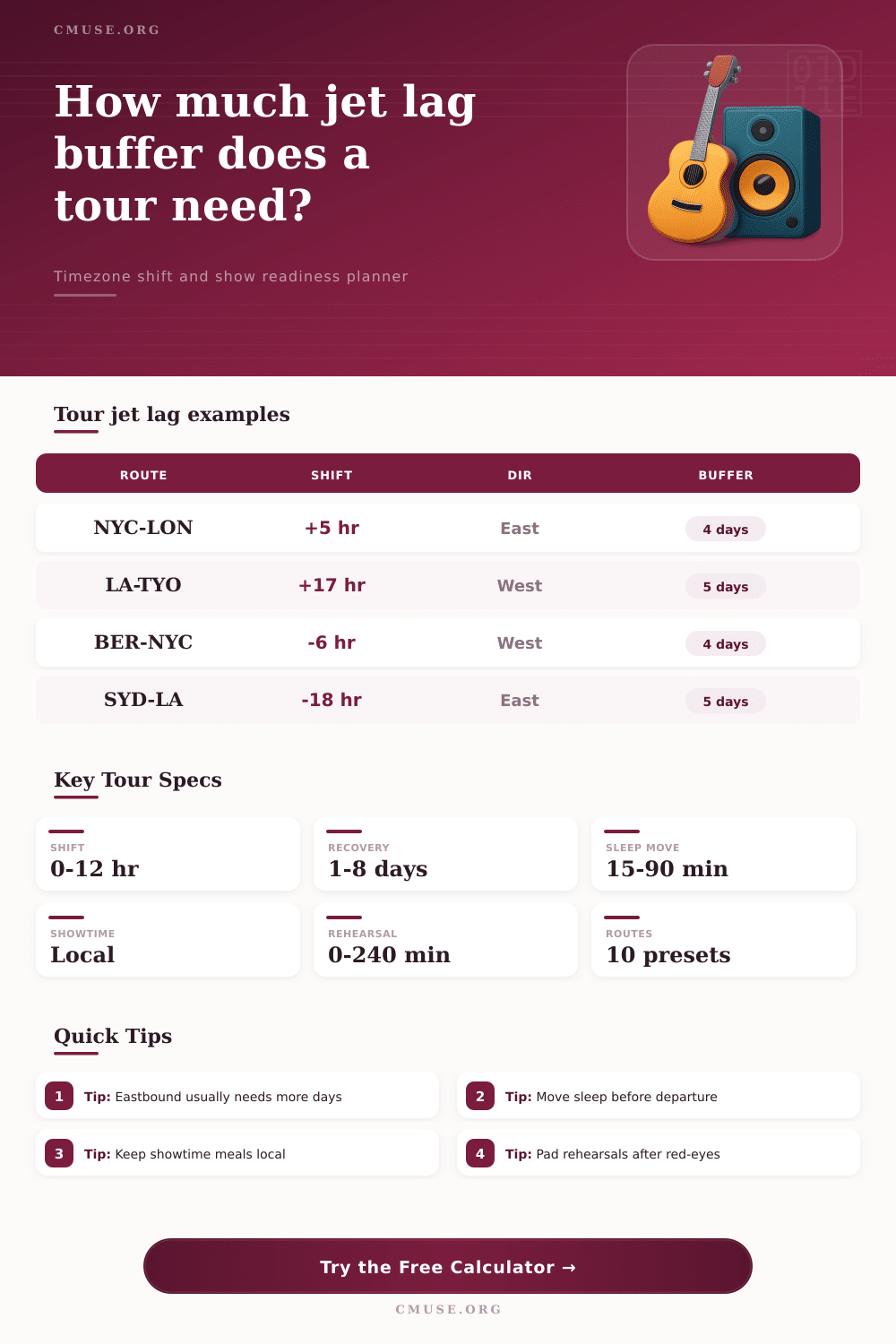
| New York to London | +5 hours | Eastbound, bedtime gets earlier | 3 to 4 days |
| Los Angeles to Tokyo | Normalized 7 hours | Date-line westbound routing | 4 to 5 days |
| Berlin to New York | -6 hours | Westbound, evening alertness shifts later | 3 to 4 days |
| Sydney to Los Angeles | Normalized 6 hours | Date-line eastbound routing | 4 to 5 days |
| Direction | Clock Problem | Show Risk | Calculator Weight |
|---|---|---|---|
| Eastbound | Sleep must move earlier | Late-night wakefulness, morning fog | Higher recovery days |
| Westbound | Sleep moves later | Afternoon dip, early wakeups | Moderate recovery days |
| Short shift | One to three hours | Usually manageable with light cues | Lower buffer |
| Date line | Calendar changes confuse routing | Arrival day can feel inverted | Manual override useful |
| Performance Type | Recovery Target | Rehearsal Buffer | Watch Item |
|---|---|---|---|
| Club band | Shift hours x 0.6 to 0.8 days | 60 to 90 minutes | Vocal warmups and late dinners |
| Vocal showcase | Shift hours x 0.8 to 1.0 days | 90 to 150 minutes | Hydration and sleep debt |
| Orchestra or charts | Higher sensitivity setting | 120 to 180 minutes | Reading focus and coordination |
| Festival fly-in | Add travel fatigue multiplier | 90 minutes plus changeover | Red-eye arrivals and stage heat |
| Adjustment Pace | Best For | Use Before | Practical Limit |
|---|---|---|---|
| 15 minutes per day | Long advance notice | One to two week routing | Slow but comfortable |
| 30 minutes per day | Normal touring prep | Transatlantic club dates | Balances sleep and schedule |
| 60 minutes per day | Short-notice flights | Showcase and fly-in weeks | Harder on rehearsal days |
| 90 minutes per day | Emergency correction | Date-line or missed prep | Use with strong light cues |
Jet lag is a condition that affect the functioning of the human body. Jet lag cause changes to sleep patterns, focus, and hearing accuracy. People who suffer from the effects of jet lag may find it dificult to retain information about the timing of events and the pitch of sounds heard.
These effect upon musicians may result in mistake during a performance. In order for a musician to successfully perform before an audience, there must be enough time within the musician’s schedule for the musician to adjust to the new time zones. The jet lag calculator require a few piece of information from the musicians before it can provide a recovery time window for those musicians.
How Musicians Can Plan for Jet Lag
These pieces of information include the musician’s origin and destination time zones, the length of the musician’s flight, the musician’s level of fatigue after the flight, and the musician’s performance sensitivity to the songs that will be performed. The origin and destination time zones will help determine the size of the time shift that the musician will experience. The length of the flight and the musician’s level of fatigue will help to determine the musician’s sleep debt.
The musician’s performance sensitivity will account for the difficulty of the songs that the musician will perform; the more difficult the musician’s songs are, the more days that will be recommended for the musician to recover from the jet lag. Eastbound travel is thought to be more difficult for the body then westbound travel. This is due to the fact that eastbound travel requires the human body to sleep earlier.
Westbound travel is often thought to be easier because eastbound travel makes it possible for musicians to remain alert for longer periods of time after the musician begins to travel westward. The jet lag calculator accounts for this difference in the physiology of the human body. For example, jumping eastward across the Atlantic ocean is thought to require more days of buffer time than traveling westward across the same ocean.
The jet lag calculator must account for the direction of travel of the musician; thus, the musician must input this information into the jet lag calculator. The musician can use the override field for the jet lag calculator if the musician’s route cross the date line. Musicians can adjust for jet lag prior to traveling by adjusting their sleep schedules before departure.
For example, shifting the musician’s bedtime by thirty minutes each day over a period of several days will allow the musician’s body to adjust to the time difference prior to the musician’s departure. The jet lag calculator can build a sleep schedule for the musician based off the musician’s normal bedtime and target bedtime at the musician’s destination. The musician can use either a gentle or fast pace to adjust the musician’s sleep schedule prior to departure.
For example, if the musician has many days prior to their departure, a musician may use a gentle pace. However, if the musician has little time prior to their departure, a musician may use a fast pace to adjust the musician’s sleep schedule. The time at which the musician arrives at their destination can have an impact upon their adjustment to the time zones.
Arriving in the morning is thought to be easier than arriving at midnight; when musicians arrive in the late night, their body thinks it is the previous day. The jet lag calculator takes into account the time that musicians arrive at their destination. Early arrival will reduce the number of days of buffer time required by the musician, but a red-eye arrival will increase the number of days of buffer time required.
Musicians may wish to consider including a rehearsal period in their tour prior to performing concerts. During this rehearsal period, musicians can determine if their sleep debt is causing them to rush during the concert or lose their musical pitch. Additionally, the jet lag calculator will include the rehearsal time for the musician, as the performance sensitivity for the musician will increase the recovery time window if the musician’s performances are of high performance sensitivity.
There are variable to each tour that cannot be accounted for in the jet lag calculator. For instance, musicians may find that they are late to load into the concert, the concert hall may be hot, or they may have hospitality duties that keeps them from sleeping. The jet lag calculator cannot account for these variable.
However, it does allow musicians and tour managers to decide how much time they wish to provide for musicians to recover from the jet lag; if the number of day available cannot account for the time recommended by the calculator, the concert may need to be shortened or the rehearsal time may need to be protected. The reference table located on the page provide additional information regarding jet lag. The first table includes common route for musicians.
The second table includes information regarding the difference in travel between eastbound versus westbound travel. The third table includes information regarding different adjustment time and for what circumstances each adjustment time may be appropriate. These tables are not rules, but they do provide the musician with an understanding of the different variable related to jet lag and the recovery time for musicians from jet lag.
Planning for jet lag allows musicians and managers to make the cost of travel visible, and visibility of the cost of travel allows musicians to account for the musician’s schedule to provide enough time for recovery from jet lag.