Power Distro Calculator
Plan stage distribution from feeder ampacity, phase configuration, connected show loads, breaker limits, branch circuits, phase balance, neutral estimate, and usable headroom.
Distro planning model: Choose a realistic venue profile, then replace the loads and breaker details with the current power plot, venue disconnect, and branch panel layout.
Distro Calculation Breakdown
| Feeder type | Typical rating | Common venue use | Distro note |
|---|---|---|---|
| Stage pin or Edison branch | 15 A to 20 A | Small audio, backline, control | Keep high inrush loads separated from consoles and RF. |
| L6-30 or L14-30 twist-lock | 30 A | Mobile DJ, small dimmer, powered PA | Good subfeed size when the panel is nearby. |
| Bates / pin and sleeve | 60 A to 100 A | Theater, ballroom, medium stage | Check gender, voltage, ground, and neutral before tie-in. |
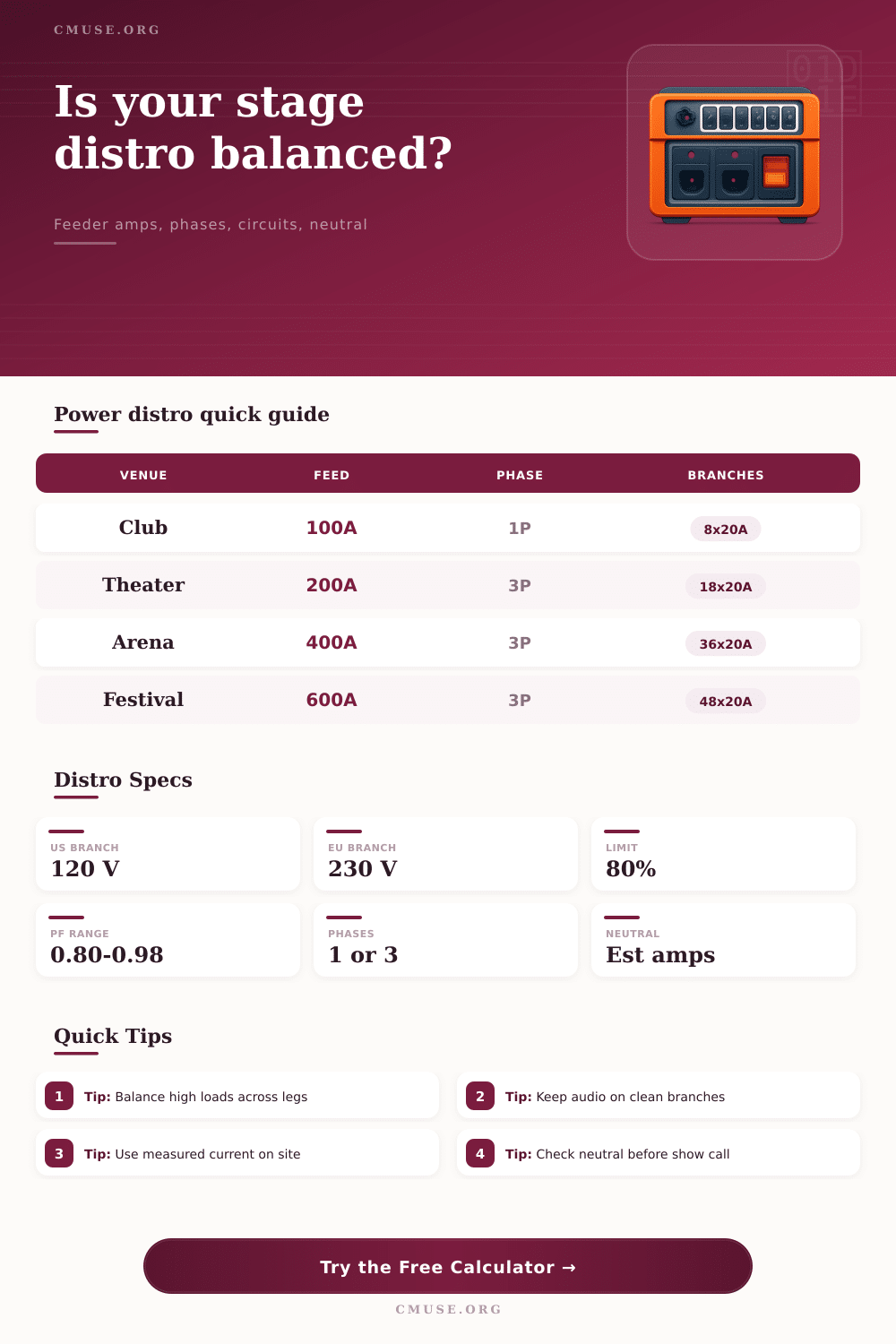
| Camlock feeder set | 200 A to 400 A | Touring stage, arena, festival | Confirm phase rotation and install order with the house electrician. |
| Parallel camlock sets | 400 A to 1200 A | Large lighting, video wall, broadcast | All conductors and distro gear must be rated for parallel use. |
| Breaker size | 80% usable amps | 120 V planning watts | 230 V planning watts |
|---|---|---|---|
| 15 A | 12 A | 1,440 W | 2,760 W |
| 20 A | 16 A | 1,920 W | 3,680 W |
| 30 A | 24 A | 2,880 W | 5,520 W |
| 60 A | 48 A | 5,760 W | 11,040 W |
| 100 A | 80 A | 9,600 W | 18,400 W |
| Profile | Feed style | Likely loads | Planning concern |
|---|---|---|---|
| Black box theater | 100 A to 200 A single or 3-phase | LED plot, small PA, dimmer leftovers | Split dimmers, movers, and audio across clean circuits. |
| Corporate ballroom | 200 A 3-phase | Audio, video, uplight, projection, scenic | Video and lighting can dominate branch counts. |
| Festival stage | 400 A to 600 A 3-phase | PA, monitor world, lighting, backline, FOH | Long feeder runs and generator balance matter. |
| Broadcast showcase | 200 A to 400 A 3-phase | Cameras, comms, screens, lighting, audio | Neutral and harmonic load can climb with switched supplies. |
| School auditorium | 60 A to 100 A subfeed | House lighting, small PA, projector, backline | Older panels may have limited spare branch capacity. |
| Balance result | Spread between legs | What it means | Production action |
|---|---|---|---|
| Excellent | 0% to 5% | Phase currents are close together. | Keep the plot, then verify with clamp readings. |
| Usable | 5% to 12% | One leg is working harder but still manageable. | Move a few fixtures, racks, or utility circuits. |
| Watch | 12% to 20% | Feeder headroom may be uneven. | Reassign lighting groups or backline power. |
| Rebalance | 20% plus | One phase can trip while the total kW looks safe. | Build a new phase map before energizing show loads. |
Power distribution for live events must account for both the planned designs of the live events and the way in which the live events will play out in the real world. Power distribution for live events must be planned around the fact that the power loads within the live events isnt going to remain the same throughout the event. For instance, lighting rigs will load more power into certain stages during cues within the live event, audio systems will load more power according to the content of the live event, and video walls may load more power into certain areas of the venue than others relative to there nameplate ratings for the products.
In these situations, you can use a calculator to adjust for the demand factors of each of these categories separately to make sure that the calculation for power distribution within the live event is accurate. While it is important to account for each of these varying loads, it is necessary to avoid overestimating each of those power loads, as the use of higher feeders and distribution equipment will result from such overestimations. Additionally, it is necessary to avoid underestimating each of those power loads, as the power system will be vulnerable to failing within the live event due to underestimations of those loads.
How to Plan Power for Live Events
Phase balance in power distribution systems is important in that each of the legs of a three-phase power distribution system must be even in how it distributes the power. Any overload of one phase of a three-phase power system can result in the breaker for that phase tripping, even if the total power within the three phases is within the limits of the system. To account for this, you can target percentages of the total power to each of the phases of a three-phase distribution system.
These percentages can be tested prior to patching any equipment. Even if the individual loads of each phase are different than the others, they should all be relatively even and within a narrow range of one another. If the power spreads within the three phases of the distribution system are not narrow and even from one phase to the next, the power system will be unbalanced and you will have to move any equipment to even out the distribution of power.
Neutral current within a three-phase power distribution system is another consideration for live events. Some of the most common loads on a power distribution system for live events are nonlinear loads, such as LED lighting and digital control systems. The use of nonlinear loads within the power distribution system can create harmonics within the power system that do not cancel out in the same way as linear loads.
You can estimate the neutral current of a power system by entering the nonlinear share of each distribution system into the power load distribution calculator. While this estimate is not a substitute for measuring the equipment, it can serve as a warning that the neutral conductor may experience more issues than the total wattage would indicate. The process for planning the branch circuits for a show follows a logical process.
First, you must determine how many branch circuits are required for the show. One way to estimate the number of circuits that will be required is to establish the branch circuit breaker size and the continuous planning limit for the circuits. The continuous planning limit is often set at 80 percent of the circuit breaker size because circuit breakers are not designed to remain on the circuits at 100 percent of the circuits voltage for long periods of time.
Using these parameters will provide an estimation of the number of branch circuits that will be required for the show and if additional distribution equipment is required. The conditions in the show venue can alter the calculations that were performed. Long feeder runs can result in a significant drop of the available voltage to the equipment.
Many show venues use older electrical panels that may not have the same limitations as the electrical panels that are manufactured today. The effects of high panel temperatures can also affect the performance of the power distribution system calculations. All of these variables is complex and difficult to account for in the design of the power distribution system.
For these reasons, you should use the calculator as a baseline for the power distribution system for a show venue. There are also reference tables that list the different types of feeders and the values for the branch circuit breakers that are planned for each type of feeder. These tables help designers to ensure that the show’s power needs fall within the parameters of common power distribution systems in the industry.
These tables list the number of watts that can be distributed by each type of branch circuit at 120 volts, 208 volts, and 230 volts. These numbers are not rules that must be followed for an effective power distribution system, but they do provide a frame of reference for power distribution engineers to compare the options for supplying power to each show venue circuit. The calculator is a design tool that can be used to test different scenarios for the installation of branch circuits.
Use the calculator to alter the duty factors and the phase shares for the circuits. Monitor the changes to the headroom and the neutral conductor calculations. These changes can help to ensure that you understand which parameters of your power distribution system are robust and which are sensitive to design alterations.
Understanding the parameters that is sensitive to changes in the power system will allow you to understand the system before the generators start to run and before the show begins.