XLR Cable Length Limit Calculator
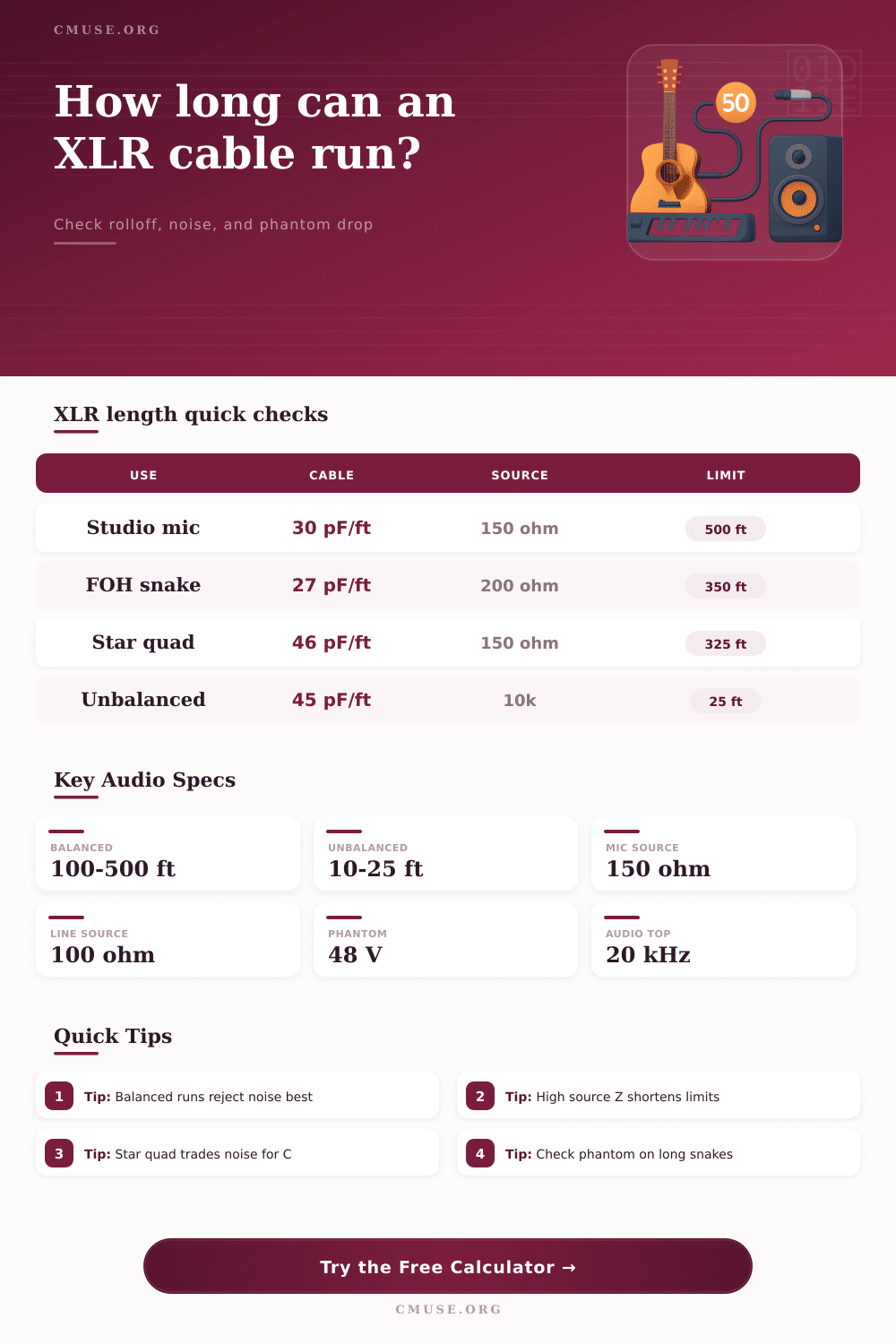
Estimate safe XLR run length from balanced or unbalanced wiring, cable capacitance, source impedance, high-frequency rolloff, noise exposure, and phantom-power voltage drop.
Load a named cable and use case, then adjust the electrical inputs. The calculator treats balanced mic and line runs differently from unbalanced XLR wiring because source impedance and common-mode rejection change the usable length dramatically.
Calculation Breakdown
Total Cable Capacitance
RC Cutoff Frequency
Round-Trip Cable Resistance
Length Headroom
| Cable Type | Typical Capacitance | Best Use | Length Note |
|---|---|---|---|
| Low-capacitance touring cable | 18 to 24 pF/ft | Long balanced stage runs | Best electrical headroom for distant FOH or install paths |
| Standard balanced mic cable | 28 to 35 pF/ft | General studio and live use | Usually fine for hundreds of feet with low-Z sources |
| Star quad microphone cable | 40 to 50 pF/ft | Noisy stages, broadcast, ENG | Better magnetic rejection, slightly shorter HF limit |
| Miniature or vintage cable | 50 to 70 pF/ft | Short patching or special rigs | Watch high source impedance and long phantom-powered runs |
| Source Type | Typical Source Z | Balanced Length | Unbalanced Length |
|---|---|---|---|
| Transformer or active microphone | 120 to 250 ohms | 300 to 800 ft often workable | Not recommended as unbalanced |
| Console or interface line output | 50 to 200 ohms | 500 ft or more with quality cable | 25 to 50 ft only if quiet |
| Passive DI or pickup on XLR adapter | 10k ohms or more | Use active buffer or DI first | 10 to 20 ft before tone loss |
| Tube or vintage output stage | 600 to 2k ohms | Keep conservative, test HF loss | Short patch lengths only |
| Run Length | 24 AWG Loop | 4 mA Drop | 10 mA Drop |
|---|---|---|---|
| 50 ft / 15 m | 2.5 ohms | about 0.03 V | about 0.06 V |
| 150 ft / 46 m | 7.5 ohms | about 0.09 V | about 0.19 V |
| 300 ft / 91 m | 15 ohms | about 0.18 V | about 0.38 V |
| 500 ft / 152 m | 25 ohms | about 0.30 V | about 0.63 V |
| Scenario | Typical Length | Main Risk | Practical Choice |
|---|
When you run a microphone cable, you need to consider the length of that microphone cable. The length of the microphone cable can affect the quality of the audio signal that travel from the microphone to your audio equipment. While a microphone cable will almost always carry a signal from the microphone to the receiving audio equipment, the signal may sound different at the audio equipment due to the length of the cable.
Microphone cables has limits to the length of the microphone cables based off a variety of factor, including the electrical characteristics of the wire that make up the microphone cable, the impedance of the equipment that is connected to the microphone, and the environment in which you are using the microphone cable. One of the main factor that limits the length of microphone cables is high frequency loss. Microphone cables act as filter formed by the capacitance of the microphone cable and the resistance of the microphone itself.
Why Microphone Cable Length Matters
As the length of the microphone cable increase, the cutoff frequency of that filter decreases, which result in the loss of high frequencies from the microphones sound. This loss of high frequencies is often noticed in microphones that has a high percentage of high frequencies in their sound, such as cymbals and human speech. The calculator that is provided can help you determine the amount of high frequency loss that will occur with a given length of microphone cable.
Another factor that affect microphone cable length is the type of wiring that is used for the microphone cable. Balanced microphone cables utilize common mode rejection to eliminate noise caused by external sources like power lines and lighting dimmers. Because of this ability of balanced microphone cables to avoid picking up noise caused by these external factors, balanced microphone cables (like XLR cables) can be of long lengths.
In contrast, unbalanced microphone cables must be kept short to avoid noise. The calculator can calculate a noise risk score for the microphone cable based upon the wiring mode for the cable. Phantom power is introduced into a microphone signal and can also have an impact on the length of microphone cables.
Condenser microphones often require a voltage supplied to them by phantom power that is introduced into the microphone cable. The voltage delivered to the condenser microphone is often less than the voltage that the phantom power source supplies because of the resistance of the microphone cable. If the voltage drop too low, the condenser microphone may distort or it may not work at all.
The calculator models the voltage drops that may occur along the microphone cable so that you can determine if the voltage to the condenser microphone will be sufficient. Note that dynamic microphones dont draw any current, so phantom power voltage drops do not impact the signal from dynamic microphones. Another factor that you should consider is the impedance of the signal source and the microphone that is being utilized.
Microphones with low output impedance can drive long microphone cables with high capacitance. Microphones with high impedance will lose more of their signal when they are driving a microphone cable. The ratio between the impedance of the microphone signal source and the load impedance of the audio equipment will impact how much the filter function of the microphone cable impact the signal from the microphone.
Impedance values need to be entered into the calculator for it to calculate the impact of the microphone cable on the microphone signal. Lastly, the physical environment in which you are using the microphone can also have an impact on the microphone signal and the ability of the microphone to function at the length that is planned for it. Factors like temperature can alter the resistance of the conductor in the microphone cable, the repeated movement of the microphone cable can fatigue the shield of the cable, and damaged connectors can introduce resistance into the microphone signal.
These factors can reduce the life of the microphone signal to a length shorter than that calculated for the microphone cable. The tables provided provide typical values of the capacitance of microphone cables of different constructions. These tables provide only the starting point for considering the length of microphone cables that can be used.
It is generally recommended that you stay well within the limit for microphone cable length for the microphone that is being utilized. This provides a margin of error for any changes to the microphone setup. For instance, you might want to allow some room in case new lighting is added to the stage, or you may want to use a condenser microphone instead of a dynamic microphone, which draw more current.
The numbers that is provided in the microphone cable length calculator are a starting point for making a decision about the length of microphone cable that will be used. However, it is recommended that you also perform a test with the actual microphone cable and source to ensure that the signal quality is within the range that you desire.