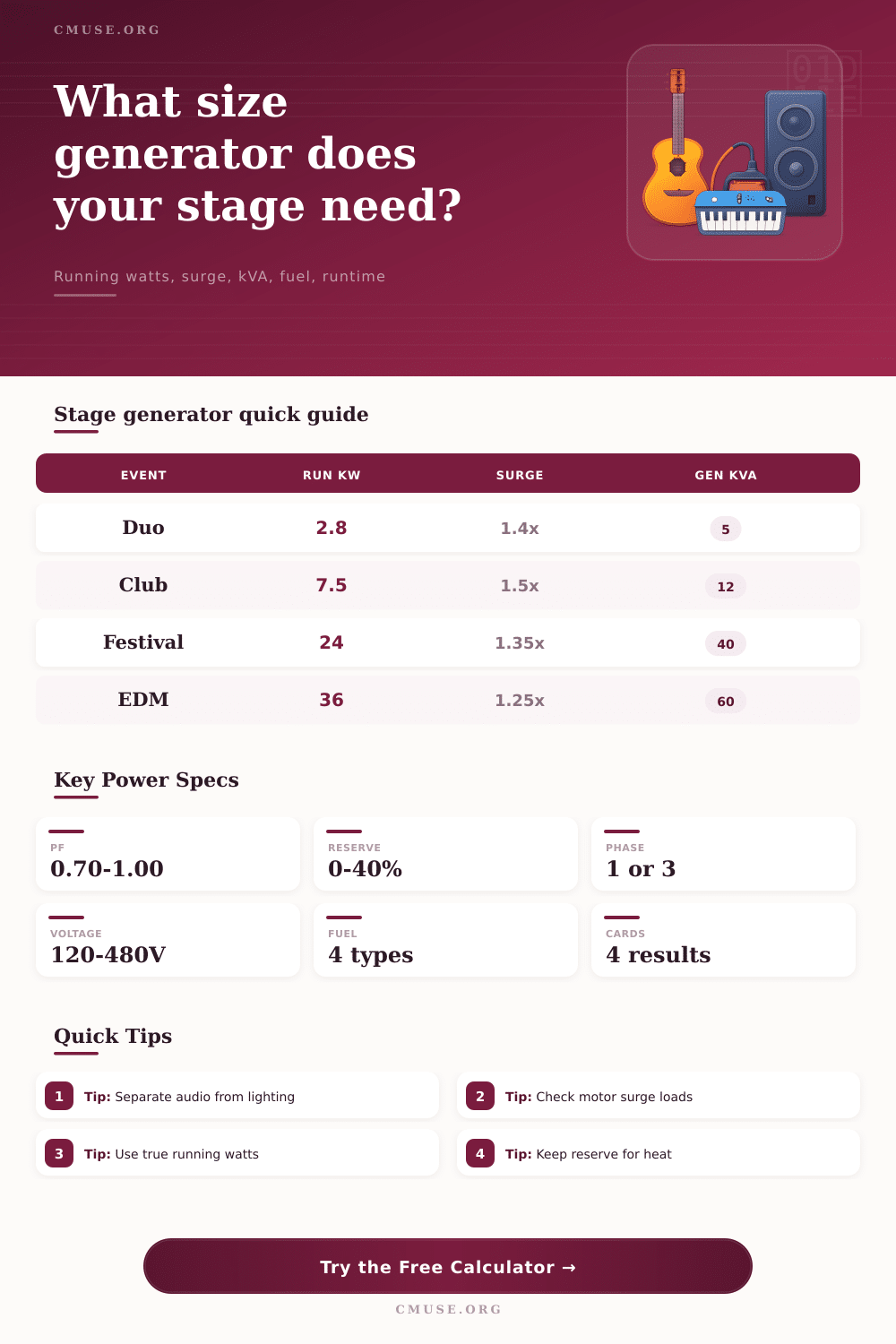
Generator Size Stage Calculator
Estimate event generator capacity from audio, lighting, backline, video, rigging motors, catering, voltage, phase, power factor, starting surge, reserve margin, fuel tank size, and show runtime.
Stage power model: Pick a realistic event profile, then replace the running loads, starting surge, phase, reserve, and fuel details with your production plot numbers.
Generator Sizing Breakdown
| Stage Item | Typical Running Watts | Power Factor | Surge Note |
|---|---|---|---|
| Powered 12 inch PA top | 250 to 700 W program | 0.85 to 0.95 | Small electronic inrush |
| Powered dual 18 sub | 900 to 2200 W program | 0.80 to 0.95 | High peak draw on bass hits |
| LED moving head | 250 to 900 W each | 0.70 to 0.95 | Pan, tilt, and lamp start add peaks |
| Hazer or fog machine | 600 to 1600 W heat cycle | 0.95 to 1.00 | Cycles hard when reheating |
| Backline amp stack | 150 to 800 W each | 0.80 to 0.95 | Usually modest surge |
| Small compressor cooler | 300 to 900 W running | 0.65 to 0.85 | 2.5x to 3x start current |
| Preset | Running Load | Phase | Typical Generator Class |
|---|---|---|---|
| Coffeehouse Duo | 2.2 kW | 120 V single | 5 kVA |
| Wedding Band | 7.1 kW | 240 V single | 12 kVA |
| Club Rock Night | 12.9 kW | 240 V single | 20 kVA |
| Festival Side Stage | 20.2 kW | 208 V three | 35 kVA |
| EDM Tent | 36.0 kW | 208 V three | 60 kVA |
| Broadcast Stage | 30.4 kW | 208 V three | 50 kVA |
| Fuel | Energy Basis | Practical Electrical Yield | Planning Note |
|---|---|---|---|
| Diesel | About 128,700 BTU/gal | 11 to 14 kWh/gal | Best common runtime for towable event sets |
| Gasoline | About 114,000 BTU/gal | 8 to 11 kWh/gal | Common on small portables and short shows |
| Propane | About 91,500 BTU/gal | 6 to 8 kWh/gal | Cleaner storage with lower energy per gallon |
| Natural gas | About 1,037 BTU/cu ft | 3 to 4 kWh/100 cu ft | Runtime depends on service capacity and pressure |
| Service | Current Formula | Best Use | Watch Point |
|---|---|---|---|
| 120 V single | A = W / V | Small PA, ceremony, booth power | Easy to overload one leg |
| 120/240 V split | A = W / 240 | Small band, mobile DJ, food tent split | Balance 120 V legs |
| 208 V three phase | A = VA / (1.732 x V) | Most festival distros and stage packages | Balance phases by department |
| 400/230 V three phase | A = VA / (1.732 x V) | International event distribution | Confirm connector and neutral plan |
| 480 V three phase | A = VA / (1.732 x V) | Large lighting, HVAC, motor loads | Requires transformer for 120 V gear |
Choosing the correct generator for your live show requires careful planning. The generator must provide power for all the equipments in your live show. Many peoples feel that choosing a generator based only on the running watts of the equipment will provide the correct generator size for your live performance.
However, choosing a generator based only on the running watts of the equipment will often provide an incorrect value for the generator size that is needed. The generator must be able to handle the starting surge of the equipment in addition to the running watts of the equipment. If the generator isnt able to handle the starting surge of the equipment, then the voltage will drop and the equipment will lose power.
How to Choose the Right Generator for a Live Show
The stage will contain several types of electrical loads. Each type of load will draw power differently from the generator. Audio amplifiers will draw a steady load from the generator, but the audio amplifiers will draw a more higher load from the generator when a low musical note is played.
LED lights will be efficient in the amount of power that they use, but the power factor of the LED lights will be lower than one. The motors in lighting fixtures will draw a high amount of current when they start up, and if the generator is too small to handle that starting surge the generator will fail. To ensure that the generator remains stable, each department in the live performance should be assigned its own power load.
If the audio, lighting, video, and catering departments is assigned to share a power leg from the generator, then the combined load of that department can exceed the limit for that power leg and drop the voltage for all departments sharing that leg. The calculator allows for the entry of the running watt load of each department and the surge factor of the largest motor in the live show. The calculator suggests the generator size to the live show manager.
A reserve percentage and derating percentage are also provided to account for environmental factor. The reserve percentage is used to provide a cushion of power for situations that may occur. The reserve percentage can provide extra power for the generator to compensate for the drop in power output from high heat temperatures.
Another reason to use the reserve percentage is for long cable runs for the equipment, as the voltage can drop with long cable runs. The reserve percentage also protects the generator. Many generators are rated for standby use rather than prime power use.
The continuous power output of a generator rated for standby use is less than the continuous power output of a generator that is rated for prime power use. The continuous power rating of the generator must be used rather than the prime power rating. The fuel for the generator is another important choice for the manager of the live show.
Diesel generators are better suited to long live shows because diesel fuel contains more kilowatt-hours per gallon than gasoline. Gasoline generators are more easier to transport to the live show location for small generators. However, gasoline burns faster than diesel fuel and can be difficult to store for several days.
Propane fuel is also an option and is easy to store, but the energy density of propane fuel is less than diesel fuel. Therefore, more propane fuel will be needed for the same length of time that diesel fuel will run the generator. Another fuel option is natural gas, which can be used if there is a natural gas service line available at the live show location.
The pressure and flow of the natural gas service line will impact the amount of power that can be provided to the live show. Another important factor to consider for the fuel is the length of time that the live show will run. The length of time should be planned based off the average load of the generator.
Most live shows do not run most of the equipment at full power for the entire live show. The setting for the average load of the generator in the calculator will allow the manager to determine the length of time for the fuel and the size of the generator. Common mistakes in setting up a live show generator is for the manager to use the peak wattage ratings of the equipment in place of the continuous wattage rating of the equipment.
Using the peak wattage of the equipment will result in a generator that is too small for that live show and will not be able to supply power to the electrical equipment. All of the equipment must be checked to ensure that the continuous wattage of the equipment is used in calculating the required size of the generator. Additionally, the surge load of the largest motors in the live show must be accounted for.
Another important calculation of the generator is the estimated line current of the generator. The line current can be estimated based on the voltage of the generator and the number of phases of electricity that the generator will use. For live shows, three-phase power is used to even out the power load on each leg of the three phases.
However, care must be taken to ensure that the load on each leg of the three-phase generator is even. If too much equipment is on one leg of the three-phase generator, that leg will drop the voltage for all of the equipment on that leg. Finally, another important consideration is for the manager to consider the unexpected changes to the live show.
For example, it is possible for the production manager to decide at the last minute to add more lighting to the live show. The live show may also need to be set up in the sun for visibility, which can heat the generator to high temperatures. It is also possible that the length of the cable run from the generator to the live show location may be longer than planned for the live show.
The reserve percentage and derating percentage of the generator will allow the generator to handle these unexpected changes and remain stable in voltage and phases for the live show.