Truck Pack Volume Calculator
Estimate tour truck cube from interior dimensions, case size, planned case count, stack height, aisle or void factor, pack density, reserved gear space, and remaining cubic volume.
Start point: Load a named vehicle profile, then adjust the interior cube and case inputs to match your real trailer, van, bus bay, or box truck.
Pack Breakdown
Selected Truck
About 650 cu ft raw cube
Stack Height
Caps case layers before ceiling height.
Pack Density
Real-world use of clean cube.
Reserved Cube
Loose gear kept out of case math.
| Truck or rig | Typical usable dimensions | Raw interior cube | Best use |
|---|---|---|---|
| Cargo van club rig | 10 ft x 6 ft x 4.5 ft | 270 cu ft / 7.6 m3 | Combo amps, drums, stands, and small merch bins |
| High-roof van | 12 ft x 6.2 ft x 6.1 ft | 454 cu ft / 12.8 m3 | Local tour with upright cases and safer stack height |
| Sprinter band pack | 14.1 ft x 7.2 ft x 6.4 ft | 650 cu ft / 18.4 m3 | Backline, compact PA, merch, and luggage |
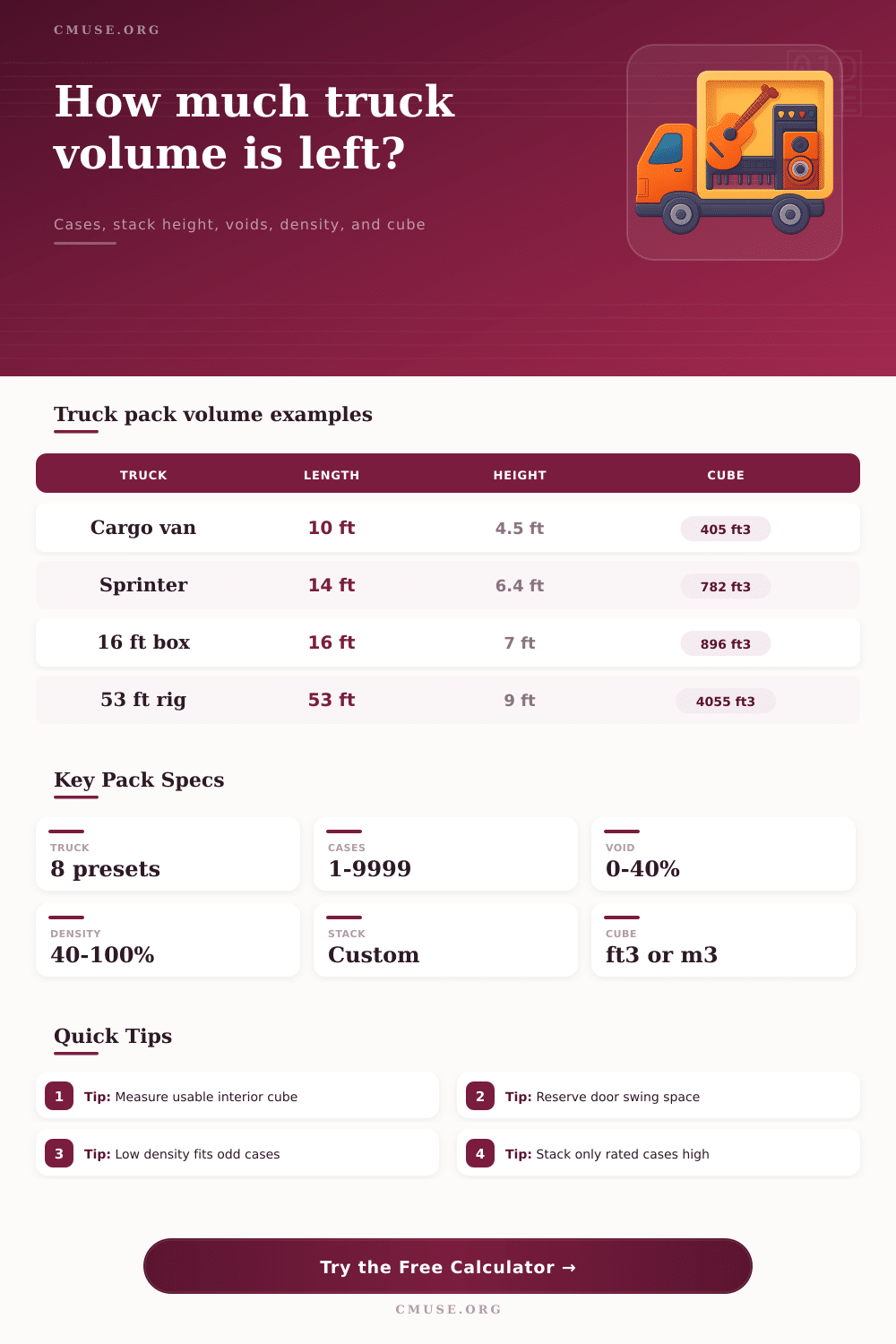
| 16 ft box PA | 16 ft x 8 ft x 7 ft | 896 cu ft / 25.4 m3 | Speaker stacks, lighting trees, and larger case counts |
| 26 ft straight truck | 26 ft x 8.2 ft x 8.4 ft | 1791 cu ft / 50.7 m3 | Regional production with pack carts and aisle lanes |
| 53 ft festival rig | 53 ft x 8.5 ft x 9 ft | 4055 cu ft / 114.8 m3 | Full production, staging cases, barriers, and risers |
| Case type | Typical size | Volume | Pack note |
|---|---|---|---|
| Guitar vault | 45 in x 18 in x 8 in | 3.8 cu ft / 0.11 m3 | Usually stacks only when flat and padded |
| Combo amp case | 30 in x 24 in x 24 in | 10.0 cu ft / 0.28 m3 | Keep handles and casters clear in the width |
| Medium trunk | 48 in x 24 in x 30 in | 20.0 cu ft / 0.57 m3 | Good representative case for mixed tours |
| Speaker case | 48 in x 30 in x 36 in | 30.0 cu ft / 0.85 m3 | Often limited by stack rating, not cube alone |
| Lighting trunk | 60 in x 30 in x 36 in | 37.5 cu ft / 1.06 m3 | Leave void for clamps, cables, and odd lids |
| Pack cart | 72 in x 30 in x 48 in | 60.0 cu ft / 1.70 m3 | Fast load-in but lowers density in small trucks |
| Pack condition | Void factor | Density range | Use this when |
|---|---|---|---|
| Tight matched trunks | 5% to 8% | 88% to 96% | Most cases share width, height, and stacking pattern |
| Mixed band backline | 10% to 16% | 74% to 86% | Drums, amps, guitars, keyboards, and merch ride together |
| Loose gear and soft bags | 16% to 24% | 62% to 76% | Items cannot square up cleanly against hard cases |
| Aisle-lane theater pack | 18% to 28% | 58% to 72% | Crew needs access lanes or show-order unloading |
| Pallets or pack carts | 12% to 22% | 65% to 82% | Speed matters and wheels consume dead space |
| Stack height target | Typical case layers | Risk level | Planning note |
|---|---|---|---|
| Under 4 ft / 1.2 m | 1 to 2 layers | Low | Useful for fragile amps, instruments, and hand unloads |
| 4 to 6 ft / 1.2 to 1.8 m | 2 to 3 layers | Moderate | Common for band vans and medium trunks |
| 6 to 8 ft / 1.8 to 2.4 m | 3 to 4 layers | Higher | Needs straps, load bars, and stack-rated cases |
| Above 8 ft / 2.4 m | 4+ layers | Specialized | Usually production trailers with trained loaders |
Packing a truck for a tour is a task that requires precise calculation to take into account the obstacle in the truck and the difficulty in arranging the equipment cases. The interior of a truck typicaly has obstacles to taking into account in relation to the equipment cases that are to be transported in the truck. For instance, many people may believe that calculating the length, width, and height of the truck will provide a figure of the total volume of space that can be utilized for the equipment cases; however, this dont account for the fact that there may be restrictions to how high the cases can be stacked, that there may be issues with the swing of the truck doors, or that there may be issues with the wheel wells of the truck.
The calculator that is provide helps to account for some of these variable for the owner of the truck. For instance, the calculator adjusts for the limits of how high the equipment cases can be stacked within the truck. Furthermore, the calculator also adjusts for the idea of “void” percentages within the truck; there will always be some empty space within the truck for equipment cases, regardless of how many case are attempting to be loaded into the truck.
How to Pack a Tour Truck
Other variables that the calculator recognizes are the dimension of the truck, the size of the equipment cases that will be loaded into the truck, and the number of the case that will be loaded. Based off these variables, the calculator is able to determine how many case of equipment will fit into the truck. Other considerations by the calculator include the variables of how high the cases will be stacked into the truck; the higher the height of the cases relative to the height of the truck, the more likely that the cases will be limited by the footprint that they will occupy on the ground.
Thus, if there is a limited volume of cases that can be loaded into the truck based upon the height of the cases and the height of the truck, the calculator will provide this figure to the owner of the truck. In addition to accounting for height and footprint variable, the calculator also accounts for the void percentage of the truck, the empty space within the truck. Some examples of void percentages include the area within the truck that is occupied by the wheel wells, the area that is required for the truck doors to swing open, and the gaps between equipment cases of different sizes.
These variables will require the owner to choose a void percentage for their truck; the percentage for a theater whose cases include an aisle lane, for instance, would be more higher than the void percentage for a group of bands who all have cases of the same size. Other variables that the calculator accounts for include the density of the equipment cases. For instance, if the cases contain drum and amplifiers and merchandise bin, there will be gaps between the item that can be loaded into the cases.
Some reference table are included within the calculator to help the user to remember the different variable. For instance, a table that includes preset truck allows the user to input the type of truck that they have, and the calculator will provide the usable cubic volume of those trucks. Another table that may prove helpful is the road-case volume table, which allows the user to input the dimension of the case that will be loaded into the truck, in inches, and the calculator will output the volume that the case will occupy in cubic feet.
Additionally, the void and density guide includes the range for both void and density variables for different type of tours, case size, and case contents. These tables are intended to inform the user of these variables, but are not meant to replace the measurement that the user can make of their own truck and cases. It is important to reserve some of the volume within the truck for gear that will be loaded into the truck in addition to the equipment cases.
Other examples of the type of gear that should of been accounted for in the determination of the usable volume of the truck include stand and ramp, merchandise bin, and bag for the band member. The volume of this gear will be subtracted from the total volume of the truck, as the remaining volume of the truck will be the volume that is available for the equipment case. The calculator makes a distinction between the volume for loose gear for the band and the volume that will be occupied by the equipment cases.
As with any tour, the equipment cases will need to be moved within the truck. Thus, the density of the cases can be used to account for this movement of the cases. The density setting of the calculator does not account for the fact that every inch of the truck may not be utilized by the case.
In instances in which the equipment cases contain fragile item, for instance, the owner of the truck may wish to lower the height of the cases that are to be loaded into the truck. By lowering the height of the cases to which the truck is to be loaded, the calculator will take into account this constraint to the height of the cases. Thus, the purpose of the calculator is to provide the owner of the truck with an understanding of both whether the cases will fit into the truck, and whether or not the truck may be of the appropriate size for the show that is to be performed with those case of equipment.
By accurately calculating the variables for both the truck and the cases, the owner of the truck will know how to best load the truck, and arrive at the next performing location with all of the equipment from the truck intact.