Gear Weight Load Calculator
Estimate instrument, backline, PA, lighting, cable, case, crew lift, payload, axle, and safety buffer weight before a van, trailer, or truck leaves for the show.
Use case: Pick the closest show package, then replace the weights with actual scale readings for loaded cases, racks, trunks, carts, instruments, and lighting boxes.
Load Breakdown
| Category | Small rig | Club rig | Theater rig | Weight notes |
|---|---|---|---|---|
| Instruments | 80-250 lb | 300-650 lb | 700-1600 lb | Includes guitars, cases, keyboards, horns, strings, stands, and personal pedalboards when they are not packed in backline trunks. |
| Backline | 150-450 lb | 600-1400 lb | 1500-3200 lb | Drum hardware, amp heads, cabs, keyboard stands, risers, playback racks, and DJ furniture quickly become the densest pack. |
| PA and audio | 200-700 lb | 800-2500 lb | 3000-7000 lb | Subwoofers, powered speakers, consoles, copper looms, stage boxes, and mic stand cases drive both payload and lift planning. |
| Lighting and power | 100-400 lb | 500-1600 lb | 2000-6500 lb | Truss, bases, moving fixtures, distro, feeders, clamps, and cable trunks can exceed the PA on production-heavy shows. |
| Case type | Typical loaded weight | Lift planning | Pack note |
|---|---|---|---|
| Guitar or horn case | 15-45 lb / 7-20 kg | Single carry | Count many light pieces because they consume trips even when payload is low. |
| Rack or amp case | 90-220 lb / 41-100 kg | Two-person carry | Use ramps or liftgates where possible; dense racks can overload one axle area. |
| Subwoofer or speaker case | 120-300 lb / 54-136 kg | Team or wheels | Stack low and spread left-right to reduce top-heavy movement in transit. |
| Lighting trunk | 180-450 lb / 82-204 kg | Ramp control | Fixtures plus clamps and cable often weigh more than the same trunk appears. |
| Cable trunk | 250-700 lb / 113-318 kg | Liftgate preferred | Copper mass hides in small cases; keep these near the axle centerline. |
| Vehicle profile | Planning payload | Typical rear share | Use this when |
|---|---|---|---|
| Cargo van | 1500-3500 lb / 680-1588 kg | 60-75% | Small band, DJ, worship flypack, or local backline with limited subwoofer count. |
| Single trailer | 3000-7000 lb / 1361-3175 kg | 55-70% | Club package with PA, backline, lighting trees, merch tubs, and tool trunks. |
| Box truck | 8000-12000 lb / 3629-5443 kg | 55-68% | Theater, corporate, ballroom, or festival support package with liftgate loading. |
| Shared semi bay | 18000-30000 lb / 8165-13608 kg | 45-60% | Large support package where position in the trailer changes axle distribution. |
| Preset | Raw load | Cases | Vehicle | Planning concern |
|---|---|---|---|---|
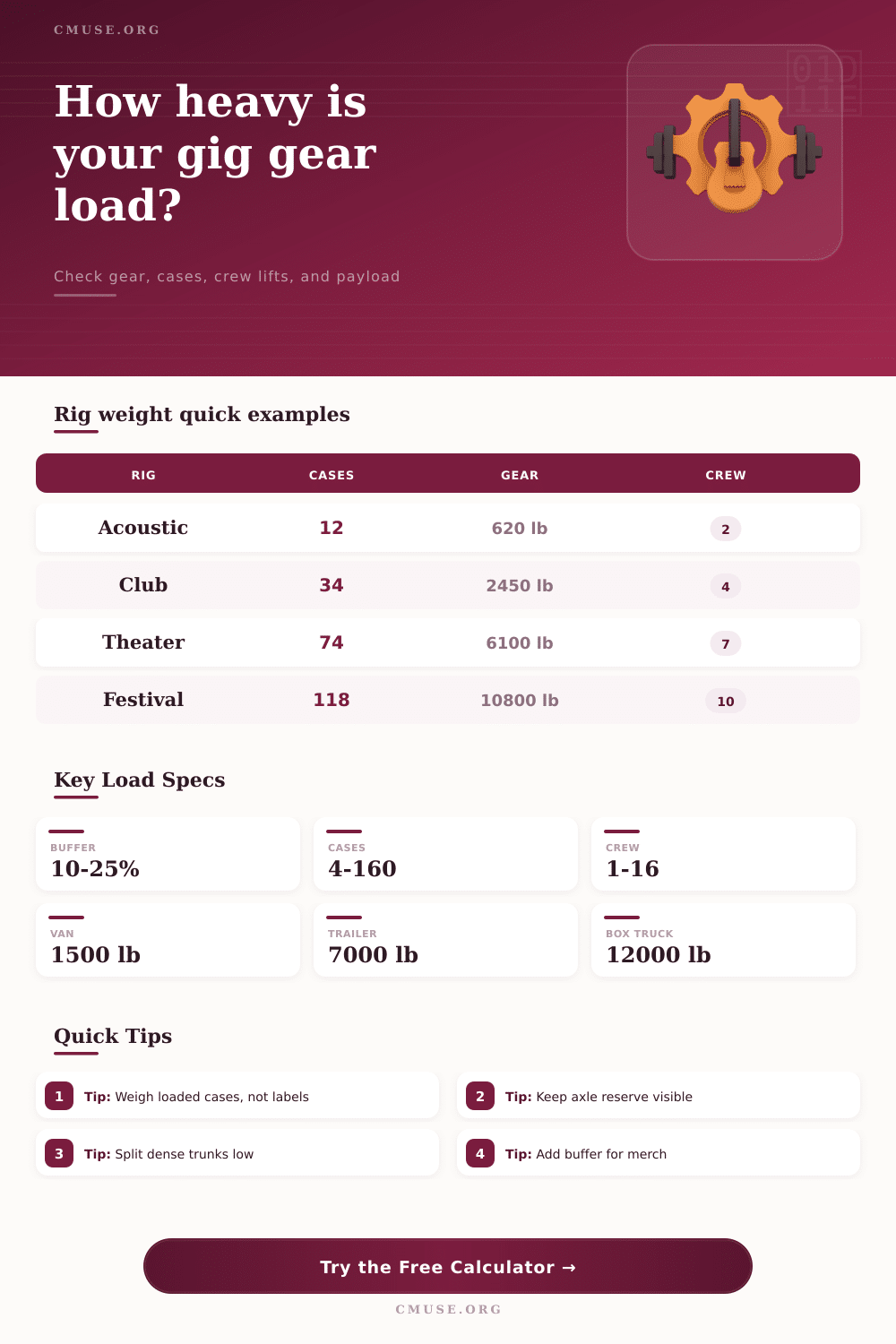
| Solo Acoustic Cafe | 620 lb / 281 kg | 12 | Cargo van | Trip count matters more than payload; keep guitar cases separated from cable tubs. |
| Club Rock Backline | 3846 lb / 1745 kg | 34 | Trailer | Backline and subs need low center stacking and a visible rear axle reserve. |
| Theater Fly Date | 8940 lb / 4055 kg | 74 | Box truck | Liftgate cycles, lighting trunks, and console racks decide the working crew size. |
| Festival Support Slot | 14240 lb / 6459 kg | 118 | Semi bay | Shared trailer position and cable trunks can swing axle balance quickly. |
A gear weight load calculator allow a person to determine if a vehicle can carry a specific amount of equipment. Many people will attempt to guess at the weight of the equipment that will be transported. However, guesses at the weights of equipment are often inaccurately because there are many different items of equipment such as cables, merchandise tubs, and flight cases.
The gear weight load calculator allows a person to add the individual weight of each of these equipment items to determine the total weight of the load. The gear weight load calculator require several specific inputs to determine the total weight of the gear that a vehicle will carry. The first of these specific input is the instrument weight, which includes items like guitars, basses, keyboard, and stands.
How to Use a Gear Weight Load Calculator
The backline weight includes items like drum kits, amplifier heads, and playback racks. The user will enter the weight of the PA and lighting gear into the gear weight load calculator; this weight include items like subwoofers, consoles, and power distributors. Additionally, the user will enter the weight of the cables and merchandise; this includes items like copper cables, power tails, and merchandise tubs.
Finally, the user will enter the case tare weight into the gear weight load calculator; this is the weight of the empty road case and carts in which the gear will be transported. The next section of the gear weight load calculator is the section in which the vehicle profile is selected. For instance, a cargo van often has a limited payload and a high percentage of the weight of the van is placed upon the rear axle.
In contrast, a trailer or a box truck will distribute the load more even, but the rear axle will still be the axle that is placed upon the most weight. The user can adjust a rear share percentage in the gear weight load calculator; this is helpful to account for in what way the gear will be stack in the transport vehicle. For instance, if the transport vehicle has trunks that contain heavy equipment, those trunks can be placed near the tailgate to increase the rear share percentage; alternatively, the user can move those heavy trunks to the front of the transport vehicle to decrease the rear share percentage.
Another set of specifications that will be asked of the gear weight load calculator is the number of crew member that are available to load the transport vehicle with the gear. Additionally, each crew member should have a certain comfortable lift weight; this is the weight that a person can lift comfortable and frequently throughout the loading of the transport vehicle. Based on the number of available crew members and the crew members lift weight, the gear weight load calculator will calculate the estimated lift cycles that will be required for loading the transport vehicle with the gear.
This help to indicate whether additional crew members are required to load the transport vehicle, or if the use of a liftgate is necessary. Additionally, a safety buffer percentage can be entered into the gear weight load calculator. For most shows, a fifteen percent safety buffer is used; however, a twenty-five percent safety buffer can be used for tours that last for several day, as this percentage accounts for the potential for the addition of merchandise during those tours.
The gear weight load calculator also includes reference tables that provide additional information. One of these tables includes information regarding the distribution of the weight of gear packages, such as club packages or theater packages. Another of these reference tables includes information regarding the weights of the different type of cases.
This information can indicate if the cases for the gear will be equipped with wheels, and how many crew members are required to move each case. Additionally, there is a table that includes the payload that can be expected from each type of transport vehicle; this table ensure that the inputs entered into the gear weight load calculator are realistic. Finally, the gear weight load calculator can provide several specific outputs based off the input of the information regarding the gear and the transport vehicle.
One of these specific outputs is the buffered gear load, which is the total weight of all of the gear that will be transported, after the safety buffer has been established. The gear weight load calculator will calculate the payload remaining; this indicate the weight capacity of the transport vehicle after the gear is accounted for. The axle check will report the percentage of the total weight of the transport vehicle that is placed upon each axle; the highest percentage will be reported.
This percentage can help determine if the transport vehicle’s gear should be rearrange. The crew lift load indicates how many lift cycle will be required for each crew member to load the transport vehicle with the gear. Finally, the crew lift load can help to indicate in how much time the transport vehicle can be loaded with the gear.
The use of the gear weight load calculator can help the transport crew to make specific decisions regarding the gear. For instance, if the axle check percentage is high, it is possible to either move some of the gear to even out the weight of the axles, or to remove some of the gear from the transport vehicle altogether. A low axle percentage and high payload remaining does not necessarily indicate that the transport vehicle will have its gear evenly distributed, but low axle percentage and high payload remaining does indicate that there is time and weight capacity to make adjustment to the transport vehicle.
Additionally, adjusting each axle’s share of the total weight of the gear can help reduce the wear and tear upon the transport vehicle’s suspension, and make the transport of the transport vehicle is more stable. The gear weight load calculator can significantly improve the efficiency of a transport crew. For instance, rather than debating in what transport vehicle the gear can be transported, the gear weight load calculator can provide the answer to that question.
Additionally, the gear weight load calculator enables a transport crew to become familiar with the weight of the different types of gear; some gear will be heavier than other gear. Furthermore, as a transport crew becomes familiar with the weights of the different types of gear, the loading of the transport vehicle will become a routine procedure.