Fuel Range Tour Calculator
Plan a band, crew, or production tour vehicle from real fuel economy, tank size, payload penalty, route distance, reserve range, station spacing, refuel stops, and daily driving legs.
Use case: Load a named tour setup, then tune the tank, MPG or L/100km, payload, reserve, station gap, and daily legs for your actual routing sheet.
| Day | Route Leg | Venue Add | Total Miles | Fuel Burn | Refuel Notes |
|---|
| Vehicle Profile | Typical Tank | Baseline Economy | Best Use |
|---|---|---|---|
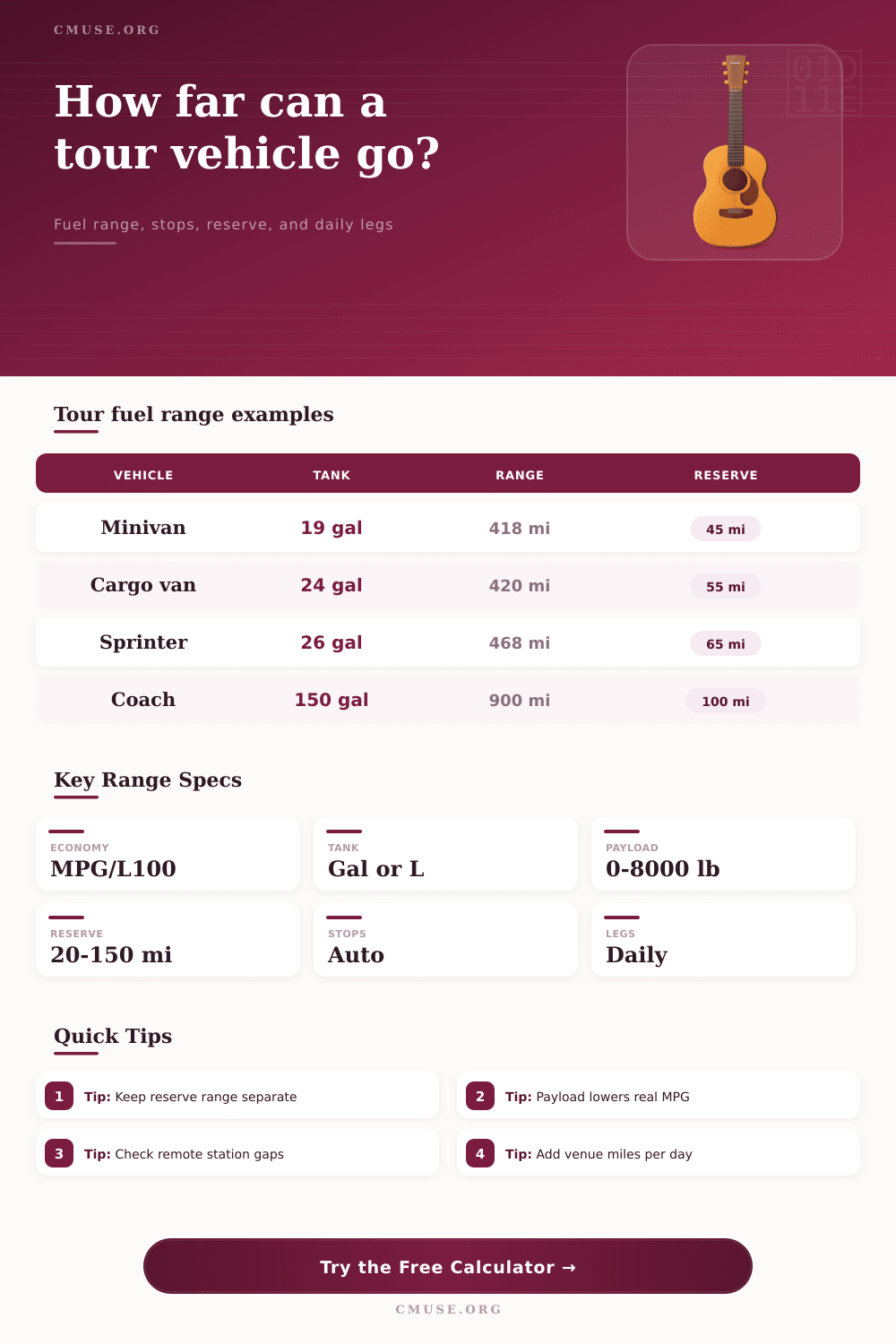
| Minivan merch and instruments | 18 to 21 gal / 68 to 79 L | 20 to 25 MPG / 9.4 to 11.8 L/100km | Club runs, small merch, light backline |
| Cargo van with backline | 22 to 31 gal / 83 to 117 L | 14 to 19 MPG / 12.4 to 16.8 L/100km | Four-piece band with cases and amps |
| High-roof Sprinter style van | 24 to 26 gal / 91 to 98 L | 16 to 21 MPG / 11.2 to 14.7 L/100km | Long drives with standing cargo room |
| SUV towing small trailer | 20 to 28 gal / 76 to 106 L | 10 to 16 MPG / 14.7 to 23.5 L/100km | Trailer cases, drums, merch tubs |
| Box truck production load | 30 to 50 gal / 114 to 189 L | 7 to 12 MPG / 19.6 to 33.6 L/100km | PA, lights, staging, and backline |
| Sleeper coach or bus | 120 to 180 gal / 454 to 681 L | 5 to 8 MPG / 29.4 to 47.0 L/100km | Overnight touring with crew and bunks |
| Planning Item | Conservative | Typical Tour | Remote Route |
|---|---|---|---|
| Reserve range | 30 to 50 mi / 48 to 80 km | 50 to 80 mi / 80 to 129 km | 80 to 150 mi / 129 to 241 km |
| Maximum fill percent | 85% to 90% | 90% to 95% | 95% to 100% |
| Refuel trigger | One stop before empty | Before reserve is touched | Before the next known gap |
| Daily leg sanity check | Under safe range | Safe range plus one stop | Confirm every station gap |
| Payload Situation | Typical Load | MPG Loss Guide | Planning Note |
|---|---|---|---|
| Light acoustic trio | 400 to 900 lb / 180 to 410 kg | 1% to 4% | Mostly people, guitars, merch boxes |
| Club band backline | 1200 to 2400 lb / 545 to 1090 kg | 4% to 10% | Amps, drums, cases, stands, cables |
| Trailer or heavy cases | 2500 to 5000 lb / 1135 to 2270 kg | 10% to 22% | Aerodynamics and hills matter more |
| Production truck | 5000 lb plus / 2270 kg plus | 15% plus | Use actual fuel logs when possible |
| Tour Shape | Daily Drive | Fuel Strategy | Risk Flag |
|---|---|---|---|
| City club week | 120 to 220 mi / 193 to 354 km | Top off every other day | Urban MPG loss |
| Regional theater run | 250 to 400 mi / 402 to 644 km | One planned stop per long day | Late load-out fatigue |
| Interstate festival loop | 350 to 550 mi / 563 to 885 km | Start each morning full | Remote station gaps |
| Bus and truck routing | 450 to 700 mi / 724 to 1127 km | Driver fuel windows | Weight and wind |
Planning for fuel range require thinking about fuel range before you leave the location. The distance between the venue isnt the only thing that relates to fuel range planning. The distance between the venues is only one part of the range, but the other part include the distance that is needed for the vehicle to carry enough fuel to make the entire route.
In addition to the distance needed to complete the route, there also has to be fuel for unexpected event along the route. The buffer for these unexpected events is known as the reserve range. This is the distance between the last comfortable mile a vehicle can drive with the fuel that is currently in the vehicle and the distance at which the engine of the vehicle will run out of fuel.
How to Plan Your Fuel Range for a Tour
Many tour crews understands the importance of the reserve range after they have run out of fuel in the middle of their tour. As a result, many tour crews calculate the reserve range prior to every tour that they undertake. The calculator will require you to enter information regarding the vehicle that will undertake the tour, the length of the route, the distance that should be driven each day, and the payload of the vehicle that will be undertaken.
You should understand how each of these factors will impact the range that the vehicle can undertake. Specifically, the payload can have a significant impact on the fuel range of the vehicle. The payload is the total weight of the trailer and the merchandise that the vehicle will transport.
An increased payload will change how the engine of the vehicle function and how the wind moves the vehicle. These factors will impact how often the vehicle must stop for fuel. The penalty percentage can be used to calculate how much the additional weight of the payload will reduce the fuel economy of the vehicle; thus, including this variable ensure that the vehicle will not run out of fuel while on a tour with fuel stations that are widely spaced.
The terrain and the traffic along the route will also impact the fuel consumption of the vehicle. These factors must be taken into account when planning the tour. Even if the terrain is flat, there may be construction zone along the route that will force the engine of the vehicle to work harder to make the journey.
The terrain multiplier allow for this scenario to be accounted for when planning the tour. Additionally, if the distance that is to be driven every day is above the range that the vehicle can travel without needing to refuel, that does not mean that the vehicle cannot make the tour. Instead, it means that at least one fuel stop will have to be planned along these long days of driving.
The reserve range is another setting that many people are surprised by when using the range calculator. The crew must set the reserve range to the proper distance before the tour starts. A reserve range that is too short may place the vehicle in a situation in which the last comfortable mile of the vehicle is driven without fuel when there are no fuel station near that location.
A reserve range that is too high will make the vehicle require fuel stops too often. Depending on the distance between stops at the venue, and the range of the stops, the reserve range can be adjusted. If the distance between fuel stations is more than the safe leg range of the vehicle, then a fuel stop must be set before the gap in which the stops are located.
The distance between each venue and the distance driven to hotels will accumulate throughout the tour. Each of these distances add to the total distance of the tour. This distance is accounted for in the fuel burn of the vehicle.
Additionally, the daily leg plan that the range calculator produces will be more accurate if these miles are included in the calculation. This will ensure that the daily leg plan for the tour reflects the actual fuel consumption of the vehicle rather than the fuel consumption that is calculated on flat highway. The reference tables will provide information on the typical fuel tank sizes and the fuel economies of vehicles of certain classifications.
These tables is not meant to replace the fuel logs of the vehicle. However, these tables can be used to ensure that the numbers that are entered into the calculation are within normal range for the vehicles. The most common mistakes with fuel are the incorrect assumptions made about the fuel of the vehicles.
One of the most common is assuming that the fuel tanks of the vehicles are always filled to capacity before the vehicle leaves the location where the fuel was filled. The fuel pump of the stations will turn off before the vehicle fills its tank. Another mistake is to ignore the changes in the payload of the vehicle during the tour.
The payload of the vehicle will change based on the merchandise that is stocked in the trailer. These variables will impact the fuel economy of the vehicle. Thus, the fuel needs of the vehicle will need to be recalculated after these adjustments to the payload.
Ignoring the miles between the venues and the hotels where the vehicle will stay is another mistake that is made frequently. The distance between each venue and the hotels will be driven every day during the tour. These miles should be accounted for in the fuel calculations for the vehicle.
If these miles are not accounted for, the fuel budget for that tour will be depleted by the end of the week. These daily miles will be required to be entered into the fuel range calculator for the tour to have a realistic daily leg plan for the vehicles that will undertake the tour. The numbers that are provided from the fuel range calculator will allow you to see how tight the schedule for the tour is.
If there are many fuel stops that will be required along the tour, that does not necessarily mean that the fuel economy of the vehicles is poorly. The frequency of fuel stops can result from the significant payload of the trailer and the remote route along which the stops are to occur. One of the goals of the fuel range calculator is to ensure that the driver of the tour vehicle knows in advance where the fuel stops will occur.
This will eliminate the need for the driver to make this decision at the last moment of the tour. After the tour is over, it is useful to compare the fuel receipts of the vehicle with the fuel calculations made prior to the start of the tour. The actual fuel receipts and the odometer of the vehicle can be used to adjust the inputs of the fuel calculation calculator for the next routing sheet that will be created for the tour.
With the repeated use of the fuel range calculator and the adjustment of the inputs according to the actual fuel consumption of the vehicle, the numbers that are calculated will approach the number that is measured by the vehicle during each tour. When the calculated and measured numbers are the same, the reserve range will match the way in which the tour vehicle are driven. This habit will make the crew move from location to location without unnecessary stress.