Gear Depreciation Calculator
Estimate a realistic used music gear value from original purchase value, years owned, usage intensity, gear category curve, condition grade, maintenance record, demand, accessories, and residual value floor.
Start point: Load a named instrument, studio, or stage gear profile, then tune the value and condition inputs to match the exact item being assessed.
Depreciation Breakdown
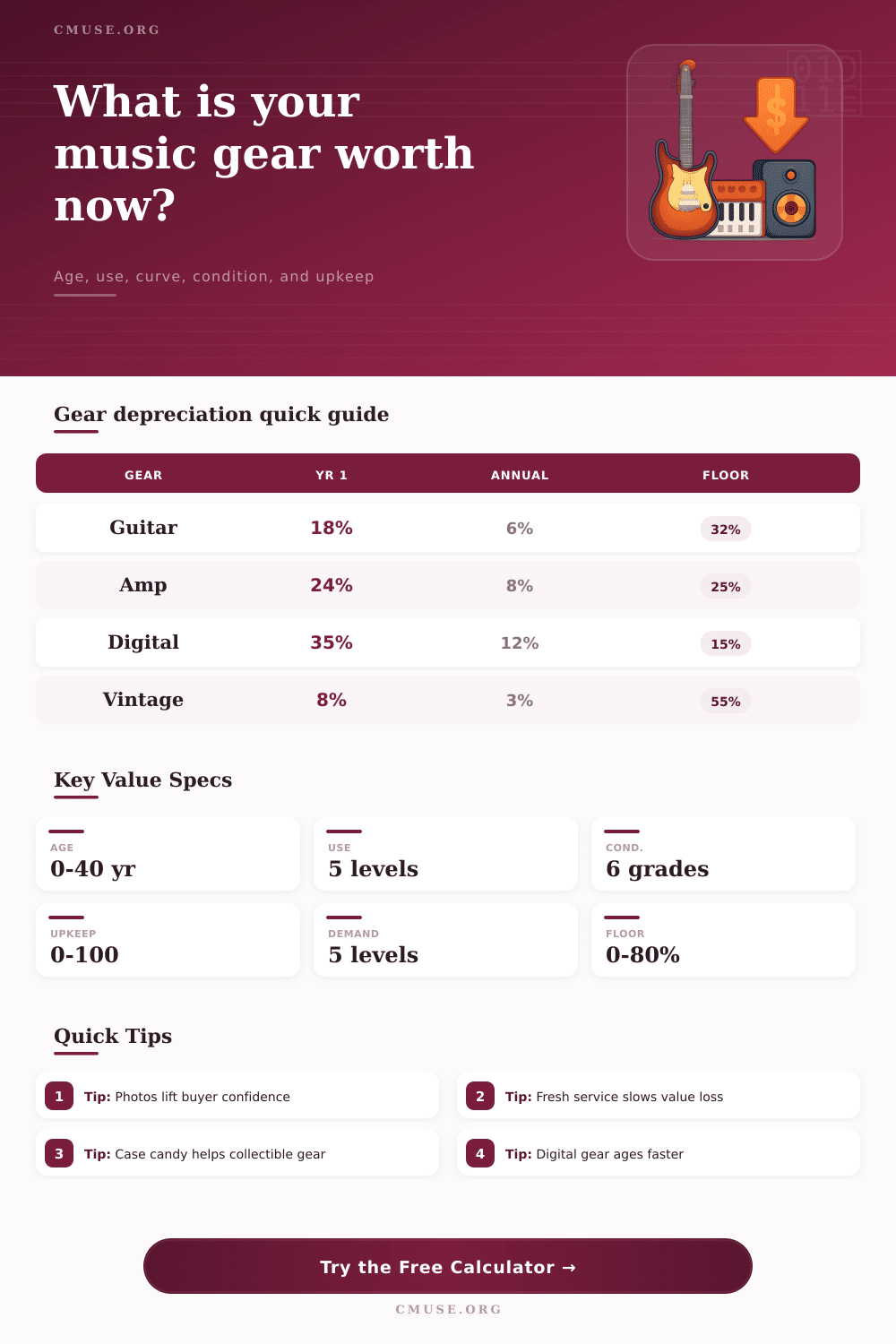
| Gear Category | First-Year Drop | Later Annual Drop | Natural Floor | Curve Note |
|---|---|---|---|---|
| Electric guitar or bass | 18% | 6% | 32% | Stable if clean, playable, and not heavily modified. |
| Acoustic guitar | 16% | 5% | 35% | Humidity control and neck health matter strongly. |
| Tube amplifier | 24% | 8% | 25% | Tubes, transformers, speakers, and service history shape value. |
| Pedal or small analog unit | 20% | 7% | 30% | Small wear is accepted, but missing boxes reduce confidence. |
| Digital workstation or interface | 35% | 12% | 15% | Obsolescence, drivers, and converters pull values down faster. |
| Keyboard or stage synth | 30% | 10% | 20% | Keybed feel, display health, and power supply status matter. |
| Orchestral string instrument | 12% | 4% | 40% | Setup quality, cracks, seams, and bow/case contents matter. |
| Brass or woodwind | 22% | 7% | 28% | Dents, pads, valves, slides, and hygiene service drive value. |
| Drums, cymbals, percussion | 26% | 8% | 22% | Cracks, keyholing, shell roundness, and hardware wear are critical. |
| Vintage or collectible gear | 8% | 3% | 55% | Originality, scarcity, documentation, and demand can dominate age. |
| Input | Setting | Multiplier | Typical Evidence |
|---|---|---|---|
| Condition | Mint | 1.10x | No visible wear, no repair needs, complete presentation. |
| Condition | Excellent | 1.00x | Light signs of use, clean electronics, stable setup. |
| Condition | Very good | 0.90x | Normal play wear, minor cosmetic marks, fully functional. |
| Condition | Good | 0.78x | Visible wear, older service, but dependable function. |
| Usage | Collector stored | 1.06x | Low handling and storage stability support the value. |
| Usage | Studio use | 1.00x | Controlled environment with normal professional handling. |
| Usage | Touring | 0.84x | Road cases, travel wear, and stage handling lower value. |
| Usage | Rental or school | 0.76x | High-contact use needs stronger inspection and service proof. |
| Factor | Low Signal | Neutral Signal | Strong Signal |
|---|---|---|---|
| Maintenance factor | 0-40: uncertain service | 50-75: playable, typical upkeep | 80-100: fresh setup or service notes |
| Market demand | Oversupplied models can lose 15% | Normal demand keeps the base curve | Scarce examples can add 15% |
| Accessories | Item only, missing supply or case | Correct case, cables, or supply | Complete documents and original parts |
| Modification impact | Heavy irreversible changes | Stock or reversible changes | Useful upgrades with originals included |
| Residual value | Too high can overstate weak gear | 25-40% suits many working items | Collectible floors may be much higher |
| Preset | Category | Age | Use Level | Starting Signal |
|---|---|---|---|---|
| Touring Strat | Electric guitar | 7 yr | Touring | Road wear, good service, strong buyer familiarity. |
| Studio Les Paul | Electric guitar | 5 yr | Studio | Controlled use, excellent condition, original case. |
| Boutique Pedalboard | Analog pedals | 3 yr | Gigging | Useful accessories, moderate demand, mixed wear. |
| Vintage Tube Amp | Collectible amp | 28 yr | Studio | Higher floor, service history, originality matters. |
| Digital Workstation | Digital gear | 4 yr | Home | Fast curve, firmware and compatibility matter. |
| Student Violin | Orchestral string | 6 yr | School use | Setup and cracks matter more than cosmetics. |
| Stage Synth | Keyboard | 6 yr | Gigging | Keybed, screen, and power hardware drive confidence. |
| DJ Controller | Digital gear | 2 yr | Heavy use | Fast-moving digital market and control surface wear. |
When you decide to selling your musical gear, you must determine the current resale value of your musical gear. The original purchase price of your musical gear isnt the same than its current resale value because the current resale value of your musical gear may have depreciated over time due to its usage and travels. Many peoples is surprised at how the current resale value of their musical gear is less than its original purchase price.
In order to determine its current resale value, you can use an calculator to determine how much value your musical gear have depreciated over time. The resale value of different types of musical gear may differ. For example, electric guitars tends to maintain their resale value if the frets is serviceable and the finish is good.
How to Find the Resale Value of Your Musical Gear
Digital workstations, on the other hand, may depreciate quick because digital workstations must have the latest firmware updates and features to be of high resale value. Tube amps has a resale value in the middle for musical gear. However, the value of tube amps may also depend on the condition of the transformers and speakers within the musical gear.
Input the information about your musical gear into the calculator to determine its resale value. This allows you to avoid guessing at how much your musical gear will appreciate or depreciate each year. The age of your musical gear is just one of the factors that dictate the current resale value of your musical gear.
Other factors include the condition in which you store your musical gear. For instance, a musical instrument that is stored in a climate-controlled studio will have a higher resale value than one that is transported in a van. The usage of your musical gear will also have an impact on its resale value.
The higher the usage intensity of your musical gear, the more lower its resale value will be due to both visible and invisible wear on the musical gear. You can grade the condition of your musical gear for visible wear. However, maintenance of your musical gear dictates invisible wear on your musical gear.
Therefore, both the condition and the maintenance of your musical gear will have a direct impact on its resale value. The number and type of accessories that come with your musical gear will also impact the resale value. For example, original cases and original manuals will increase the resale value of your musical gear because they are a signal of trustworthiness regarding the musical gear.
Modifications to your musical gear may increase or decrease its resale value. For example, any modification that increase the playability of your musical gear will increase its resale value. Irreversible modifications, however, may decrease the resale value of your musical gear because not all buyer will desire your modifications to the musical gear.
Use the calculator to adjust for any specific modifications to your musical gear so that the resale value estimate is accurate to your musical gear. Market demand for your musical gear exists outside of your musical gear itself. Market demand also dictates the resale value of your musical gear.
For instance, if a model of musical gear is becoming scarce and the manufacturer discontinues it, the resale value of that musical gear will increase regardless of its age. Market supply will also be impacted by the resale value of musical gear. For instance, if there are many instance of a specific model of musical gear in the market, the resale value will decrease.
Adjust the demand setting for your musical gear in the calculator to account for market demand. The residual floor for your musical gear will prevent the resale value from being too low or too high. If you set the residual floor too low, the resale value of your musical gear may appear more valuable than it truly is.
However, if you set the residual floor too high, the resale value of your musical gear will be undervalued. Use the residual floor to establish the resale value of your musical gear. Then, use the other inputs to adjust that value.
Many people makes mistakes when determining the resale value of their musical gear. For example, many people overstate the condition of their musical gear because they are used to the dings and wear on the musical gear. Additionally, many people understate the impact that their high level of usage of their musical gear may have on the resale value.
While this musical gear resale value calculator will not replace an in-person inspection of your musical gear, it will help you to think through the condition of your musical gear. By determining the realistic resale value of your musical gear, you can make informed decision regarding your musical gear. For instance, if the resale value of your musical gear is high, you may want to sell your musical gear to recieve the cash.
Converseely, if the resale value of your musical gear is low, you may want to invest in a professional setup for your musical gear. Additionally, if you use the logic behind depreciation to decide whether or not to purchase new musical gear, you will also understand the future resale value of the musical gear you purchase.