Merch Quantity Calculator
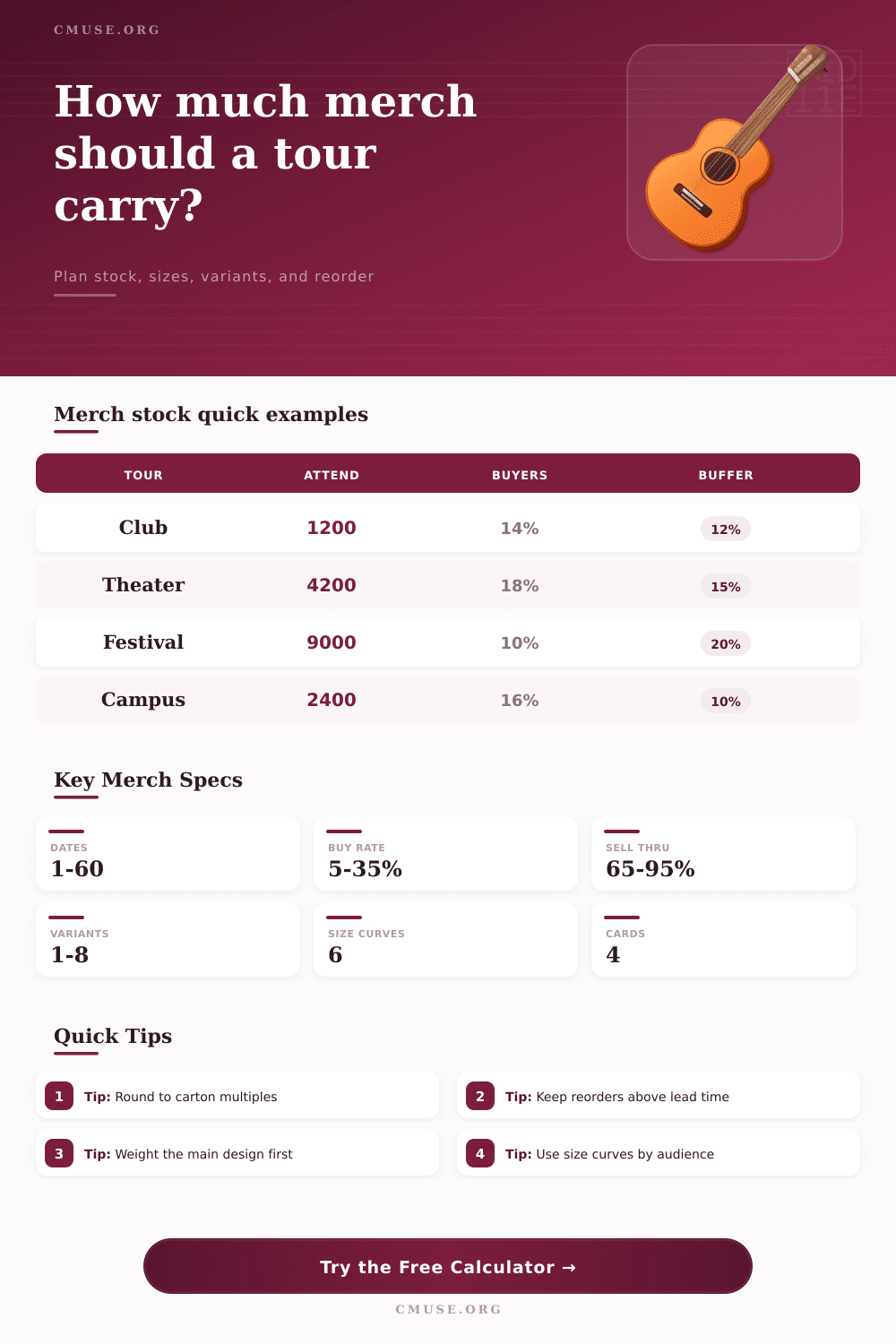
Plan tour merch units from attendance, buyer conversion, units per buyer, target sell-through, design variants, apparel size mix, buffer stock, current inventory, and reorder threshold.
Planning model: Load a tour profile, then tune attendance, dates, sell-through, size curve, design variants, and reorder rules. Results are quantity estimates for stock planning, not revenue forecasts.
| Allocation | Share | Recommended Units | Planning Note |
|---|
| Curve | XS/S | M/L | XL/2X/3X |
|---|---|---|---|
| Balanced adult apparel | 24% | 48% | 28% |
| Slim crowd, smaller sizes | 34% | 46% | 20% |
| Extended sizes emphasis | 17% | 42% | 41% |
| Youth or school event | 46% | 42% | 12% |
| Festival mixed crowd | 22% | 46% | 32% |
| One-size merchandise | 0% | 100% | 0% |
| Item Type | Carton Multiple | Approx Weight | Size Handling |
|---|---|---|---|
| T-shirt or long sleeve | 12 units | 0.45 lb each | Use full size curve |
| Hoodie or sweatshirt | 6 units | 1.30 lb each | Use full size curve |
| Hat or beanie | 12 units | 0.25 lb each | One-size allocation |
| Poster or print | 25 units | 0.12 lb each | One-size allocation |
| Tote bag | 12 units | 0.35 lb each | One-size allocation |
| Vinyl record | 20 units | 0.70 lb each | One-size allocation |
| Sticker or small item | 50 units | 0.02 lb each | One-size allocation |
| Scenario | Buyer Rate | Target Sell-Through | Buffer Cue |
|---|---|---|---|
| Small club merch table | 10% to 18% | 78% to 88% | Keep buffer moderate |
| Theater lobby with line | 14% to 24% | 75% to 85% | Protect key sizes |
| Festival booth traffic | 6% to 14% | 65% to 78% | Carry wider mix |
| Release event or hometown | 18% to 35% | 82% to 92% | Raise primary design |
| Choir, school, or ensemble | 12% to 28% | 80% to 95% | Use known size lists |
| Preset | Attendance Plan | Merch Profile | Reorder Emphasis |
|---|---|---|---|
| Weekend Club Run | 350 x 8 dates | Tees, 3 designs, balanced curve | Three-date lead coverage |
| Indie Theater Tour | 700 x 12 dates | Hoodies, 2 designs, extended curve | Protect larger sizes |
| Festival Booth | 3000 x 3 dates | Hats, 4 variants, one-size | Higher buffer for traffic spikes |
| Campus Mini Tour | 400 x 6 dates | Tees, 3 designs, youth curve | Fast reorder threshold |
| Album Release Pop Up | 950 x 2 dates | Vinyl, 2 variants, one-size | Primary edition weighted |
When planning a tour, there is many different factor that must be considered. One of those factors is the management of the merchandise for that tour. Merchandise is a source of revenue for the tour, but it is also a potential loss if the number and types of merchandise that is transported for the tour is not correctly calculate.
The first of the factors to consider is the attendance for the shows. The attendance will help to determine the numbers of potential buyers of the merchandise for the tour. The numbers for the attendance for each show can be used to determine the potential sales for that show.
Planning Merchandise for a Tour
However, the percentage of the attendees that will actualy purchase the merchandise (the “buyer rate”) will change depending upon the venue for the show and the ticket price for the shows, as well as the time of day that the shows occur. The buyer rate for a venue like a small club is likely to be more high than a large music festival due to the tendency of the fans of smaller clubs to be more dedicated to purchasing merchandise from those shows. The buyer rate is a critical number in determining the amount of merchandise to order for each show.
A slight change in the buyer rate will change the number of boxes of merchandise of each type that is ordered from a few to an entire pallet case of merchandise. The next factor to consider is how many unit of merchandise each buyer will purchase. Some buyers will purchase a single shirt, but others may purchase additional merchandise like a poster or two shirts.
You should calculate the average number of units of merchandise that each buyer will purchase. The target sell-through rate for the merchandise will determine the amount of merchandise that must be kept as safety stock in case some of the merchandise are sold out but some of the remaining merchandise remains in inventory. In addition to the type of merchandise that will be sold, the size and designs of the merchandise must also be planned for.
Not every fan that attends a show will want every size of clothing or every design of clothing. The merchandising table may look understocked in each of the designs if the manager does not distribute the merchandise evenly among each design. A calculator can be used to determine the number of units of each design of merchandise that should be stocked in inventory.
However, no calculator can determine if a specific shirt design will be in higher demand due to the songs that the performers are to be played, or if the lighting at the performance are likely to make some colors of shirts difficult to see for audience member. Another factor to consider in the planning of the merchandise that will be transported for the tour is the addition of a buffer stock of merchandise to the inventory. A buffer stock is used to account for merchandise that may be sold that was not accounted for in the initial calculations, as well as to account for any merchandise that may be damaged or provided to the crew member at the shows.
Another consideration in the management of the merchandise is the implementation of a reorder threshold for the merchandise. The reorder threshold is used to determine at what level of inventory of each type of merchandise that order additional merchandise for the tour. If the reorder threshold is established too low, it is possible that the merchandise will run out of stock for a specific size before ordering more merchandise.
However, if the reorder threshold is established too high, the merchandise manager will have tie up their cash in purchasing merchandise that may not be able to be sold. People must also consider the weight of the merchandise and the size of the shipping carton in which the merchandise is transported. Many people will round the number of units of merchandise to the nearest carton to simplify inventory management.
However, rounding to carton quantities may mean that more merchandise will be purchased than the calculations required. This merchandise will add to the weight of the transport vehicle for the tour. Many people make mistake when planning the merchandise for a tour.
One of the mistakes is assuming that the number of merchandise buyers will be the same at each show in the tour. For instance, the hometown show may draw more buyers than other shows in the tour. Another common mistake is underestimating how fast a specific size of merchandise will be sold out.
If one size is sold fast, the merchandise table may appear to be empty when it is possible that merchandise of that size is still in inventory. A way to avoid this mistake is to order more units of the most common design (the primary design) for the tour. The goals that the tour manager establishes for the merchandise will have an impact upon the amount of merchandise that is transported on the tour.
For example, merchandise sales may be used to break even on merchandise costs, but other tours may use merchandise sales to cover other costs like gas and lodging for the tour members. These goals will determine how much merchandise is transported for the tour. By reviewing the number of units of merchandise that were left at each show after the tours were over, the merchandise manager can make better decision about how many units of each type of merchandise to order for the next tour.
After each show ends, the leftover merchandise becomes the merchandise that is used to start the next show. Thus, the goal of merchandise management is to ensure that the merchandise table look full with merchandise but does not overstate the inventory of that merchandise.